Essay by Søren Bo Aggerbeck Larsen
Love as Event: Three poems by Caroline Albertine Minor
21.5.2026
I propose to read Caroline Albertine Minor’s three poems, published here in pas tout, through Jacques Lacan’s idea of love in Seminar XX, focusing on a few moments where the poems resonate with Lacan’s account of love. My suggestion is that this account allows us to think love as an Event: not simply an event, a happening within ordinary reality, but the occurrence of a certain impossibility, something that interrupts and reshapes ordinary life. Love does not merely happen within my understanding of reality and its rules; it changes my very relation to reality, to what reality is and can be. Love changes the “impossible to happen” into the impossible that happens. The Event of falling in love, or of loving one’s child, involves a fall, a radical imbalance, not symmetry or harmony. Lacan says:
“The displacement of the negation from the ‘stops not being written’ to the ‘doesn’t stop being written,’ in other words, from contingency to necessity — there lies the point of suspension to which all love is attached. All love, subsisting only on the basis of the ‘stops not being written,’ tends to make the negation shift to the ‘doesn’t stop being written,’ doesn’t stop, won’t stop.” [i]
In this way, through a dialectical reversal, contingency turns into necessity. The Event of love is contingent: it is contingent that I should meet this or that person in the supermarket that particular Tuesday; it could also not have happened. However, once it does happen, it has the effect of turning this contingency into necessity. It begins to seem necessary that I should have met you, that it was “meant to happen.” It becomes the defining Event of my life. While it is contingent that I met you, once I fall in love with you, it is as though “I have always loved you,” as though fate itself made us meet.
Love is an Event that involves retroactivity: it posits its own cause; it “will have been” necessary. In ordinary cases, we distinguish more easily between cause and effect, but the Event is an effect that retroactively establishes its own cause, in a strange temporal loop. Love begins from what “stops not being written,” from the contingent encounter that could have failed to happen; but then it shifts into what “doesn’t stop being written,” into necessity. Or, as Kierkegaard says, “love believes everything and yet is never deceived.”
This might be illustrated with an everyday-example, equally miraculous and trivial, often evoked by Žižek: When I fall in love, something changes about contingency. It is contingent that I met this person in the supermarket or at a football match, or at work. I might easily not have met this person. Yet, once I fall in love, it seems like it was "made to be", that it was a necessity. It seems as though I have always loved you. Love is, in a way, an illusion compared with objective reality, but it an illusion that matters more than ordinary reality, the reality-principle of what can be objectively verified. As Žižek says: "Falling in love changes the past: it is as if I always-already loved you, as if your love was destined long before we met. My present love causes the past which gave birth to it." [ii].
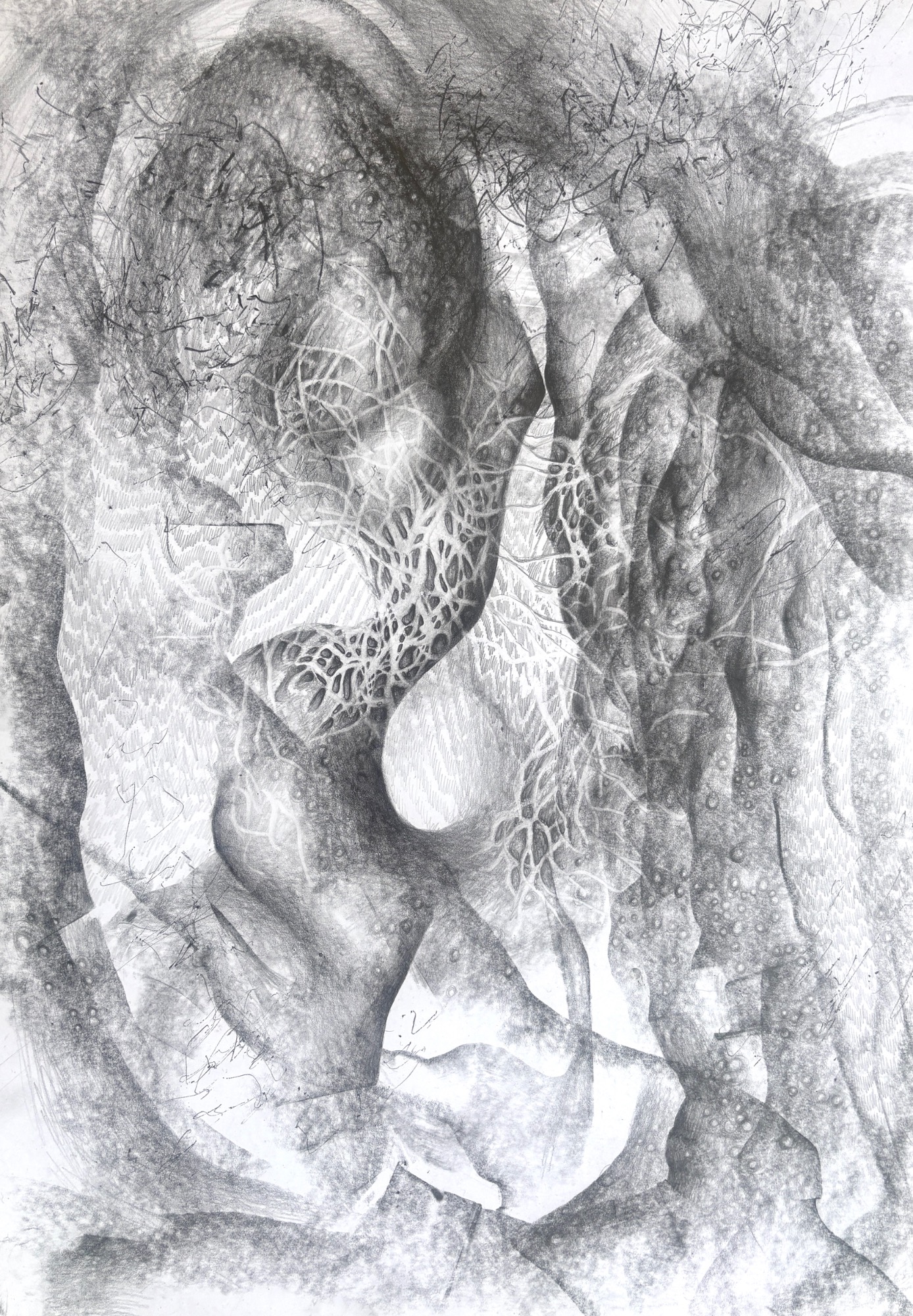
Patricia Detmering, April 2026
In one of my favourite poems from Minor’s Nivå Bugt Strandenge, there is a line dedicated, presumably, to the son of the poem’s speaker. Whereas an accident befalls the beloved, the love for the son remains intact, something that cannot be corrupted by whatever happens, perhaps in the same way that an "eternal idea", shines through the level of appearances, something not reducible to circumstances. Here we find the lines: “The mother is known by her silence / inside, the numbers fall / like quick red rain / she works with / love’s mad mathematics // you were added.” [iii] The phrase “love’s mad mathematics” condenses, almost in the form of a Lacanian formula, the paradox at stake here. Love is “mad” because it does not obey the ordinary logic of calculation, exchange, or equivalence; but it is still “mathematics”, in contrast to the romantized notion, because something is counted, added, and made irreversible, like Lacan's "won't stop" that also is a result of "mad mathmatics", like the open set of pas tout, the non-all.
Minor uses the phrase elsewhere as well, at the end of the novel The Lobster’s Shell, where there is an exchange between unknown lovers in a flooded Venice, "miraculously" unaccounted for in the story's linear arc: “The truth is that I am made for love. My life became a life according to love’s mad mathematics. Never again being able to subtract what has once been added. The children’s hands and bellies and necks and jewel-like faces.”[iv] This passage offers a particularly clear poetic articulation of the logic at stake. It is contingent to have this child; it is not fated that this particular child should exist. However, once the child is "added", that addition becomes necessary, as though it was always meant to be this way. What was contingent in its occurrence becomes necessary in its consequences. It retroactively posits its own conditions, like any true Event.
Minor’s Nivå Bugt Strandenge repeatedly links love to this "mad mathematics" — a structure of intimacy, exclusion, abstraction, and infinity. This is also the terrain in which Lacan often places Cantor: not merely as a mathematician of number, but as a thinker of the impossible excess within number, where infinity itself ceases to be one. Minor develops a comparable association in two poems. In one poem dedicated to Vally Sophie Guttmann, Cantor’s wife, mathematics appears as the exclusion of the other: “where your young / husband spent / most of your / honeymoon days / in discussion with / Richard Dedekind, mathematics / hanging in the room / around them like / the rancid smell / of madness.” [v] Here mathematics is not a neutral science but an atmosphere, almost a stench, which fills the room and displaces the marital relation. The honeymoon, normally the scene of erotic union, is invaded by an abstract masculine discourse from which Vally is excluded.
But Minor does not reduce mathematics to this exclusionary scene. In another poem, Cantor’s transfinite appears as a passage into another order: “a hidden / door in the wallpaper / access to another, fully / illuminated level / and here to feel the same / planetary calm / that Georg Cantor must have felt / when he proved that there is a difference / between infinities.” [vi] Mathematics is again close to madness, but now madness is not only claustrophobic; it is revelatory. The transfinite opens a door in the fabric of the visible world. It makes possible another “level,” fully lit, where one can experience a calm that is not so much cosmic totality, but rather a-cosmic inconsistency.
Taken together, the two passages suggest that love and mathematics share the same paradoxical structure. Mathematics excludes the beloved from the room, replacing intimacy with abstraction; yet it also names the impossible excess that love itself encounters. Cantor’s discovery that there are different infinities becomes a figure for love’s own impossible measure: love is not simply the fusion of two finite beings, but an encounter with a difference that cannot be totalized. This is why Minor’s Cantorian imagery resonates with Lacan. The mathematical infinite is not a metaphor for harmonious completion, but for the non-relation, the gap, the excess, and the impossible calculation around which love is organized.
Minor is often read as a poet of the subtle non-event: the novels and poems are often constructed around something like a void, akin to a mathmatrical attractor: a virtual point of reference, that never becomes part of the novel itself, that towards which the variables of the novel's events, happen, that towards which all lines and point tend, however this point is purely virtual, it never comes to exist as such. To me at least this captures something central in Minor’s work: her attention to the fragile, almost imperceptible connections through which lives touch one another without fully coinciding. But, perhaps, it is also necessary to posit the dialectical reversal. As in these poems, contingency does not remain mere contingency. At certain moments, the contingent encounter suddenly takes on the force of necessity. What could have failed to happen becomes, once it has happened, impossible to subtract from the world. So, it is not, as the saying goes, that love overcomes all obstacles. It is rather that love itself is the obstacle (within our ordinary reality, that would otherwise run its smooth course), yet it is precisely as such it also enables something new to take place, something that cannot simply be “subtracted”.
Lacan speaks of materialism not as the primacy of matter, but rather only of “dialectical materialism,[vii]” and also, in his “Geneva Lecture on the Symptom” (1975), of moterialisme—the materialism of the word, playing on the French mot (“word”). We all know that words can have effects in the body. The contemporary "affective turn" tends to dismiss language and its "prison-house" (as though affects were somehow outside of language). But Lacan's model offers instead their conjunction. Think about the words: "I love you". They both make the world less than it was before, they both indicate the ways that words fail, but they also adds something to the world, that was not there before, and can touch a Real of jouissance in the body. Love is precisely such an Event, that is, something in excess of its own causes, something that retroactively establishes the conditions for its emergence.
I
The poem Honig und Beeren begins with a phrase that could easily belong to an exchange between two lovers, the German question: “Was bleibt, wenn du gehst?” What remains when you leave? The question can be reformulated in the language of love: what is your impact on me, as beloved, once you are no longer present? What remains of you in me after your departure? Or, to put it in more Lacanian terms: what is in “you” more than you? What is added by the Event of love itself, beyond all material causes, empirical circumstances, and everyday occurrences?
The poem then immediately makes a decisive shift. The speaker is not placed in an elevated lyrical scene, but in a bathroom stall: “the sticker on the door of the commune’s / toilet asks me every time / I am sitting there.” This setting invites a vulgar-materialist reading. The question “what remains when you leave?” seems, in this context, to refer to defecation: to what remains when one leaves the stall, namely the smell of shit, the later latrine-like punchline. At first, then, the poem appears to reduce the question of remainder to bodily residue, to what Žižek calls “the ever-changing corruptive and corrupted matter.”[vi]
Yet this vulgar-materialist answer is only the poem’s first movement, not its final one. The poem sets up an apparently crude answer to the question “what remains?”—smell, bodily waste, residue—but then refuses to let this answer exhaust the scene. Instead, it turns toward what Lacan calls moterialisme: the materialism of the word. What remains is not simply matter in the ordinary sense, but the material effect of words: how they sound, how they are written, how they call upon the speaker, and how they produce effects that cannot be reduced to their immediate causes.
This is also what the poem has in common with psychoanalysis. The question is whether love should be translated simply into an event of the brain, into neurological causality, bodily chemistry, or a matter of “desublimation.” Is love nothing but its material substrate? The poem’s answer, like that of psychoanalysis, is not to reject materialism, but to pursue materialism more radically as moterialisme. The speaker does not simply encounter a smell; she encounters a word. She is called upon by language: “and every time I feel / called upon to answer – / but answer what? Der Geruch / someone has added in pen / underneath.”
The movement of the poem is therefore very precise. Far from treating vulgar materialism as the final truth of the situation—one sits in the bathroom, one leaves behind a smell—the poem begins, as a psychoanalyst would, to listen to the word. Instead of accepting a simple answer, a factum brutum, it asks about the material life of the word itself. As Lacan says: “Don’t try to understand.” That is, do not assume too quickly that you have grasped the meaning. Listen instead to the word and its work: to its sound, its slips, its echoes, and its capacity to produce unexpected associations. This is precisely what the poem does.
The importance of sound is easier to see in the Danish original, where the poem plays on a cluster of related or echoing sounds: Ruch, ryggen, rygte. Der Geruch means “the smell” or “the stench.” Yet the speaker does not seem to know this immediately. Instead, she listens to the sound of the word and to what it evokes in Danish. Geruch comes to resonate with ryggen, “the back”: “That means, I guess, / the back?” Close in sound to Der Geruch is also rygtet (“rumour” or “reputation”), which appears within the same verse. The poem thus establishes a chain: Der Geruch – ryggen – rygtet. What matters here is not translation in the ordinary sense, but moterialisme: the way a word is pulled into another language by sound before it is secured by meaning.
The poem then moves on, and only later do we receive the more correct translation, one that evokes the logic of retroactivity:
“when your friend
over a glass of pastis on the last night of my visit
guides me carefully as through
marshlands through Bachmann’s Thema und Variation
and casually corrects
my misunderstanding,
which, with a perfectly
timed
timid
delay,
releases
the lavatory
punch-line
– the stench!
right in the middle of the poem’s
dim summer-forest
loftiness.”
Many things could be said about these lines. First, the passage stages a belated production of meaning. As in psychoanalysis, meaning is not simply given at the beginning; it arrives afterward, through a later correction or encounter. There is, in analysis too, a “perfectly timed delay.” The friend’s correction is casual and contingent, but once it occurs, it reorganizes the entire preceding sequence. Geruch has, of course, always meant “smell” or “stench.” Yet in the poem this meaning becomes effective only afterward, as an event of delayed understanding. What seemed to be merely one possible sound among others suddenly becomes the word that determines the scene.
Here the poem does something especially subtle. Why is the word "stench!" placed differently than all the other verses? It suggest that it is both a punch-line, and yet oddly out of place. That we should pay attention. My reading is, that the out-of-place word, make us notice the poem as a visual structure as well, and now it does indeed look a bit like a "back" or "spine". Paradoxically, only when we realize that "back" is not the correct translation. Once “stench!” arrives as the belated meaning of Geruch, the mistaken association with ryggen, “the back,” is not left behind as mere error. It remains in the poem. At the very moment when Geruch is correctly understood, the poem begins to resemble a back or spine, and "stench!" is both the correction translation, but also like spinal disc out of joint, something that does not fit the "back" of the poem. The poem suggest that what "remains when you leave" with the correct translation is perhaps not what really matters. What remains are words as material products, with their own effects. Words say more than they mean, or which could simply be translated into their signifieds.
In other words, the poem evokes "materialism" of the bodily remainders, only in order to move toward moterialisme. What remains is not merely bodily waste, but the word: its sound, its written form, its placement on the page, and its belated effects. Freud’s method in Die Traumdeutung offers a useful technique for this procedure. Freud does not interpret the dream by reducing it to crude bodily or instinctual content. He attends instead to words in their material form: to their sounds, substitutions, and unexpected connections. In the classical dream of Alexander, the dancing satyr does not simply signify a libidinal satyr. It must be read like a rebus: Sa Tyros — “Tyre is yours.” The image matters only insofar as it can be broken apart into sounds. The picture of the satyr is dissected into the phrase Sa Tyros.
It is in this sense that the poem’s materialism is Lacanian. The poem does not abandon matter for meaning, nor does it reduce meaning to matter. It shows instead that words themselves have a material force. They sound, stick, slip, return, and reshape what came before them. Here, “stench!” finally appears as the word that releases the earlier scene into readability. It is the "lavatory punchline", but also more than a punchline: the moment in which the contingent movement of the word is retroactively converted into necessity, and as such it is also paradoxically (and visually) out of place. As a psychoanalyst, or when one is in analysis, such material effects of words are important. One can talk and talk, but suddenly there is a word that works a bit like a punchline, where something of the subject's Real is touched upon, and such words or gestures both hit the mark, and yet feel oddly out of place. The unconscious is not something "in my mind" a personal or private issue, but out there, in the words, like in the movement from Geruch to ryggen, to rygtet, that I speak and of which I do not know the meaning.
II
We see something similar in the next poem: “Late Conversation.” Here too, love appears as a radical imbalance. The poem moves by way of certain words, as though trying to locate what remains from the “you” of the poem. The point is not simply lexical venture, of trying to establish knowledge. It is not merely that Latin has two words for blood: one for spilled blood, and another for blood “when / it runs / well-behaved / in the arteries.” What matters is not the opposition between the two Latin terms as such, but the way the poem allows this division to multiply. The voice of the "you" instills a lack, a search, close to Freud's "Wissbegierde", that also is the result of lack of signifier (such as children wondering where they come from). The distinction between cruor and sanguis becomes the starting point for a series of passionate analogies—voice and thought, wound and mouth, scars and writing—but none of them finally stabilizes the relation. The poem does not resolve the bifurcation; it lets it remain open until the phrase appears: “warm red / news from you.” Instead of resolving the two terms for blood, the poem suspends the search of analogy and symmetry itself. The speaker writes, “I must have searched for / a fitting analogy,” but no analogy finally fits. The movement from cruor and sanguis to voice and thought, wound and mouth, scars and writing, does not produce a stable relation. Each analogy opens another gap. Yet this failure is not simply negative. The impossibility of finding a “fitting analogy” becomes productive. Out of the failed analogies, there is first the white gap between the stanzas, as if indicating the futility of such a search. Then there suddenly emerges the summary "all this" and the next phrase: “warm red / news from you.”
This is a jump from the law of the signifier, the search for the proper knowledge, to the sudden suspension of such a law, the "warm red" is rather like the sudden sign of love, not the search for another (conclusive) signifying dyad. The poem does not choose between cruor and sanguis, nor does it synthesize them into a higher unity. Instead, it produces something else. “Warm red” is not a concept, not a successful analogy, and not a translation. It is a phrase that carries the force of the longing itself. The “red” still belongs to the field of blood, but it has moved into the register of address, as an opening to the "you", rather than a lexical search. What the speaker longs for is not, so to speak, blood as biological substance, nor blood as spilled wound, but “news from you.” The materiality of blood is transformed by the Event of love into a sign, the "love letter" that Lacan speaks of in Seminar XX, the "encore", which means both "still" and "more" (and perhaps also an affect in body, en corps).
The break before “all this” is therefore important. The white space allows the final stanza to gather up the failed or suspended analogies into a single gesture. The particular materialism of the words can also be heard in the final lines, with their small beat, like a pulse in the arteries, now less “well-behaved” in the repeated t sounds. This is even clearer in the Danish: “alt dette kun / fordi jeg længtes / efter at høre / rødt varmt / nyt fra dig.” The soft ts at the end of several words create a pattern; they no longer belong simply to the analogies, or to the lack of analogy, but instead resemble the repeated (heart)beat of impossibility of a fitting analogy, something that is both necessary and impossible: "doesn't stop, won't stop". Instead of the search for the signifiers or knowledge, we find the enjoyment of the words themselves, especially the repeated soft t's, that are like a pearls on a string. The final stanza is thus "encore" (it asks for more, but is also more bodily, en corps, the words themselves as a form of bodily affect).
Since the poem also mentions Seneca, one of the main references of Stoicism, which has a contemporary revival, it is perhaps worth it to mention an aspect of Stoicism that does not get much attention today (but which Lacan always emphasized, as did Gilles Deleuze), namely, first the signifier as material, and secondly the theory of immaterial Events (phantasmata), surface-events, that precedes material reality. The poems are much more interested in this half-forgotten, or rather repressed, aspect of Stoicism, if anything, not in the focus of "robust" self-possesion, which is advocated in many places, especially the market today (both in academia and popular accounts). The poem does not so much concern itself with self-possesion, and is itself more interested in the small and overlooked, such that the attention is to what is said "en passant" - what slips in between the words, not so much the "content" of a philosophical doctrine - or rather, to be more precise, the poem dialectical reverses both, so that the most important, the surface-events are precisely to be found in the minute, and otherwise fleeting.
It is as though, in the final stanza, a sudden contingency is, through the “miracle of love,” turned into necessity: from “doesn’t stop not being written” into the miraculous turn, “doesn’t stop. Won’t stop.” What matters in love is precisely not to heal the radical imbalance, not to restore some homeostasis after the fall, but to sustain this fall, as it were, to continue the “work of love,” to go on falling. In love, contingency is turned into necessity — it is as if I have always loved you — but it also maintains its surprising contingency. This is what prevents love from falling back into the normal flow of things, from becoming simply another event within ordinary reality. Love keeps the surprise of “won’t stop.”
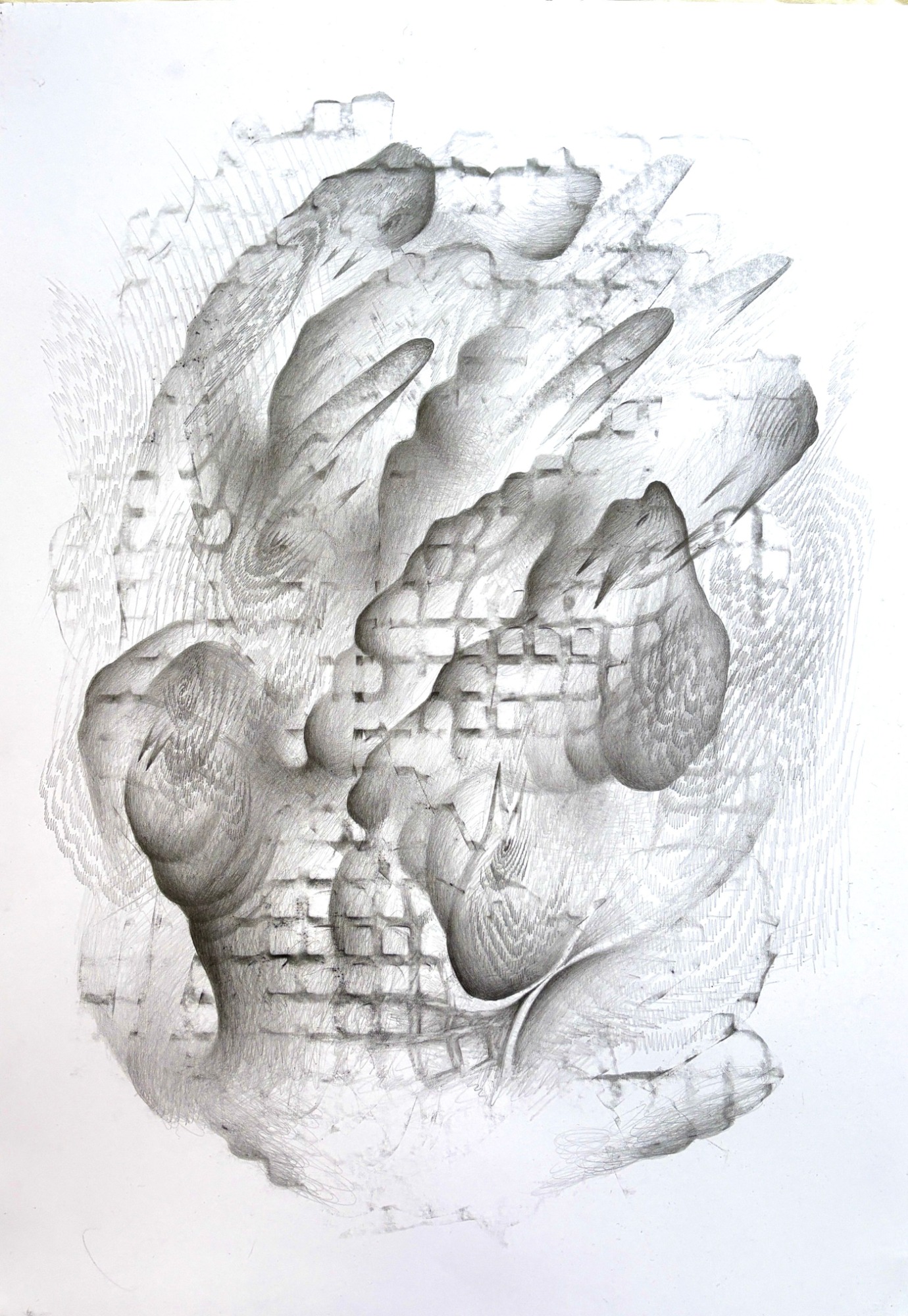
Patricia Detmering, April 2026
III
The last poem is titled Parabellum. At first I did not know what this meant, but I suspected a kind of flower. It contracts para and bellum. The phrase comes from Latin and derives from the longer saying: si vis pacem, para bellum: "if you want peace, prepare for war." Is war love by other means? The phrase suggest "peace through strength." The phrase also appears on certain modern ammunition, I found out, printed on bullets, often as, in the poem, as a single word: parabellum. Hence, it did not mean a flower. Yet, the poem still evokes something more with this contraction. The poem already stages a kind of moterialisme. The poem initially asks the you (the lover, the reader?) to "observe." But what is observed is only revealed in the last and third stanza as the effect: the you's indifference towards the speaker leads to a pleasure, to "humiliation into an end in itself."
The final words of the poem thereby changes the hiearchy between the "I" and the "you." If the you's indifference looks like a position of sovereignty, against the "I" as servant or subject, if it is a humiliation as an "end in itself," and if there is "still greater pleasure," things are not so clear. If the indifference is like bullet "elegant and guiltless," the humiliation as "end in itself" undermines cause and effect. If the bullet's trajectory would be straightforward, the final words introduce a trajectory, that is instead circular, even growing (the still greater pleasure).
Humiliation as an end in itself suggest the logic of the superego. It is the most saintly, that at the same time experience the most guilt. The superego is precisely the agency where the subject gets jouissance out of its own suffering and humiliation. And often love is misread as involving the logic of the superego (even by Freud in his reading of christian love). But there is also a way to read the Event of love as a suspension of the superego and its spiraling circle. Love is rather what suspends the vicious logic of the superego, of law and its obscene transgression, which only works to sustain it.
The word therefore becomes a small model of the Event of love. Love is not simply the result of a linear cause, just as the poem is not structured like a bullet moving directly from weapon to wound. Love happens contingently, but once it happens, it changes the meaning of what came before it. It turns contingency into necessity. What first appeared accidental begins to seem as if it had to happen. Parabellum is of course my own misunderstanding of the word, taking it for flower rather than the name of a bullet, yet perhaps such misreadings are themselves constitutive of the point: the Effect is more than its “material” cause, just as the final stanza evokes an effect, that is not “accounted” in a necessary "causal chain," for in the previous stanzas. It involves a surprise: La verité surgit de la méprise, as Lacan says.
This brings us back to the Event of love. Love is not to restore of imbalance but the production of an imbalance that one nevertheless remains faithful to. As philosopher and psychoanalytical theorist Anders Ruby points out, love involves on the one hand an emergence of something new, but every new emergence also makes reality seem like a "less-than." [vii] If, we just see the Event as the miraculous encounter from another dimension, we presuppose ordinary reality as fully constituted, perfect unto itself (as the shape of the bullet). However, Lacan's moterialisme, also means that the order of being is not fully closed, not a complete chain of causal necessity. The poem emphasizes precisely such a lack of equilibrium. The “you” remains indifferent, and this indifference gives rise to a jouissance of humiliation. The indifference is compared to a bullet, patron in Danish, a word that also evokes patronage, the paternal and the subordinate. Yet, the patronage is only valid if the order of being can be closed, and it cannot, there is something more that "doesn't stop, won't stop."
Humiliation, however, does not function here as simple injury. It turns “into an / end in itself.” This changes the hierarchy. If the bullet suggests a direct trajectory—weapon, wound, victim—the poem’s movement is more circular. The speaker is not simply struck and injured. Rather, the wound becomes bound up with jouissance. Indifference does not merely hurt; it produces “my / still greater pleasure.” The point is not that suffering should be embraced for its own sake, but that love does not obey the logic of self-preservation or balance. As the pun, often made by Badiou and Žižek, has it: one has to "fall" in love (there must be a fall, an obstacle, also in the ontological incomplete character of reality, the world as such "breaks down," is inconsistent). The work of love, like the work of the poem, is to sustain this fall, work out its consequence, including a fidelity to what happened. Once love has occurred, even the beloved’s indifference can become charged with necessity. What would otherwise be a contingent wound becomes part of the Event’s "mad mathematics," what cannot simply be subtracted (although one can betray the Event, pass it over...).
Perhaps this is also, at least one way, of how the poems can be linked with psychoanalysis. The point is not simply that analysis eventually reveals love to be nothing but an illusion, a narcissistic veil behind which the truth of sexual desire is hidden. Psychoanalysis is not a cynical demystification of love. Nor is it a recommendation for the contemporary relations, that are based on the market and the logic of the contractual or entrepreneurial self and exchange. It involves a “mad mathematics.” It is the difficult work of sustaining the Events that have already impacted the subject and its history: the encounters, words, losses, and attachments that have thrown the subject off balance and continue to organize its life. As Kierkegaard has it, “love believes everything, and yet is never deceived.” In this sense, psychoanalysis too can be understood as a work of love. It is not only a fidelity to the Event of love, but also a fidelity to the love of the word: to words in their material effects, including their mistakes, their misreadings, and their accidental condensations — such as when a bullet turns into a flower. Minor's prose and poems are often read as enunciating silences, but it is perhaps worth noting that they also involve a very powerful way of naming, of a materialist (or moterialist) position. An Event.
[i] Lacan, Jacques. On Feminine Sexuality, the Limits of Love and Knowledge: The Seminar of Jacques Lacan, Book XX, Encore, 1972–1973, ed. Jacques-Alain Miller, trans. Bruce Fink (New York: W. W. Norton), 1998, p. 144. In my reading I draw on postlacanian readings of love as Event, most notably Alain Badiou and Slavoj Žižek.
[ii] Žižek, Slavoj. Event: Philosophy in Transit (London: Penguin Books. 2014, p. 111.
[iii] Minor, Caroline Albertine, Nivå Bugt Strandenge, Gutkind, 2024, “Moderen kendes på sin tavshed / indeni falder tallene / som hurtig rød regn / hun arbejder med / kærlighedens sindssyge matematik // du blev lagt til”, p. 12, my translation.
[iv] Minor, Caroline Albertine, Hummerens Skjold, København, Gutkind 2020, 269). “Sandheden er, at jeg er skabt til at elske. Mit liv blev et liv ifølge kærlighedens sindssyge matematik. Aldrig mere at kunne trække det fra, der én gang er blevet lagt til. Børnenes hænder og maver og nakker og juvelansigter” my translation.
[v] Minor, Caroline Albertine, Nivå Bugt Strandenge, Gutkind, 2024, p. 72, my translation.
[vi] Ibid., p. 52, my translation.
[vii] Lacan, Jacques, On a Discourse that might not be a Semblance. Seminar of Jacques Lacan, Book XVIII, ed. Jacques-Alain Miller, trans. Bruce Fink, Cambridge. Polity, 2025, p. 19: “If there is something that I am, it is clear that I am not a nominalist. By which I mean that my point of departure is not one implying that a name is something that is laminated onto reality. You have to make a choice. If you are a nominalist, you must completely give up on dialectical materialism, such that, in short, the nominalist tradition – which is, strictly speaking, the only danger of idealism that can be found in a discourse like mine – is quite obviously ruled out.”
[viii]. See also Laporte, Dominique. History of Shit. Translated by Nadia Benabid and Rodolphe el-Khoury. Cambridge, MA: MIT Press, 2000. Unfortunately Laporte is too fascinated with the scatological as the site of the Real: the scatological instead rather serves as a screen, a bit like Marcus Aurelius' famous warnings about sex: one should imagine the beloved's bodily insides, not to be too fascinated with them in sexual passion. Here, however, the materialism, the Real is on the side of the "fascination", not on the bodily remains. (which itself takes quite a bit of "fantasy", not simply things as they really are.
[ix] Ruby, Anders. "Negative Emergence". In: pas tout. March 2026.
Søren Bo Aggerbeck Larsen works as external lecturer at the University of Copenhagen, with a strong interest in the relationship between psychoanalysis and aesthetics. He holds a Ph.D. from Cornell University, focusing on Paul Celan, lyric subjectivity and the politics of universality. Latest publications in English are "Freud's Fever Children" in Lamella 10, and "Paul Celan and Maybug-dreams" in European Journal of Psychoanalysis (forthcoming).