Q & A with
Laura Eftychia Papachristos & Margaux Compte-Mergier
10.11.2025
1. The Beginning
What first moved you to begin working on Stillleben? Was there a particular moment, experience, or intuition that initiated the project?
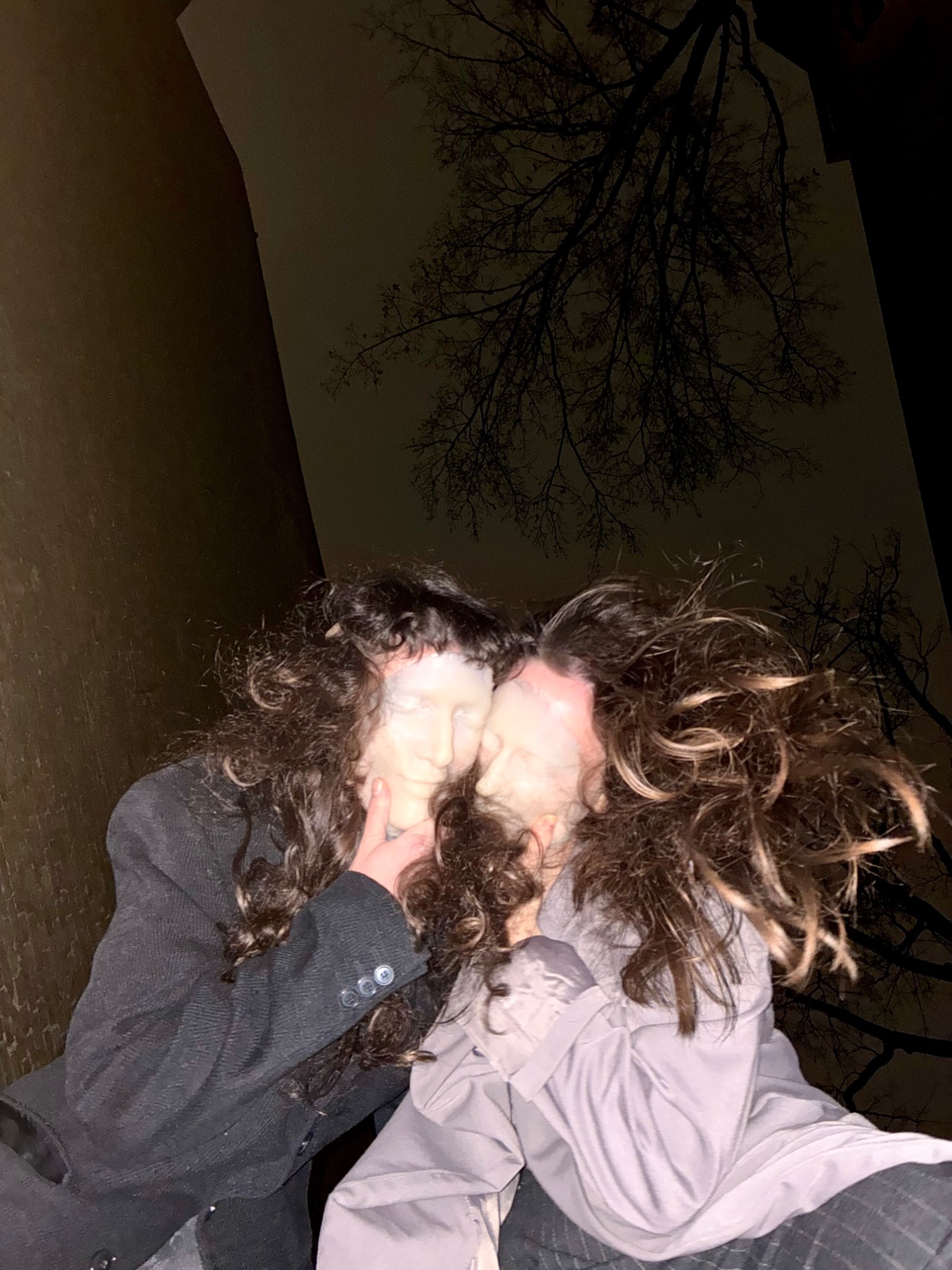
Working with still life is a way to talk about the human condition indirectly, en creux – as you would say in French, on that which is present in the negative. Stillleben in French is nature morte, so it’s very on the nose, a bit too much so maybe, it forces you to look at something to the end. Beauty becomes a function of a temporal relation (thank you for showing us this passage of the ethics of psychoanalysis, Sophia). During the Corona-lockdown Margaux started creating these “ghosts of objects” by putting many layers of latex on an object (like a cup), letting them dry and taking them of – they hold the shape.
2. Title and Tradition
Stillleben evokes both stillness and the long tradition of still life in European art. What does the term mean for you in the specific context of performance and perhaps our current moment?
As a young girl Laura was gifted the name Stillleben, when she first saw the painting by George Flegel - Stilleben mit einem Hirschkäfer, so still life with stag beetle. In front of a plate with a fish, bread and wine there is a stag beetle, seemingly on it’s way to explore the dead fish. This has led to a profound irritation on what makes the still life still and what makes it life - as the beetle seemed to travel in between. What irritates unbewegtes Dasein is movement then. Joining these opposition between the nature morte and the Stillleben has been the driving force of this collaboration.
3. Breath, Body, and the Atemwende
Breathing appears central to your work, as both material and rhythm. Paul Celan speaks of the Atemwende — the “turn of breath” that carries the poem towards something new. Breath seems important for your work on Stilleben as well. Does performance have its own kind of “breath-turn"?
Breath is the negative of Poetry, or the other way around. It is material and rhythm, because of our bodily existence, it has to be so. In performance this becomes even more obvious. The installation is a room, is a dress, without Laura as a perfomer it is a still life. Breath is literally what makes it become alive, what rebels against the still, what invokes the existence of the body, which always is the vulnerable object of any performance and relates to the spectators as bodies too. The perfomer’s breath is resonating through the audience’s body before filling up the space – we think it is possible to call this an Atemwende as the breath does carry the performance towards something new.
4. Sublimation and a Different Morality
In Seminar VII, Lacan writes that sublimation — like perversion in art — opens the possibility of a different criterion of morality, one that stands apart from the rules and principles of ordinary reality. Does Stillleben create such a space? Do you see your work as allowing another form of ethics, another relation to the body or to the Real?
This seems to grand a question for us and here we strongly believe in the division of labor: We cannot be the judge of that.
5. Singularity, Collaboration, and the Collective Body
Psychoanalysis is concerned with the singular subject. Is performance for you likewise singular, an event that resists repetition and generalization? Or does it also speak to something collective? Since you work as a collective how does the collective? In Stillleben, do you think of the singular or the collective body as a constellation of singularities?
A performance needs to be structured in a way that it is at the same time singular, resists repetition and generalization but also allows it. The idea of the spiraling movement comes from a personal interrogation and a found metaphor for it: The specific suffering in what we often call depression, a cowardice towards the own desire, is a narcissistic one. It’s like sitting in front of a huge plate of spaghetti with a fork, you dig in and start turning the fork. You expect there to be an organic end to that motion, that you can take the fork to your mouth, eat, taste and devour. But instead, there is no end to the motion, you accumulate more and more pasta and at some point, even the plate starts to turn. Nothing can be differentiated anymore, so the other disappears and you stay empty. In our work process as a duo this very singular image starts to oscillate. The proximity of objects, bodies, thoughts and our constant search for translation reshapes this personal symptom on every level. This reshaping climaxes through the performance. A singular shape is always weird but it finds a rationality in the lived embodiment of the performance and the appropriation and reshaping it gets through the audience.
6. Audience, Gaze, and Exposure
Lacan talks of the dialectics of eye and the gaze. The gaze is what erupts when the subject's vision breaks down. The world looks at us but not from the place where we see it. How is vision and gaze part of the way you work?
When we think of the gaze we think of Virginia Woolf’s novel the waves where there is a constant uncertainty about what is inside and what outside. We remember a dinner party scene: Bernard, one of the characters, seems to address an unknown guest. But as readers we are never sure if he does actually speak to another person or if he talks to himself (for whatever that means). Bernard tries to retrieve a self he is not sure he ever possessed. In his observation of the other he takes it’s place which allows him to look at his own consciousness as an observer might: “To be myself I need the illumination of other people's eyes and therefore cannot be entirely sure what is my self.” This of course he finds rather painful and confusing for the lines remain blurred - though it is insightful. But he feels the endeavor remains unsuccessful as we are not able to leave this immense machine, that seems to “expand in and out like the mainspring of a clock”.
Our fondness of marrying installation and performance stems from a similar experience of life that disturbs and must be shared through work to be endured.
7. Looking Ahead
Stillleben works with stillness — but does the project have a “next movement”? Your work seems equally interested in what happens after "still life" - Are there gestures or directions you feel drawn toward in your future work?
This was our 4th collaboration and we feel they always speak to each other. There have been movements before and there will be many afterwards.
Margaux Compte-Mergier is a French artist based in Berlin. Her sculptural practice explores the unstable threshold between past and future, nature and culture. Working with stone powder, silicone, resin, and latex, she creates hybrid forms — fragmented bodies, animal and vegetal figures, and objects — that oscillate between relics and anticipations. Her work reflects on myth, metamorphosis, and the human drive to challenge and exceed its own condition. She studied literature, philosophy, and aesthetics in Paris before completing a Master’s degree at EHESS- Paris. Represented in Spain by RÍO & MEÑAKA gallery, she has undertaken residencies including 104-Paris and presented solo exhibitions in Berlin, Paris, Madrid, and Lisbon.
Laura Eftychia Papachristos is a performance artist and teacher in Berlin with an interest in psychoanalysis. She is intrigued by the relation of inside and outside as one can get from one to the other without crossing the edge. In her work she explores this irritating correlation. She has studied anthropology with a focus on technology and sexuality in Berlin and Athens.
The two artists meet in the desire to transcend the art experience by animating the inanimate. Papachristos inhabits the sculptures of Compte-Mergier, creating a dialogue—two times, two expressions of experience, a breath at the heart of fossils. They have been working together since 2021.