Q & A with
Patricia Detmering
2.2.2026
1) When you first invited us to your studio, there was art in many different formats; more recently and especially in our collaboration, we have seen a very large number of pencil sketches from you. Can you tell us a bit more about the differences in format and how you would describe this shift towards pencil art retrospectively? Pencil sketches are often seen through the prism of immediacy, repetition, and informality. What does drawing allow you to do—conceptually or temporally—that other media perhaps did not?
I originally studied painting and did a great deal of drawing during that time. Actually, it goes much further back than that. As a child, I drew constantly. All of my school notebooks were filled with drawings. It had a calming and regulating effect on me to lose myself in the details of a drawing. In the final semesters of my painting studies, I abandoned this practice and focused exclusively on new, mostly digital media. Then, about two years ago, the pencil returned to my hand. At first, it had no particular meaning for me. There were no concepts, nor any external necessity. There was simply a need to do something again purely for itself, without function, to engage in a kind of work that allowed me to step outside the increasingly oppressive protocols of the market. Over time, it became clearer and clearer that the drawings offered a form of autonomy for me. On the one hand, I had started to see some success with my digital art, and a certain fatigue toward the art market had set in. The drawings became a private space whose meaning I did not fully understand myself, but which felt like a site for sense-making for precisely that reason. I was drawing for no one, and this brought back a kind of pleasure that I had long missed. On the other hand, I had long been longing for a more sensuous form of work, something more immediate, without computer programs whose parameters are already predefined. All of the drawings share the same format, C3, simply because this particular paper is only available in that size, and I find its material qualities perfectly suited to my very filigree drawings. The limitation of the format also helps me to remain focused. I have a tendency toward expansive rhizomatic growth.
2) Would you consider “sketch” the right word? The word has rich philosophical connotations in German as “Entwurf” – both Freud and Heidegger use it. Is there something about the “sketch“ that you find more valuable, more materialistic maybe, in its unfinished character?
To be honest, I would only describe them as sketches to a limited extent. With the drawings, I always arrive at a clear point of completion. In some ways, they may even feel more like finished works to me than my large, elaborate digital pieces, which in some cases took years to complete. At the same time, a sense of non-completion nevertheless persists, through the strongly associative, prefigurative mode of image-making, as well as through the serial structure. There is a kind of chronology that will always remain open toward the future, and it is there that I see the potential of the unfinished more strongly than in understanding the individual image as a sketch.
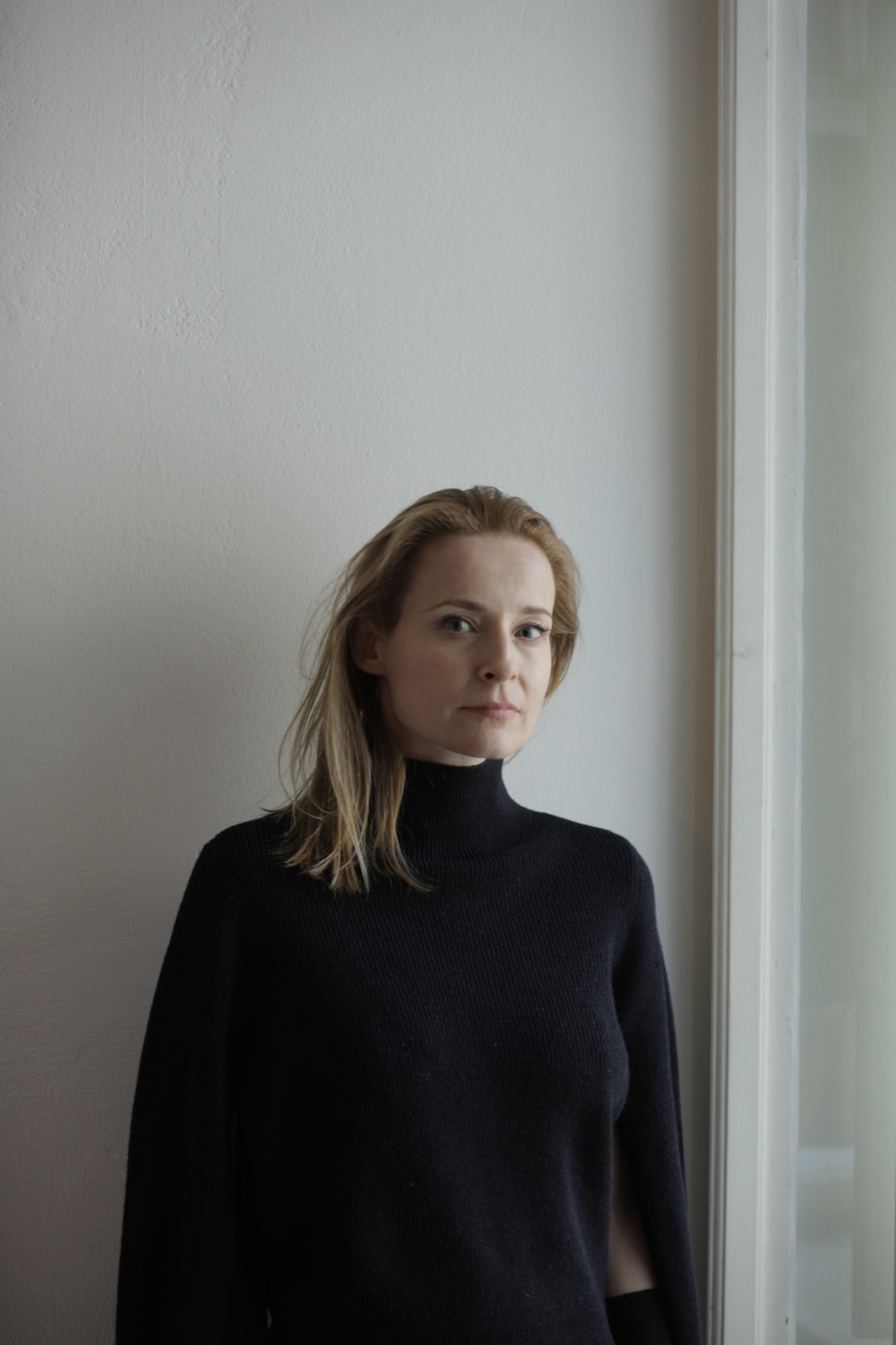
Foto:
Jonas Brinker
3) The idea of pairing an essay with your art came to mind since we knew you as an avid reader and discussant and were curious to hear to see what you would say in response to the essay we were planning to publish. Was this the first time you were approached with such a request? How did you imagine this to work and could you tell us a bit about what might have surprising about it so far?
The idea immediately fascinated me. We began with a poem by Paul Celan, and I really enjoyed allowing myself to engage with it. I have to say that I am now very curious to see how the texts guide me, and how I can manage not to simply illustrate them, but instead to place an aesthetically autonomous space alongside them, one that negotiates the whole in its own formal language. I was genuinely surprised that this succeeded. The process has certainly expanded my practice and has given me the sense that I can rely on a certain autonomy in my technique. What particularly interested me in the new text by René Rasmussen was the idea that we are never fully congruent with language. In this sense, I find myself wondering whether Butler, despite her important critique of normative ascriptions, does not ultimately assume that a coherent identity can emerge once the right words are found. I am more interested in a conception of subjectivity that takes this non-identity seriously, perhaps in the sense of a transindividual self, as described by Vujanović and Čvejić: a self that is not closed or complete, but that forms through relations, repetitions, and shifts. I see my drawings precisely in that space.
4) One other thing we would like to reveal is that you are super fast. When we send you a text to ask if you might want to make some illustration for it, you usually send us a response in form of many possible drawings within only a few days. Can you say a bit about how time influences your work, do you like to work at a rapid pace and why?
In general, I draw a great deal anyway, immediately after getting up, before breakfast, and again before falling asleep. I also tend to pick up new impulses very quickly, provided they spark my curiosity. Over the years, or probably since childhood, I have strongly oriented my actions around a principle of pleasure. In this regard, I am very receptive and largely unblocked. Creatively speaking, this is wonderful, and I am genuinely grateful for this access. I immerse myself very deeply in what one might describe as a state of hyperfocus. However, when it comes to things that do not give me pleasure, it becomes difficult, and I usually procrastinate by making even more art. I lose myself in a remarkable, almost magical way whenever I am able to follow my artistic desire. It is a strong drive that I cannot (and do not wish to) regulate, and it may be the result of a very pronounced laissez-faire upbringing. There was never an authority figure who admonished me to set other priorities.
5) There are repeated appearances of specific shapes or signifiers that return in various constellations. We think of Jacques Lacan‘s idea of the "serial" that he develops in his late seminars. How do you see this relationship between variation, repetition and return in your work?
Seriality reveals another level that exceeds the individual drawing: a temporal, processual layer. Put simply, one can read from the changes in the drawings what was unconsciously moving me at a given moment in time. Often, it only becomes clear to me weeks later why certain forms and dynamics suddenly appeared. The transitions into new forms and moods are fluid. Not all signifiers are accessible to me, to be honest. At times, I find myself looking at the images almost as a stranger, trying to interpret them. I think that meaning, as with Lacan, becomes more visible in the serial dimension—in the displacement from one drawing to the next. In this sense, I understand my series as an open algorithm: each drawing is a concrete execution, but the procedure remains open. This also resonates for me with a transindividual understanding of subjectivity—a self that does not close in on itself, but forms between images, bodies, gazes, and time. Over the past year, I have gone through several losses that repeatedly required an inner recalibration. As a result, the drawings became increasingly ethereal and dissolved each time, and over time new forms would emerge again. There is something very organic about this. Nothing linear—rather an opening and closing without direction. At times, the forms move closer to something more concrete; when that happens, I usually intervene more consciously and seek once again the prefigurative or pre-pictorial, as described for example by Didi-Huberman (What We See Looks Back at Us) and Gilles Deleuze (Painting and the Question of Concepts): that space of possibilities not yet determined by the image. A state in which assumptions, clichés, and expectations have not yet taken form. A state in which the drawing resembles a dream.
6) You also mentioned that the work is sort of meditative for you. Could one say that you are producing variations on a theme? In which ways you consider your artistic practice as influenced by psychoanalysis?
Yes, as I have already described, I have the feeling that drawing has something regulating about it for me. I even imagine that it calms my nervous system. For me, painting was the opposite. Painting is a highly intensive activity, and I always felt immensely exhausted by it. Drawing has something more introspective about it. For me, it is less a struggle and more a kind of dissolution. Identity blurs and becomes unbounded. There are variations in which I almost manically produce similar forms, until they come too close to cliché and I withdraw again into a kind of chaos, into the unbounded. Psychoanalysis plays a major role for me here. I have actually discovered similar rhythms there. I experience more open and more closed episodes, perhaps more regressive phases, in which my dreams also become difficult to read, either because of their chaotic indeterminacy or because they no longer articulate themselves within me. That is also how the drawings feel in those moments. I simply continue working, just as I continue going to analysis, and at some point I break through again and recognize parts of myself that I could not see before. New dynamics often emerge in the drawings at that point, often even before the contents themselves become conscious to me.
7) Considering the many formats you have already worked with so far, is there a format that you are curious about and have not yet had a chance to engage with?
I have in fact immersed myself in almost all media. I find that working with my own body seems particularly inaccessible to me. I have begun working with sound and with my own voice, which feels like a tentative approach toward the performative. Yet I always encounter a boundary there. I have a great deal of respect for it and find myself wondering what would happen if I were to fully engage with it. During the creative process, I would no longer be able to shift into an observing position. The unbounding would be less external and more internal. I think that frightens me somewhat and fascinates me at the same time. This question arises for me in psychoanalysis as well, whether my body should be more strongly involved there. It is as if my need for immediacy, which initially drew me to drawing, has a limit at the point where my own body begins.
8) In Benjamin‘s essay he talks innovatively about the theology and the fall. Yet, he leaves out the question of woman, otherwise so central to the fall. Could we say that in your pictures we see also a return of the repressed here, a reemergence of the jouissance feminine left out by Benjamin?
In the sense of Benjamin’s reading of the Fall, his theory of a "break in language," my drawings likewise refer to something whose truth is not immediately accessible. I remember that you once visited me and we looked at the drawings together, and there was one among them that was very explicit, leaving no room for ambiguity: a penetration. That image stands out and immediately loses its appeal. It becomes revelation and coincides with what it designates. In a strangely empty way, it releases us into boredom. There was nothing to be retrieved there. It is, in a sense, a drawing whose openness and meaning have come to rest; it has become identical with its attribution. Paradoxically, precisely because it depicts coitus, it could be said to have emerged before the Fall. For this reason, the drawing does not fit into my series. It signifies itself. The series, by contrast, is characterized by an open state, one that still precedes meaning, in which no assumptions have yet taken form. Perhaps I am also still moving prior to the gendered. I think I tend to read Benjamin more in a universalist way here; perhaps he is simply operating on a less biopolitical level. Perhaps his theory is less about everything before the Fall having been morally pure and innocent, and more about an ontological event of language. I do not experience his omission of the woman as a personal repression of myself as a woman. I see it rather as a different scaling than that of Butler and Lacan, who think language together with body, pleasure, and normativity. With Benjamin, I do not see the body. That may seem alien today, but in some way it is also refreshing to attempt to take up that position. Perhaps it is more a pleasure in language that presses itself upon me and that renders the drawings sexually connoted. But of course, things are ambiguous. Reading Benjamin in this way does not exclude that there may also be a re-emergence of repressed jouissance feminine in my drawings. The drawings emerge within a complex cosmos in which I am not engaged with a single text alone. Much remains hidden from me me.
Patricia Detmering is a media artist from Berlin. She has given lectures in renowned galleries, foundations, and universities, such as the University of Bochum and the Krupp Foundation in Essen. Her work has received multiple awards and has been exhibited at the Centre Pompidou in Paris, the Berliner Festspiele, the Kunstmuseum Bochum and other international venues. In addition, she has received numerous scholarships. For more visit www.patriciadetmering.com.