Q & A with
Aaron Schuster
18.7.2026
1) You often work on philosophical issues in relationship to psychoanalysis. How is psychoanalysis more than a clinical practice for you in your work and what does it contribute?
Psychoanalysis is like art—it’s a practice that is always ahead of its theorization. Psychoanalysts are guided by their theories of the human psyche, by their understanding of the unconscious and transference, and by their diagnostic categories, but in the therapeutic situation there is always something surprising, something singular and new, that must be dealt with as such. It’s a situation where one is searching for a language that doesn’t yet exist. Every psychoanalysis, in a way, reinvents psychoanalysis, just as every artwork reinvents art. Of course, you can apply psychoanalysis to art, and this can yield many genuine insights. But there is also something misleading in this approach, because it presumes that the theoretical frame is settled and remains undisturbed by the objects that “fall” under it. When I read Kafka, I’m not so interested in psychoanalyzing him or his fictions; rather I think it is Kafka who can help show what is worthwhile about psychoanalysis, and why we need it today.
Why was the encounter with psychoanalysis so productive for philosophy? It has undeniably been one of the great sources of creativity in philosophy for over a century. One of the things that attracts me to psychoanalysis is actually not something directly theoretical, but that it’s a tremendous source of cases and anecdotes, that are provocative, funny, and puzzling—like in Greek philosophy. I think psychoanalysis reinjected into philosophy some of the mayhem and mischief of ancient Greek thought.
Psychoanalysis has a strange and very interesting—I would say promiscuous—relationship to other fields and disciplines. There is something like “the sexual life of psychoanalysis”: psychoanalysis emulates its object of research, sexuality, in its own relationship to the university and the world of knowledge production. Like the partial object it theorizes, it has a drifting, errant character within the intellectual and cultural landscape: it does not keep to its place but wanders about the “body” of knowledge, troubling its consistency and appearing sometimes where one wouldn’t expect it. Psychoanalysis is like the “objet a” of the sciences: an unplaceable science that deals with things that are out-of-place. But this also relates to the aspirations of ancient philosophy: recall that Socrates was said to be atopos, he couldn’t be placed and, with his questions and inquiries, he knocked his stunned and shamed interlocutors out of place. Perhaps one could say that it was psychoanalysis that embodied a truly philosophical desire, it was “in philosophy more than philosophy,” to use the Lacanian locution, a follysophy that renewed philosophical investigation through the lens of psychopathology, the myriad ways that life breaks down and wanders off.
2) Both in your previous book The Trouble with Pleasure (2016), and your recent book on Kafka, How to Research like a Dog (2024), you work on the topic of complaint. Why is this an important topic for you, what does it reveal, is it particular for our time?
Complaining is a fascinating subject—I hope to have contributed something to its elucidation. Do we have a richly developed phenomenology of complaint? There are not so many good studies; in the recent literature I would highlight Rebecca Comay and Werner Hamacher, and before them, Henri Maldiney. Complaining is such a basic human activity, containing many forms and dimensions, existential, cultural, communal, political. It’s a phenomenon that cuts to the heart of paradoxes about drive and desire, pain and pleasure, self and others, the finite and the infinite. I was reading Descartes’s correspondence with Princess Elisabeth of Bohemia, and Descartes has an incredible line about complaining. He says that even those who regret their lives and express a wish to die, through their lamentations testify to the perfection of the soul that is not one with the grief and suffering, but is separated from them and can do something with them—namely, it can make a lament. In fact, Elisabeth has a darker tragic sensibility than Descartes, and that’s part of what makes their letters so interesting. But Descartes’s sensibility is part of the literary sensibility of the era. Look at Corneille’s version of Oedipus Rex. In his rewriting, after the revelation of Oedipus’s crimes and his self-mutilation, Theseus (Corneille adds Theseus to the story, with a romantic subplot), delivers an ode to the indestructibility of the soul that, surpassing the calamities that befall it, “surrenders itself entirely to its virtue.” That’s quite a moral to draw from the tragedy of Oedipus. It might sound crazy, but what if we were to reconceive Cartesian dualism through the lens of complaint? Dualism would then be not primarily a theoretical matter, like we are taught in the textbooks, but something that arises in practice, through moral action. Perhaps there is a primacy of practice in Cartesianism as well. Complainers put dualism to the test: they prove the freedom of the soul precisely through its capacity to lament its life unified with the body, and thereby find a new source of vitality in itself, what Descartes calls the interior joy of the soul.
Kafka is one of the most gifted, virtuosic complainers in the history of literature. One of his specialties was noise complaints, “The Burrow” being essentially one long noise complaint—he and Proust were contemporaries, and both had a hypersensitivity for noise. But the logic of complaint is different than in Descartes; it doesn’t testify to the perfection of the soul, but to its nothingness. Kafka was fascinated by the void at the heart of complaining, the way that complaining conjures an absence that it would disappear into, yet doesn’t: complaining persists precisely by failing to disappear into the nothingness at its core. If you want to understand the “Kafkian subject,” look at his wonderful fragment about Don Quixote. The original Dox Quixote famously tilts at windmills; Kafka’s tilts at himself. To paraphrase, the Kafkian Quixote wants to kill himself, the problem is that he’s already dead. The dead Don Quixote can only kill himself if he can find the last little missing bit of life to extinguish—and his failure to find this missing life is his life. Vainly searching with his sword for something in him to kill, he is positively bouncing with life, “somersaulting away down the ages.” This is the Kafkian Lebensphilosophie: life as a continually failed suicide. The subject—the fictional subject, the subject of the symbolic, and who better to exemplify this than Don Quixote, the “knight-errant” who lived in fictions—is a paradoxical loop, a Möbius band of life and death. Isn’t the quixotic suicide a superb name for the death drive? Another text to mention in this regard is “A Little Woman,” a story I would like to write about someday. It’s about a man who’s tormented by a little woman who rages against him, yet we never learn the reason for her annoyance, and indeed, the narrator insists that they have no relation at all outside her animosity. It’s strangely devoid of psychological analysis and explanation. It’s as if, in its austere rigor, the story effected a phenomenological reduction of complaining, distilling aggravation in its pure and empty form.
I want to quickly add something about the exorbitance of complaining. In The Trouble with Pleasure, I wrote about how anything can come to symbolize the “pain of being,” how even trivial nuisances can sometimes take on an outsized metaphysical dimension—you can see this in another way, in the cursing of small children. It is interesting to observe when children learn to curse; they are angry or irritated and they curse their parents, they might not exactly have the words for it, but they curse them to hell, to non-existence, to the wildest extremes they can muster, sometimes for the most trifling frustration. The infinite enters into their lives. Of course this looks ridiculous and unreasonable, but I think it’s actually an important event—to experiment with the abyss in this way is essential to becoming a subject, a speaking being.
3) How to Research like a Dog has the subtitle: "Kafka's new science"—what is this new science and why is it particularly important today, does it share something with the precarious status of psychoanalysis as a science?
There is a phrase from Kafka’s diaries that crystallized my understanding of what this new science is about: he speaks of the “borderland between loneliness and community.” I find this to be a very evocative image. This in-between space, where one is not totally isolated and alone, yet does not have a symbolic place in society and cannot participate in the life of community—that is the setting of Kafka’s fictions, and it’s also the interstitial domain dealt with in psychoanalysis. It’s in this borderland that symptoms are produced, the strange, oddball companions of the subject. And what are symptoms if not deeply idiosyncratic solutions to problems that could not be solved otherwise, in a more socially consensual way—solutions that the subject was forced to invent, unconsciously, under the pain of losing itself and falling out of the world? To give a brief example: everybody has to deal with loss in their lives, and different cultures and societies have different customs, rituals, and vocabularies for coping with loss. Sometimes these are sufficient, sometimes not. If, for whatever reason, the socially mandated solutions do not work, then the subject is compelled to come up with their own supplemental solutions, solutions that can appear bizarre, unintelligible, and self-sabotaging but that nonetheless give their pain some consistency and reconnect them to the world. Everyone has their particular problems, and symptoms are essentially the elaborations of these problems; they are the means by which, largely unbeknownst to and despite themselves, subjects explore and investigate what perturbs them most. Like Deleuze said, desire is a “questioning, problematizing, and searching force.”
This really opens a whole domain of philosophical research, one that evades the usual distinction between solipsism and intersubjectivity, solitude and being-with-others, and that complicates the widespread notion of the social construction of the self. That’s the new science. And yes, the precarity of this domain is also the precarity of psychoanalysis. If anything, this precarious domain is even more precarious today, because it’s extremely hard in the current ideological environment to speak about an endeavor that doesn’t directly aim at socially beneficial results, that doesn’t promise a better socialization or optimization. There is a part of life that can never be shared in common and can only be lived in the borderland between loneliness and community. Psychoanalysis creates a kind of borderland within culture wherein the subject is freed to investigate its follies and oddball solutions, its own singular borderlands.
Recently there’s been a renaissance of studies about Institutional Psychotherapy, experimental therapeutic communities in the 1950s-70s, including such figures as Tosquelles, Oury, Guattari, Deligny, and Fanon. One way of thinking about these psychosocial experiments is that they explored how to build alternative institutions in the borderland, how to create a place in the nonplace: a kind of community at the edge of community. This is not only a historical phenomenon. A few years ago, I was involved in a research project about another therapeutic community, in the Swedish countryside, led by Iris Johansson, an autistic woman who developed her own kind of therapy based on her experience and struggles, what I’d call another kind of border practice.
4) In your essay you develop the very fascinating idea of an "unwilling revolt", can you expand a bit on what this term means and how it differs from the more classical servitude volontaire?
This is what I am working on currently. Psychoanalysis is often viewed as having contributed to the question of willing servitude, which is one of the great mysteries of political theory: Why do people abet in their own domination, why do they so passionately fight for their servitude? Why do the masses desire fascism? Psychoanalysis does have a lot to say about this, but this is not where its real contribution lies. It deals rather with the reverse: the phenomenon of unwilling revolt or involuntary insubordination. This describes a situation where people want to conform, to have their place, to live in accordance with certain ideals and structures, but for some reason, they cannot, something in them refuses to go along. This crisis or disturbance is not merely a dysfunction, but expresses a mangled form of freedom. Or at least, that’s the psychoanalytic wager: that symptoms contain a kind of disguised critique, that they constitute a revolt against social norms and the self’s internalized ideals. They express not just a breakdown, but a veritable problem. We want to be rid of our symptoms, which trouble our lives and make us unfree, but the symptom itself is a kind of freedom—a Kafkaesque freedom, if you will, a freedom that appears in the guise of unfreedom. If you want to understand the problem of freedom today, I think you need to grasp it between these two poles: an autonomous heteronomy, a freely willed domination, and a heteronomous autonomy, a revolt against and in spite of oneself. Voluntary servitude meets involuntary insubordination, as its inner limit and failure.
I want to go back to and revivify a basic Freudian idea, that mental illnesses show the limits of obedience, including our desire to obey. This opens onto questions about the politics of mental health and illness, the meaning and status of diagnostic categories, and, more broadly, how we conceive the relationship between the individual and society. I want to argue against two models, one that would make mental illness a personal matter, a medical issue, to be treated as a deficit or dysfunction. And the other that understands mental problems as reflections of social problems, as generated by conflicts, tensions, and traumas in the family and social environment.
The second is already a great improvement, as it accounts for social causation, and makes mental health a political matter. But it risks erasing psychic causality, that is, what people do with their environment, how they filter and transform what happens to them, and the creativity of the unconscious. Psychopathologies have a profound social dimension, but they cannot be dissolved into social pathologies. They bear on the vulnerabilities of being human, which social laws and customs grapple with and try to normalize, and exploit. We are sick not (only) from society, but from the sick ways that society tries to solve what are ultimately insoluble problems, concerning such enigmas as selfhood, embodiment, loss, sexuality, and authority. This is a position that is beyond both psychiatry and anti-psychiatry. The hypothesis I want to explore is that psychopathologies are experiments: they are singular investigations into constitutive problems that societies try to stabilize, in historically and culturally specific ways, through shared symbolic forms and arrangements. Pathologies re-open these essential questions, that were never really closed. Symptoms are like embodied critiques insofar as they bear witness to the limits, contradictions, and holes in a given socio-symbolic order. But they are more than critiques: they are attempts to invent different solutions, to create new symbolizations, at the borders of self and community, although for the most part they are bungled, self-sabotaging creations that bring with them new stresses and misery. Nevertheless, my point is that symptoms should already be regarded as investigations, and they can be made the subject of investigations. That, for me, is what psychoanalysis is: the investigation of investigations, a technique for deliberately experimenting on the experiments that symptoms unconsciously are.
Unwilling revolt is a term to name these unconscious investigations, these “researches” in spite of oneself, while highlighting their political valence and connection to issues of freedom and obedience. It also gives a different way of thinking about resistance, something other than what you find in Foucault, for example. At the end of his life Foucault spoke about the courage of truth. One might connect this to psychoanalysis, by arguing that analysis helps subjects find the courage to confront the truth of their desire. Yet this misses a crucial twist: what’s at stake in psychoanalysis is not, or not only, the courage of truth but the impossibility to lie. It’s about how the truth expresses itself in indirect, disguised, and distorted forms, regardless of one’s cowardice or courage. If Foucault examines the concept of fearless truth-telling, psychoanalysis asks how truth continues to speak, or half-speak, despite our lack of courage. Ironically, this kind of resistance might fit better Foucault’s own life. As François Noudelmann has written about, while Foucault was lecturing about the courage of truth, he was hiding that he had AIDS, a silence that angered some of his friends. He did not have the courage to speak the truth, but he did so obliquely, in a masked way, precisely through his lectures on truth-telling. There is also here a kind of unwilling revolt.
5) In your book on Kafka you discuss often the particular "human animal" (in relation to Kafka's animals), what kind of (perverted?) animals are invented by Kafka and does it show a continuity or rupture between the human animal and other animals?
You know what’s funny? “Investigations of a Dog” doesn’t end with an animal but with a plant. So not only are there Kafka animals but Kafka vegetables. The dog is speaking about freedom, and he compares it to a stunted plant, or a wretched weed. It’s interesting because the plant metaphor belongs to the etymology of the Greek word for freedom, eleutheria. I draw here on Émile Benveniste. One could say that classical freedom is a vegetable freedom: it is about right people, or ethnic stock, who develop in the right way, the “growth group.” Kafka’s plant metaphor subverts this segregationist ideal of flourishing. The dog cultivates freedom in a way he does not socially flourish. He cares for the stunted plant of his investigations, as “nevertheless freedom.” It’s as if the animal needed to reach for something other than the animal, to express—what? Its internal otherness or self-division. If the human is decentered by the dog, the dog is decentered by the plant that does not grow and develop as it “should.” Kafka’s utopian, or better, atopian community would be humanity as a garden of weeds.
Human beings are not a higher, more perfect animal, but they do have a particular kind of derangement: we are the sick animal, as Nietzsche said. According to this logic, what differentiates humans are their characteristic kinds of illnesses. That’s the counter-identity that Freud developed: one based not on nation, religion, sex, race, class, or caste, but psychopathology. From a Freudian perspective, one is hysteric, obsessional neurotic, phobic, fetishist, schizophrenic, etc. This clinical anthropology is the “identity politics” of psychoanalysis, or better, its “non-identity politics,” since pathologies refer to a splitting of the self, a fracturing of identity. Psychopathologies are not merely dysfunctions or sicknesses, but positive ways in which the unstable, inessential, undetermined, and problematic character of human existence is expressed.
Lacan remains very interesting here; he basically ascribes to the idea of the human as the sick animal, arguing that there is both continuity and rupture between humans and other animals. This has two aspects. The first one is symbolic, so: language. But the “speaking being” is not about more complex codes or advanced communication, but misfires and miscommunication, forms of opacity and instability. To cite one of his favorite examples, other animals will camouflage themselves to blend into their environment, but they will not openly parade themselves hoping to trick predators into thinking that this all too obvious appearance must be a mask. Humans don’t just mask themselves, they are masks of themselves; or to put it otherwise, they don’t just use language, they are used, or spoken, by language. Second is enjoyment, the relation to pain and pleasure. The human animal has an “anomalous and bizarre” relation to its enjoyment; it is not regulated in a straightforward way by the compass of pleasure. It is funny to observe how some defenders of psychoanalysis, like in neuro-psychoanalysis, will argue for the complexity of unconscious mental processes, while claiming that these are ultimately in the service of homeostasis and the satisfaction of needs: a seemingly self-evident philosophy of life, as the striving for “equilibrium.” I would also mention that Lacan put a great deal of emphasis on the problem of authority; if anything unifies Lacan’s clinic, it is the problem of authority. Kafka’s dog can be connected to this. “Investigations of Dog” subverts the canine cliché of fidelity to authority, of loyalty to the master: Kafka’s dog is not man’s best friend but the truth’s. But what if, the dog wonders, the truth is a poison? His investigations are not as socially fruitful as he at first dreams, but they do lead him to an astonishing nonplace, with its own stunted freedom.
Kafka’s animals, crossbreeds, and uncanny nonhumans are literary figures for thinking the problematic character of the human, where the human being escapes from itself, its idealized self-image. Or to put it slightly differently, they emerge when this image breaks down, in its ruins. They also inhabit a kind of borderland, or even overlapping borders: the borderland of the human, and the borderland between humans and other animals.
6) Much of the reception of Kafka reads his work as some sort of fatalist enterprise, although we have seen new readings emphasizing the more “political”[1] or “open-ended” aspects: how does your work challenge the fatalist reading?
What is remarkable in Kafka is the coincidence of radical closure and unprecedented openness. You have to hold both things in your mind. The failure of many of Kafka’s readers is that they want to resolve his thinking one way or the other, to make it clearer and more commonsensical. Thus Georg Lukács argues that there is no freedom in Kafka’s universe, it’s all about domination by external powers, by capitalism. Hannah Arendt claims just the opposite: beneath all the oppression and institutional perversity there is the man of good will who wants to remake the world according to truly human laws. Either might be right in their own terms, but they miss what Kafka is about, the rigorous paradoxicality of his thought. To grasp Kafka, you could restate the paradox like this: Human beings are self-domesticating animals, the ingenious and ever-resourceful engineers of their own cages. But in this ingenuity lies a freedom that remains untamed. Does this sound more open or more fatalistic? It’s a strange loop. If anything, we become freer not by breaking out the loop (which is precisely the illusion, the lure that keeps us imprisoned), but in looping the loop, repeating it differently.
We can also consider how psychoanalysis scrambles our usual understanding of optimism and pessimism. For the twentieth-century psychoanalysis was a deeply pessimistic discourse, that insisted on the inevitability of conflict and unhappiness—no one gets through life without some defense mechanisms. We lie to ourselves, deviously sidestep problems, and concoct impossible solutions for unbearable impasses. Even further, life itself seems to be a disease, troubled from within by the death drive: it can’t be healed and doesn’t want to be. A lot of Freud’s late theorizing is precisely about this, how his patients stubbornly resist their own cure. Kafka has a great line: “It’s the old joke. We hold the world fast and complain that it is holding us.” A Freudian could say, “We hold our symptom fast and complain that it is holding us.”
On the other hand, I think that insofar as psychoanalysis continues and reinvents itself in the twenty-first century it will be as a weirdly optimistic discourse. Why? Because psychoanalysis insists that despite the human propensity for lying, delusion, and self-deception, the truth always somehow expresses itself. Repression fails. That’s the great optimism of psychoanalysis: repression never fully works, it produces a telltale symptom, some disruption or distortion that testifies to the repressed truth. Its message is that the truth cannot be extinguished, despite our valiant efforts. That the human being produces symptoms is itself a source for hope and salvation, because it means that subjects are never fully submitted to norms and ideals, that desire can never be totally captured, that life never runs as smoothly and predictably as the social order would want, for its own reproduction. Do we still believe this today? The idea of the force of truth has come under new pressures, both ideological and technological: on the one hand, the notion of so-called post-truth suggests that truth doesn’t matter anymore, it has no efficacy, reality can be rewritten willy-nilly. Truth is replaced by power. And on the other, technology seems to give us the means to infinitely simulate intelligence and manipulate desire, to program subjective experience in a molecular way. The question is: Where does the ingenuity of the unconscious express itself today, where is the unwilling revolt? I am searching for a more interesting complaint.
[1] See for example Holm, Isak Winkel. Kafka’s Stereoscopes: The Political Function of a Literary Style. New Directions in German Studies. London: Bloomsbury Academic, 2019 or Vogl, Joseph. Orte der Gewalt: Kafkas literarische Ethik. Zürich/Berlin: diaphanes, 2010.
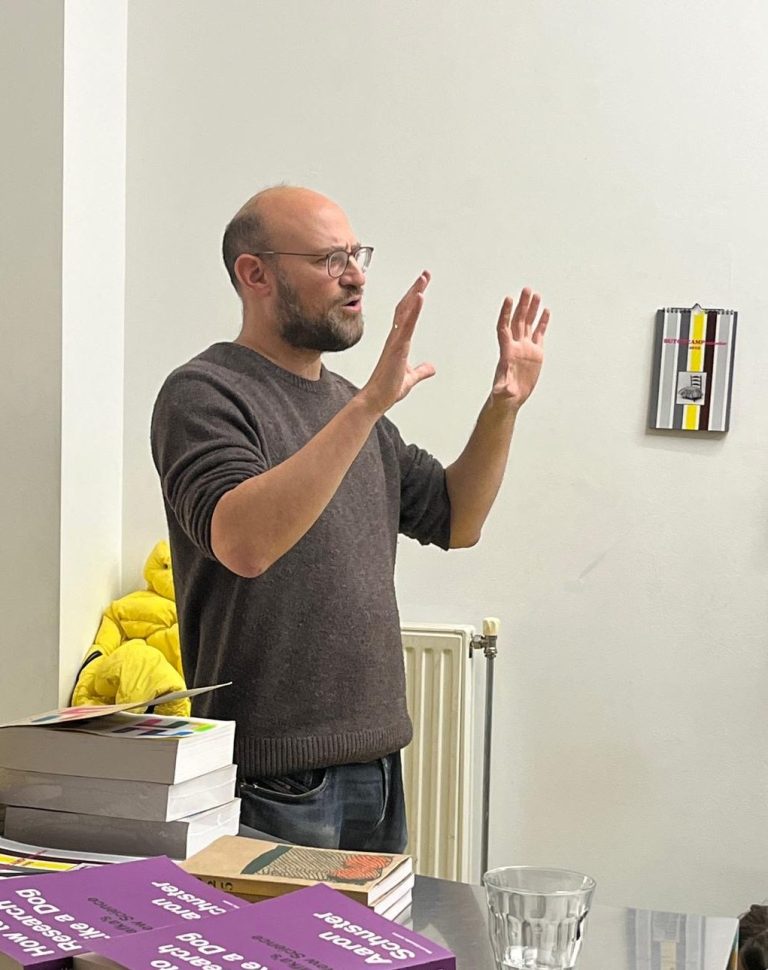
Aaron Schuster is a writer and philosopher, who lives in Amsterdam. He is the author of The Trouble with Pleasure: Deleuze and Psychoanalysis (MIT, 2016), and the co-author of Sovereignty, Inc.: Three Inquiries in Politics and Enjoyment (University of Chicago, 2019). His most recent book is How to Research Like a Dog: Kafka's New Science (MIT, 2024). His research concerns continental philosophy and psychoanalysis, and frequently engages with art, literature, theater, and film; he has written on such subjects as the theory of the break up, Platonov's Anti-Sexus, the philosophy of tickling, the comedy of Ernst Lubitsch, the popes of Francis Bacon and Jean Genet, Bolshevik feminism, the history of pleasure, and complaining. He is the editor of e-flux Notes.