Q & A with
Anders Ruby
20.3.2026
1) You have worked for many years, and in many different areas, on music and listening. And you also produce both music and podcasts yourself. Your Ph.D. is on electronic music and subjectivity (The Four Discourses of Musical Enunciation). What about Lacanian psychoanalysis is especially useful for you in your work on listening and sound?
I think psychoanalysis, if anything, is about listening. When all is said and done, this is really what Freud invented, and what is so easily missed is how radical that is. Subjectivity, in the Lacanian sense, cannot simply be said to be about the who that speaks, but must include some element of how this speech is heard. This is the major challenge for music today as a serious artform, I think. It gets so easily stuck on the who, which is to say, the belief that a subject expresses itself in the music and another subject is there as a listener, whose job is to understand this message. Psychoanalytic listening goes directly against this. Listening is a process in which the speaking subject discovers what was present in the discourse but hidden, precisely not from understanding, but in understanding. You can only listen after the fact, of course, but it is this listening that brings about the possibility of figuring out what you wanted to say in the first place. The strange thing about music in consumer society is that it does not invoke listening. It evokes consumption; we use the music in this or that context, which is to say, it plays a role for us. What is not heard in this is the music itself, so to speak. But, I’m not simply saying that the problem is simply consumerist instrumentalization; that we forgot how to truly listen to the sublime qualities of music or something like that. Rather, to return to the analytical listening, the point is not to get rid of transference (that phantasmatic relationship to the other that draws you in), but to listen to transference itself, which is to say; how is it that I myself am caught up in this?
2)You’re part of the Institute for Wild Analysis, with other philosophers and thinkers in Denmark, that really helped spread the knowledge of Hegel and Lacan to both academic and non-academic audience, as well as providing many counterintuitive analyses within the public debate. Can you say something about the Institute’s purpose, how did it start, and what does “wild analysis” mean in this context?
The most truthful answer is probably that it comes from frustration. I think the phantasy about these things is that they are some kind of surplus product: Since we’re all settled and established in our jobs and academic pursuits, we could make a new institute. The truth is that it’s in fact the product of a lack. A frustration. We’re a bunch of hysterics for
sure, and somehow we must have been unhappy with the compromise-formations we were able to make, institutionally. It’s not a love child, but not an accident either. Perhaps it can be thought of as an occupation of a faculty that does not even exist. We still have the secret, but official, hope that at one point, the State will simply have to acknowledge the existence and start funding it as if it was always the intention. Again, a proper hysteric fantasy.
Freud’s famous text about “Wild Analysis” was meant as a kind of warning, a critique at least, of the way that psychoanalysis was being wrongfully adopted as a discourse in society. The aim, as I see it, is however not to guard the psychoanalytic theory, discourse, apparatus, even further - there’s more than enough gatekeeping as it is - but rather to force society itself to think about its symptoms. And, as Freud says at the end of the text; despite the clumsy methods of these “wild analysts” they actually manage to bring the patient’s attention in the right direction and produce some “favorable results.” In fact, it might even often lead to a recovery in the end.
3) Many think that one of the most innovative readings of Lacan in the last 30 years come from the so-called Lacanian school of Ljubljana (Slavoj Žižek, Mladen Dolar, Alenka Zupančič). Why is it particularly their work that was useful for you (and other members of Institute for Wild Analysis)?
Yes, I am one of those. I’m not sure if I am properly able to answer this, because I came to Lacan through the Ljubljana school and so this have surely colored my understanding of psychoanalysis all together. I think it’s like when I try to paint the picture for my kids about how different life was before the internet, they might cognitively accept the point, but… In the same fashion, when I read more, let’s say dogmatic, or even some of the American strands of Lacanian heritage, it feels unnecessarily stiff or antiquated for me. I remember when I first visited Mladen Dolar who supervised my ph.d. thesis, I tried to, apologetically, account for my undogmatic use of the psychoanalytical vocabulary, in the realm of modern machine music, and for bringing it way beyond its borders. His response, in the usual Dolarian manner, was to say: “the point of psychoanalysis is to take it beyond its borders.” I try to remember that when I hear the hinges of the Lacanian notions bend way under use.
4) Apart from your written work, and as a music producer, you are also a teacher of psychoanalysis and Hegel. On the page of your profile in the school one finds the wonderful phrase: “if you understand Mid/Side compression, you understand something central about Hegel”. We would love to understand Mid/Side compression, but apart from that, do you find that students are as interested in Lacan and Hegel as when Institute for Wild Analysis was founded? How do students respond to them?
Haha – yes, I’m not really sure if I have ever helped anyone understand either by bringing them together. Mid/Side matrixes are a complicated way of treating audio signals by forgetting about left and right side as discrete paths but instead considering them from the point of view of sameness and difference. It opens some pretty unique opportunities that are impossible when considering things “in themselves” (each channel on its own). In order to achieve this other view of what is in the audio, you must first turn it against itself, which is to say, use its own identity inversely. To come to what is particular about it, it must turn itself inside out and become one with its own negativity. This is what I find so fascinating about Hegel. Quantum physics, advanced signal treatment, psychoanalysis, a lot of what he was thinking in the 1800s can actually help us work with state of the art science and technology today.
5) In your essay, “Negative Emergence,” you argue that what matters is not adding new entities, but how negativity/lack constitutes what “is.” Can you say a few more words about this “negative emergence”, what is it that “standard” emergence debates miss? How it is related to the “miraculous” Events, one of your examples being Love?
I think we have a spontaneous tendency to think of the world as made up of stuff, things, objects. And then we account for those objects through science, more and more precisely and completely, and in the end, we’ve got it. In some sense, this is the phantasy one needs to engage with in one form or another to motivate scientific pursuits. However, then you need to account for the relationship between these entities and then along comes the trouble - even if we still only regard the world as consisting of discrete entities. The Earth orbits the Sun and we can account for the gravitational effect of these two on each other. However, when we introduce the Moon, there is no general, closed-form solution. The so-called three body problem. Relationships are complicated. I get the Lacanian inclination here; you can account for the relationship between subject and object, but then you add the Other, and all three are screwed.
One solution, philosophically, has been to talk about emergence. Higher level properties that arise from lower level components which none the less did not contain the properties of the emergent whole. On the simple level, the will of the bird flock is irreducible to any individual bird but is also not present as its own subject when the flock dissipates. But the concept goes further in some philosophical debates: properly new entities arise from the assemblages but are ontologically irreducible to them, and yet produce new causal powers.
Consciousness is perhaps the most famous. I do not go into this discussion. However, a recent, but not in any sense new, attack from the analytical school of philosophy made me want to engage with the positivist worldview of a universe of countable objects and nothing more. My take is not to defend the “magical appearance” of strong emergence’ new entities, but rather to say that the critique fundamentally misses the point: You cannot even account for “what is,” and meaningfully call that the universe – not even scientifically.
The concept of a negative emergence that I am introducing in the essay aims at the creative, productive, say ontological force, that negativity has. So, emergence tries to account for the surplus that occurs in human and material interactions, while the prefix of negativity aims at the lack. What I’m trying to do is to bring those two things together; to say that perhaps in looking for what really drives forward ideas, subjects, societies, but also materiality itself, we might be approaching the matter too naively if we fixate the discussion around whether or not (seemingly) emergent entities can be reduced to their lower-level components. This is not the two sides of the discussion, but already itself a kind of positivist discourse. Negative emergence is in some sense a self-contradictory concept; but this is none the less what I try to pursue: What if your best ideas are not magical appearances out of nowhere, but also not preexisting building blocks in your mind. The best thing that can happen for anyone is for a really good problem to appear. The Lacanian view here is that this is how human desire works. It does not appear as a surplus, as the sudden or spontaneous wish for this or that, but it surely does not correspond to a kind of logical or physical need either. Instead, what really drives the subject is a lack. Desire does not revolve around desired objects, but around lacks. In the essay, I’m trying to make the case for “the conversation” as an everyday arena of this. Neither of the participants of a conversation owns its logic. It moves about, the themes and mood changes, and then, if you are really lucky, something negative emerges. A lack that no one can truly account for, and that cannot be said to have been there beforehand in some material sense. So, a true emergence in this way, but a negative one. This is where things start to move. This is how new thinking is born, this is how one falls in love; with someone or something that brings about the right kind of lack into one’s life.
The future does not magically appear out of nowhere, free of any material determinism, but perhaps the past disappears in a way that cannot be accounted for by the present. The case that I’m trying to make is to say; what if emergence is very real but can only be seen in the shape of a lack?
Anders Ruby is a historian of ideas working in the field of psychoanalytic theory and philosophy. He is Vice Principal at Engelsholm Folk High School and analyst at Institute for Wild Analysis in Aarhus. Together with Brian Benjamin Hansen and Henrik Jøker Bjerre, he hosts the podcast I teorien, which focuses on the unconscious theories produced in everyday cultural symptoms. Alongside the theoretical work he engages with different artistic practices, both as a music composer and producer and as a philosophical consultant for various art projects and exhibitions. Latest Natura Spiritualis in Silkeborg Bad. Other recent publications include What is Called Listening? in Lamella (2026), Timemotiv, (Poetry collection) Herman og Frudit (2024) and The Rumor of Music (Forthcoming).
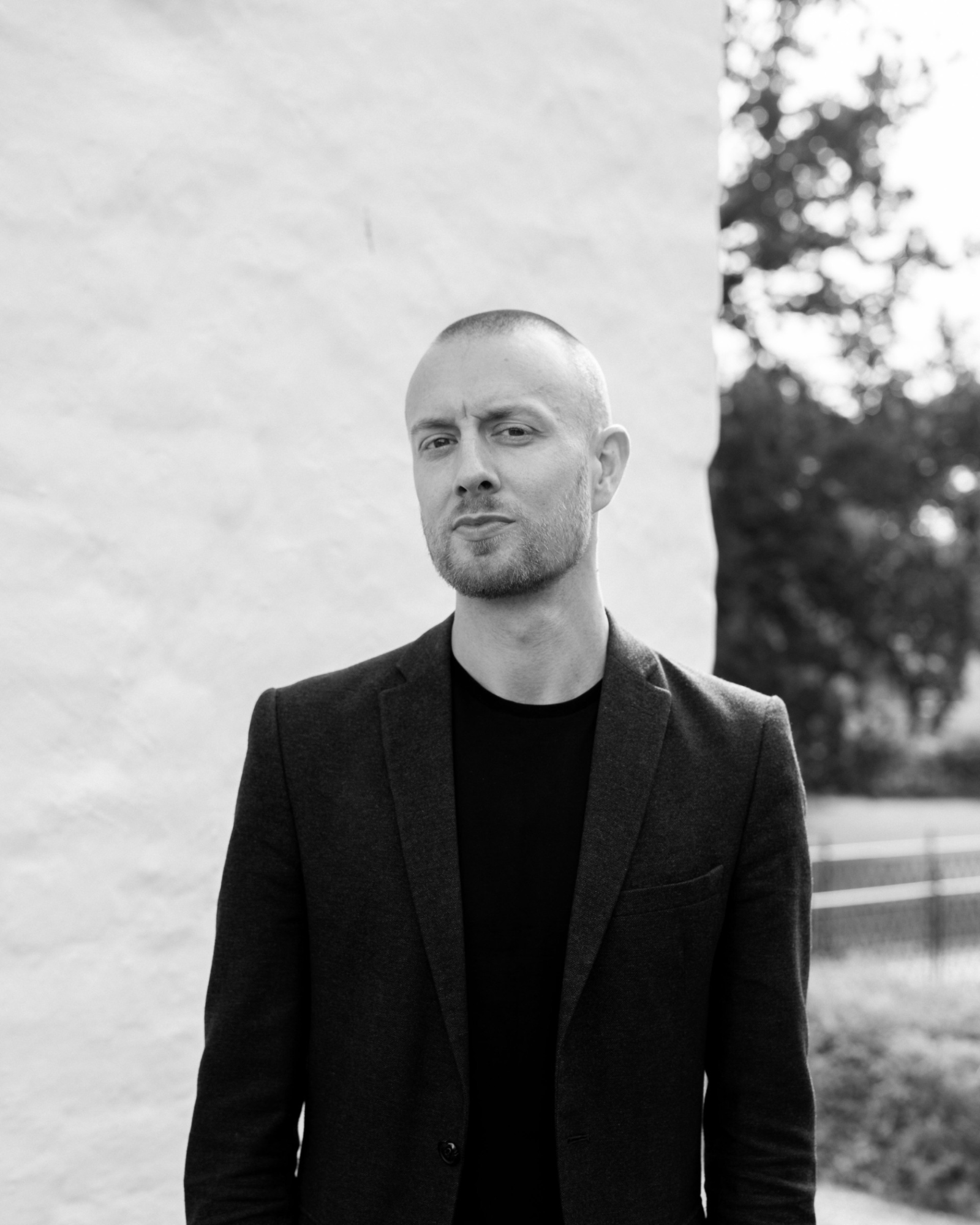
Foto:
Frederik Danielsen