Q & A with
Caroline Albertine Minor
21.5.2026
1) In your poem “Honig und Beeren,” there is a striking play on the word Geruch, which in Danish is first translated as “back” (ryggen), then as “reputation” (rygtet), before the poem arrives at the latrine punchline: “stench” (stanken). It made me think about the way words can miss the body and yet still affect it very strongly, sometimes belatedly. Psychoanalysis is also interested in this: in how words can alter something in the body, even though it is a “talking cure” rather than a bodily technique, such as massage. Do you think a lot about these bodily effects when you write?
I’m sure I do think about them – even if I think I don’t. Writing is seeing, of course, but it’s also a lot of concentrated listening. For me, language, is very much experienced as something visceral and embodied. If I do not enjoy a book, for example, it is most often because the sentences do not for some reason resonate, or sound, inside of me. They remain on the page, docile and oddly flat.
2) In “Honig und Beeren,” the translation of Geruch finally lands on “stench” rather than “back.” But because of the indentation and spacing of that line, the poem creates a peculiar visual effect: at least to me, the lines begin to resemble a back or a spine precisely at the moment when Geruch turns out not to mean “back” (ryggen), but “stench” (stanken). It is a strange punchline because, although the translation is correct, something still seems slightly out of joint. Without going too far into the specifics: is what Roland Barthes called the work on the sentence different for you when writing poetry as opposed to prose, or do you not really make that distinction?
In a story or a novel I will for stretches allow for the language to be light, even transparent – and give the impression that I’m merely providing a window through which the reader can peer at whatever is happening in the story. When it comes to poetry, I want to keep the readers alive to the “madeness of” the thing, the materiality of words, their specific color, taste, vibe. All writing is a form of curating, it is the level on which this curation takes place that differs.
3) Jacques Lacan speaks of the voice as something that falls outside meaning. For him, the voice is not the self-presence of “hearing myself speak” — a notion famously deconstructed by Derrida — but rather something strange and uncanny, almost like a foreign object within us. Do you think a literary work has a “voice” of its own, one that cannot simply be identified with the biographical author?
When my son was around four he encountered the mystery of existence – the astonishing, unsettling fact that he was him and not someone else. One evening he asked me how the voice of him was installed in his body? I kissed him and said I didn’t know and he suggested that it must work along the lines of a gumball machine – when a baby was conceived, a handle in the sky was turned and one specific voice among many, among millions, rolled down the shute and into the embryo. I didn’t contradict him, it might be happening just like that. As for books, I’m not sure either. I know I do not talk like I write, since the act of writing seems to work in reverse, shaping my thinking rather than the opposite. That’s just another way of saying that I believe that books are often smarter, more empathic and wiser than the people writing them. Some handles are probably being turned in the (some) sky.
4) People sometimes claim that short stories revolve around a decisive event. But in Velsignelser — and also in your two novels — it seems to me that many important things happen through what is withheld, or never fully explained, such as Anso’s suicide. This ability to hold something in reserve seems itself to result from very careful work on sentences and composition. Perhaps one could say that the decisive event is not a failed event, but the event as failure: something that continues to insist precisely by not showing itself. Is this something you think about when you write?
My instinct in storytelling is to explore the aftermath, rather than the climatic event itself. I’m interested in the business of interpretation and of continuing and almost always prefer periphery to center. What happens after the movie ends is what I’ve always wanted to know, and what might the minor characters be up to? In my second novel The Lobster’s Shell I set out to do one thing (tell a story with a nicely structured arch and three main characters), but ended up doing what I always do and wandered off to the edges of the scene, to a flooded Venice, which made for an ending that many readers found frustrating. I’m still quite proud of that part, though.
5) There are also some very touching motifs or scenes that seem to return across your work, often with small variations. For example, both the poem “Alhambra” and the short story “Sorgens have” contain a family in which a man ends up in a wheelchair after an accident, as well as a powerful address to a “you.” To me, it feels as if certain gestures or scenes begin to live a life of their own, almost in a virtual space that cannot be reduced to any one specific text. With Gilles Deleuze, one might call this a “surface-event”: something that is more than the individual scene, yet does not have an ontological reality of its own. Is this repetition of scenes, gestures, or motifs across your work something you think about deliberately when you write?
One of the things I enjoy most by reading someones’ entire oeuvre is when I start to notice precicely this more or less voluntary play with variations over the same themes, motives, structures. This is when obsessions, desires, perversions tend to become apparent too. We are finite, limited, beings, and this shows over time, in writing as in life. It’ not a bad thing.
6) When we read reviews of your books, they often emphasize mourning. But I also feel that your writing is very much about how the careful use of language and composition can make something new possible, even from within loss. we noticed that the question of the “holy” (det hellige) also appears at times, but in a tentative, probing way — for instance, in the poem “Alhambra”: “er der ingenting der er helligt / er min søn ikke hellig?” (“is there nothing sacred / is my son not sacred?” [PT - translation] p. 10). In “Sorgens Have,” however, this question seems to appear with something like shame, as if language were committing a kind of perjury: “denne usigelige skam: ikke at indeholde en eneste sætning der er dig værdig” ("this unspeakable shame: not to contain a single sentence worthy of you", [PT - translation],p. 117). Does writing, for you, have something to do with the possibility that something new might emerge, or is it more a way of working through a certain loss?
Because I enjoy it so much, the act of writing has at times been tinged with shame for me. It can feel indulgent, even frivolous to spend your time this way. Especially if you are writing about something very painful. Shapegiving is gratifying – and giving in to fantasy is tempting. This is where craftmansship and assessment comes in.
7) Our next question is slightly different: What was it like to translate your own poems? Did it make you see anything differently about them?
It made me like them a little better. I’m not sure that’s a good thing, though.
8) It is often said, that we live in a fast-paced age of images rather than of the written word. Do you feel that literature, as such, is in a state of crisis today? Or is that the wrong way to pose the question?
Thinking is in a state of crisis and since I believe literature to be a specific mode of thinking, sadly my answer is unequivocally yes. A crisis is not a death sentence, however, and the result can be an enrichment. But it does feel like we are at an important junction that demands very careful deliberation on our part, both as a society and as individuals.
Caroline Albertine Minor, born in Copenhagen in 1988, is a Danish author and translator of literary fiction. She studied creative writing and Anthropology at Copenhagen University and published her first novel Pura vida in 2013. Her second book, Blessings came out four years later in 2017. It was awarded the P.O. Enquist prize and has been translated into Italian, German, Deutch, Norwegian, Swedish and will be out in English later this year. In 2020 she published her second novel, The Lobster's Shell, which is also available in English, German, French, Spanish, Dutch, Norwegian and Swedish. Her latest work is a book of poems, Nivå Bugt Strandenge from 2024. In june 2026 she will publish Den forelskede ven - a kaleidoscopic retelling of a ten year long amical, erotic and intellectual relationship between an artist and her muse, which has at the outset of the novel abruptly ended.
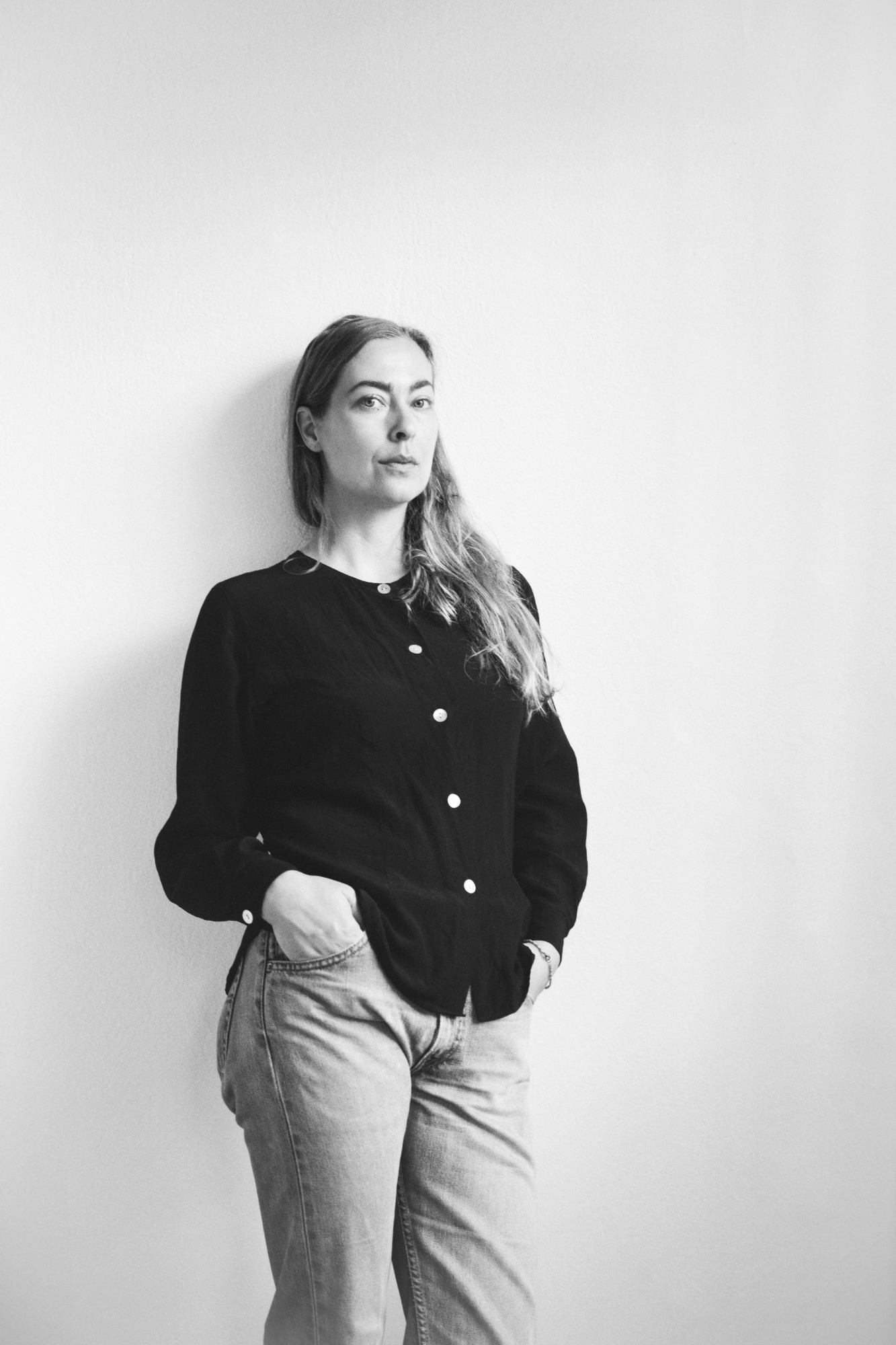
© Paula Duvå