Q & A with
Todd McGowan
15.11.2026
1) In your essay, you write about The Odyssey by Christopher Nolan, a film director whom you have written a whole book on. You have written extensively on film, and, in addition to Nolan, you have written books about David Lynch and Spike Lee, in which you use psychoanalytic theory to analyze and interpret film. What do you think psychoanalysis adds to film theory?
I’m tempted to answer that there is no film theory at all outside of psychoanalysis, that it is the film theory. While of course there are other varieties, it’s only psychoanalysis that begins with the question of how the film engages the spectator’s desire, which is, to me, the central question of cinema as an art form. This is what makes it so unfortunate that the first version of psychoanalytic film theory stressed the problem of identification rather than confronting how desire works relative to a film. All other theories tend to find what they’re looking for, whereas psychoanalysis is radically open to the way that each film deploys the desire of the spectator. It allows for a universal theory that respects the singularity of each film.
2) You mention in your essay that Hegel’s theory of the concept, and his theory of contradiction being inherent to identity, stand in opposition to the politics of Carl Schmitt, which is based on establishing an enemy. In the light of that reading, was Hegel still too Carl Schmittean when he argued for the necessity of war or do you think something else is going on there?
Hegel wasn’t compelled by war because it provided an enemy against which the political could form, as Carl Schmitt argues. His reasons are wholly different. While I do think he underestimates the danger of nationalism that war arouses, his reason for seeing the necessity of war stems from the way that it forces citizens to recognize their debt to the state, to allow them to break free from their narrow private interest and recognize their dependence on the social whole. In Hegel’s view, only war can do this—and not something like requisite public service—because only war puts one’s life at stake. To me, the way that war obfuscates the internal contradiction of a social order is an argument against it that trumps, according to Hegel’s own line of thinking, any possible benefits. So I think that Hegel’s support for war involves a misunderstanding of his own philosophy.
3) In your essay, you point to Odysseus’ self-imposed exile as a political act, for the reason that we must insist on our own self-exile, rather than exiling the stranger. Your reading of the essay made me think of another ending that you discussed on the podcast that you cohost along with Ryan Engley, Why Theory: the ending of the TV-Show, Better Call Saul. Do you think there is a similarity between the ethical implications of the Odyssey and Better Call Saul? And if so, is the self-imposed exile about a political act primarily about psychic investment of an individual subject or about material and institutional practices?
It’s undoubtedly the case that the endings of The Odyssey and Better Call Saul have a great deal in common. Both conclude with the act of self-imposed exile and a rejection of a prior symbolic identity. Odysseus is no longer king, and Saul is no longer Saul. I would attempt to thread the needle of your question by saying that the act is primarily about a psychic divestment that itself changes material practices. I don’t regard the psychic and the material as divorced but as intimately linked. To change psychically is to alter material practices and vice versa.
4) You are often considered as one of the most prominent exponents of Hegelian or Lacanian theory, Lacan wrote on the epigraph of his Écrits “style makes the man.” What kind of man are you? Are you trying to provide a counterpoint to Lacan’s style – and maybe Hegel’s too?
I’m often accused, even by my friends, of being a simplifier. I’m guilty of that, because I write in a way that translates thinkers into a language that I can understand. First of all, if I’m simplifying, I’m doing it for myself. I’m definitely not consciously trying to provide a counterpoint to the style of either Lacan or Hegel, although I would differentiate between them. I think Hegel was just a poor writer who was trying to write as clearly as he could, whereas Lacan is intentionally attempting to be obfuscatory. To me, if a sentence doesn’t make sense or if my argument isn’t clear, then I have to rework it until what I’m saying becomes evident. I believe that everyone can understand Hegel and Lacan, and I aim at writing in a way that makes manifest that belief.
5) Your newest book is called Self-Sabotage and is on our unconscious tendencies to undermine our self-interest. ‘Self-Sabotage’ is another term for the Freudian notion of death-drive. Do you think it gives readers another entry-point into the theory of the death-drive? And can you say a bit more about what you think the political implications of the death-drive are?
Yes, Self-Sabotage represents a translation of Freud’s concept into a more popular form of expression and understanding. As I see it, the death drive marks the most radical point of Freud’s thinking, the point toward which his entire career aimed and in which it culminated. It is so disruptive conceptually that he isn’t even sure how to think about it or how to integrate it into the rest of his theory. In terms of politics, what’s most obvious is how the death drive derails our best-laid political plans. Thanks to the psychic prevalence of the death drive, things don’t work out politically. But at the same time, I see the self-sabotage of the death drive as the basis for all emancipation. It’s a real double-edged sword. The death drive gets in the way of political solutions and gives us the space to strive for freedom from the oppressiveness of our contemporary situation.
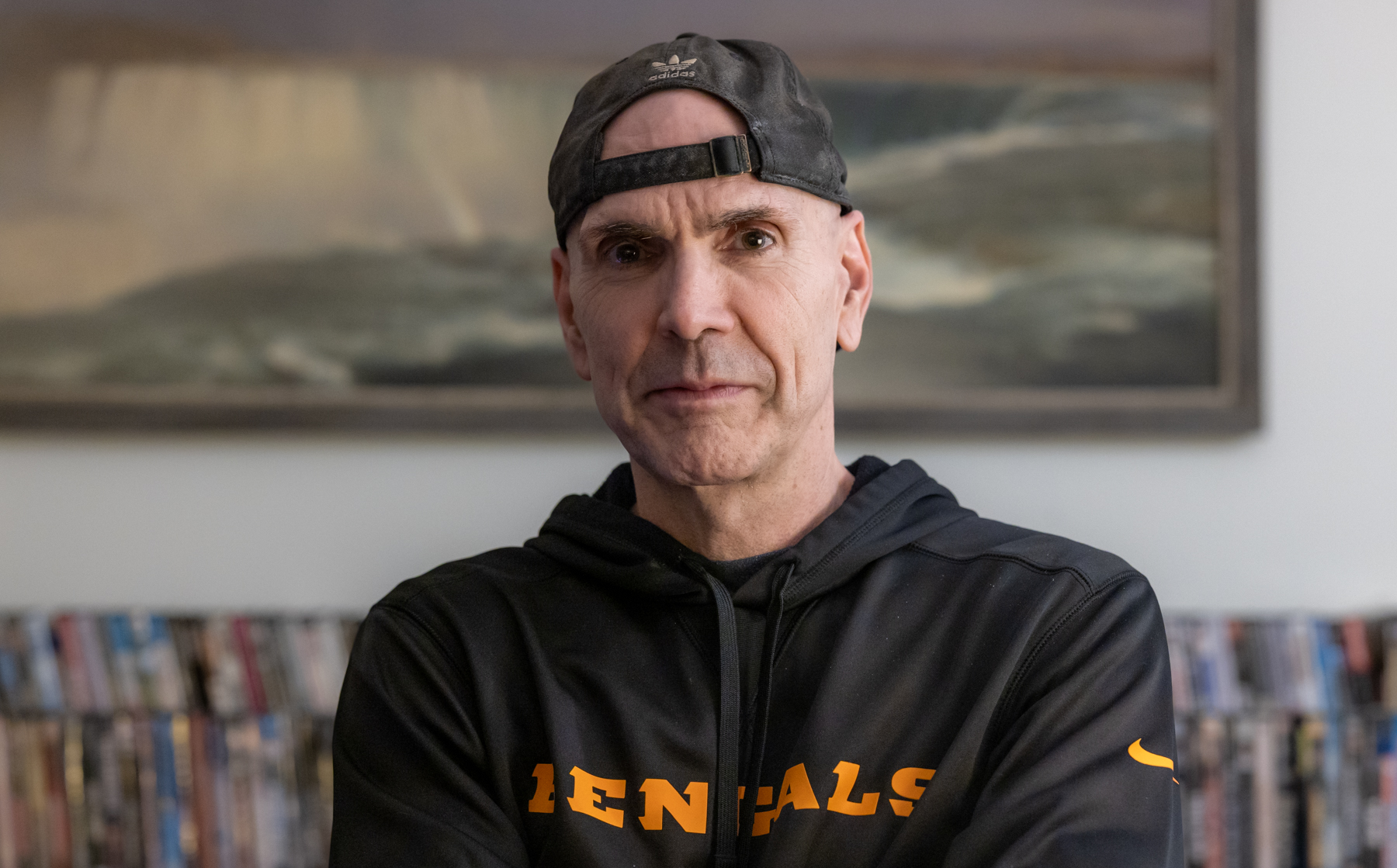
Todd McGowan teaches theory and film at the University of Vermont. He is the author of Self-Sabotage, Pure Excess: Capitalism and the Commodity, Embracing Alienation, The Racist Fantasy, Emancipation After Hegel, Capitalism and Desire, Only a Joke Can Save Us, and other works. He is also the cohost of the Why Theory podcast with Ryan Engley.