Q & A between
Lea Muldtofte & Brian Benjamin Hansen
14.9.2026
On MAD! as exhibition and method, by Brian Benjamin Hansen and Lea Muldtofte
The special exhibition GALT! ("MAD!") was presented at Museum Ovartaci from 26 February to 17 May 2026. The exhibition featured three artists who had not previously exhibited their work: writer Lea Muldtofte (b. 1987), visual artist Agne Gye (b. 1992), and textile artist Caroline Sofie Larsen (2000–2024). GALT! grew out of a collaboration between Lea Muldtofte and Museum Ovartaci. True to its title, the exhibition asked who – and what – is really mad. Muldtofte is a researcher and herself psychiatrized, and the central idea behind the exhibition was to create a space for voices that are usually drowned out by phrases of institutional power such as “lack of illness insight” “treatment-resistant,” or “non-compliant.”
GALT! offered a rare space for a critical chorus of voices that had experienced the psychiatric system from the inside in the role of the troublesome “patients.” In doing so, the exhibition turned two hierarchies upside down: the hierarchy between patient and clinician, and that between artist and exhibition institution.
What follows is a series of questions asked by researcher and co-curator of the GALT!-exhibition, Brian Benjamin Hansen, to Lea Muldtofte. While taking the form of an interview, the text can be seen as a snippet of a broader and sustained dialogue between the two about the exhibition and related matters; a dialogue that continues beyond these pages.
Brian Benjamin Hansen
What was the MAD! exhibition and what was its purpose?
Lea Muldtofte
The purpose was to refuse to be silenced by a system of power and insist on the right to speak. The purpose was to insist on the right to live undisciplined and unregulated even where life has been made unlivable. And it was to refuse the denial of accountability imposed upon psychiatrized people, the denial of the narrative that no one can be held responsible for what is done to us. We, the three artists, used art for this purpose, because that was the language available to us. One of us was killed by psychiatry. She never made it out. But she was so alive through her art, that her voice - not necessarily her story - but her voice and language, created from within her position as a psychiatrized person, needed to reach an audience.
We, you and I, used Museum Ovartaci for this - to exhibit another narrative, another voice, a voice whose capacity to produce knowledge would usually be deemed not credible. In this way, we tried to counteract epistemic injustice, and even epistemic violence, in psychiatry, where the narratives of psychiatrized people have been systematically and historically erased, or converted into symptoms of insanity. Art in this context is not a way of representing an experience, it becomes the way in which a person can even be. Present not represent.
Art is a form of knowledge in itself in this way, expressing knowledge that the system of power cannot contain. And maybe the only channel through which anyone whose language and body has been taken from them can speak. I know it was like that with me. I lost myself in that system. And writing did not give me any kind of therapeutic relief. It did not even give me existence. But it gave some kind of agency, a platform on which to play, and a space in which my voice was not lost.
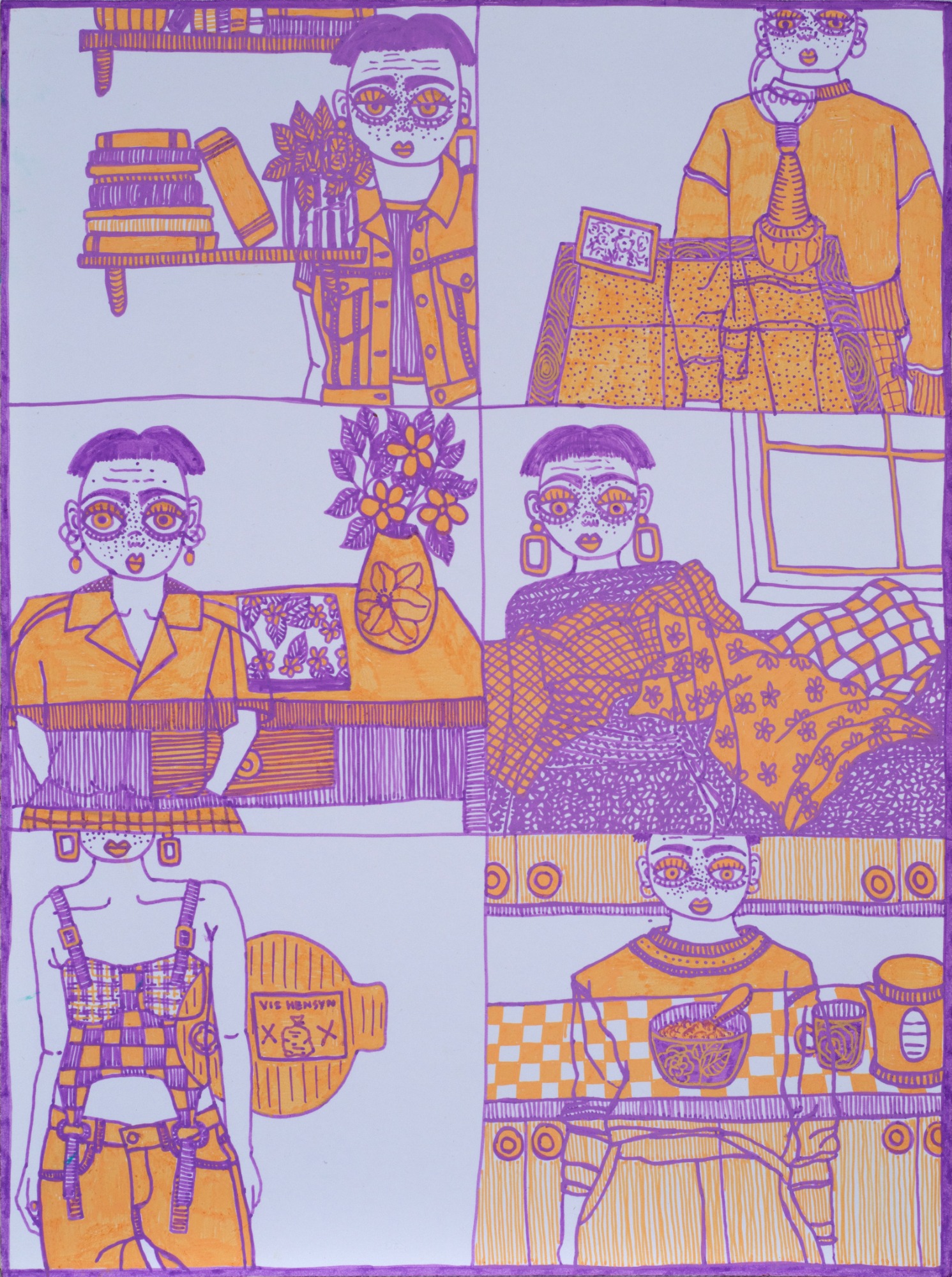
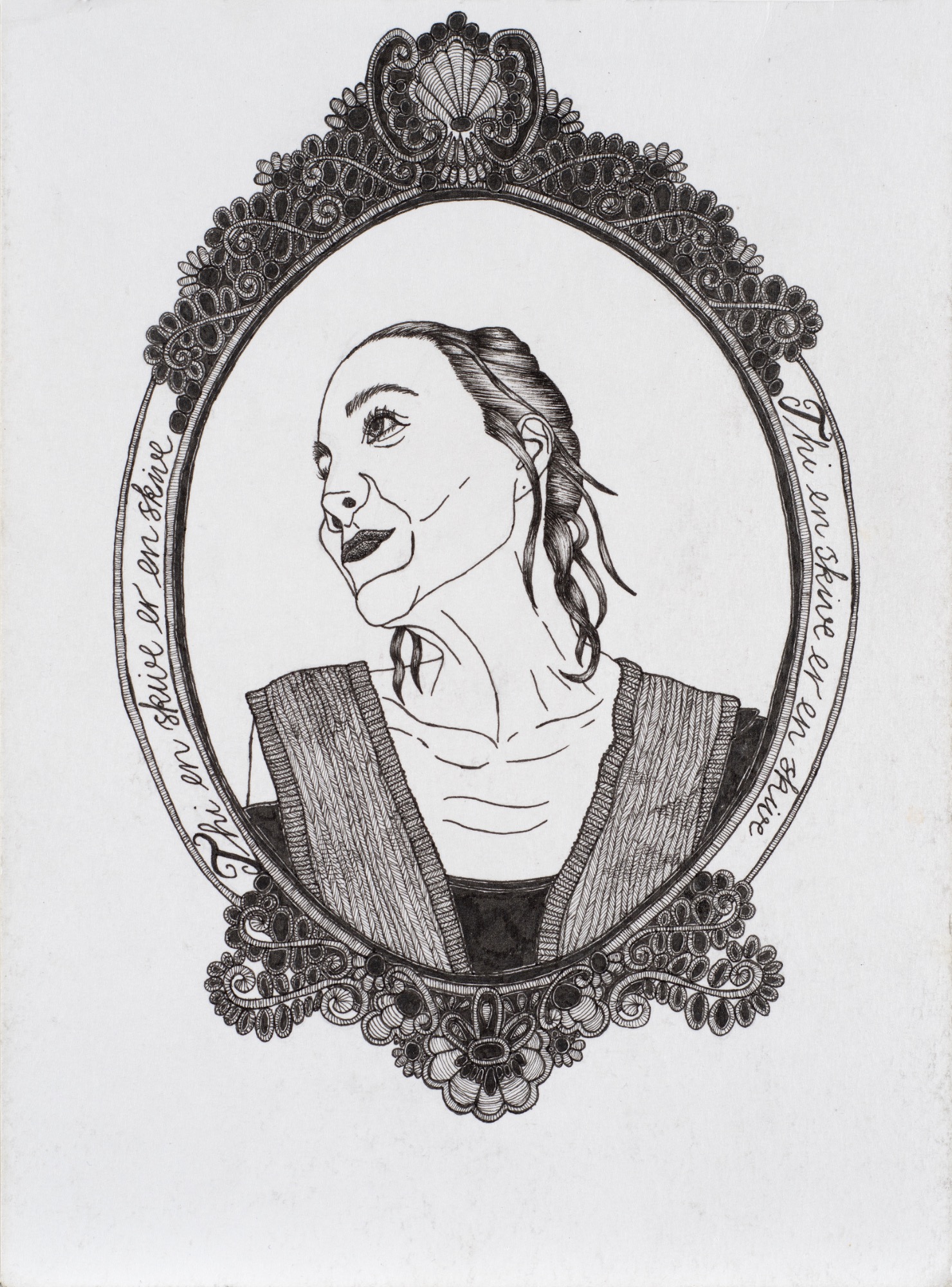
© Agne Gye
BB: Can you say something more about Caroline Sofie Larsen (2000-2024), who died while in the custody of psychiatry, and her powerful embroideries? The exhibition began as the idea of showing her work to the world, right? Why was this important? What kind of voice is Caroline's?
LM: Caroline. Caroline was the type of person who would hack every kind of system she became part of, or found herself trapped in. That was her way of escaping. She has a picture on her Instagram where she sits in an enclosed courtyard during one of her admissions. In the photograph, she has tagged a fly (@flue). Though this tiny maneuver she ridicules both Instagram's tagging mechanism and the psychiatric institution confining her. She points to the fact that she might be locked up but still possesses more wit than the system attempting to regulate her. The psychiatrist who ordered 25 electroconvulsive shock therapies against her will, and who confiscated her embroidery needles, also appears in her work, but as the mad one. Caroline invokes the popular definition of madness as repeating the same action over and over while expecting a different result. Once again, she hacks the system from within. She turns psychiatry’s classificatory logic back upon psychiatry itself, making the institution, and not the person it confines, the site of madness.
She was always smarter and funnier than systems in general, and systems, especially the psychiatric system, need to be taken seriously to maintain and reproduce itself. She disturbed that. And for that she was framed and called disturbed. This is important. That voice is important. Because psychiatry kills what does not comply. And use the power of naming people insane to legitimize that their speech should not be heard.
In the diagnostics manual, is a condition called: "Oppositional Defiant Disorder (ODD)". It is described as "a behavioral condition marked by a persistent pattern of angry moods, argumentative behavior, and defiance toward authority figures lasting at least six months." Both Caroline and I were unofficially labeled with this condition. What a genius strategy to uphold power! The dominating system simply invents a category that converts critique of authority into illness. It shuts down any kind of resistance, because resistance is made insane, and that relieves the system from listening.
If I did not risk having my fundamental human rights removed from me - again - I would stand by and actively perform this diagnosis. Like Caroline did. I would do and be oppositional defiant, and if that means disturbed - fine. I am more than willing to disturb and disrupt. For many years, I have had nothing to lose anyway. Perhaps that was the point, the product, and the productive force of the exhibition? An active performance of oppositional defiance. Removed from the psychiatric system where oppositional defiant functions as a disorder, a diagnostic category that forecloses dialogue and institutes discipline. Oppositional defiance could instead become an artistic practice, a political position, and collective practice, and a way of speaking back. Perhaps the only way.
And yes. That was my strong motivation. Caroline was my friend. Maybe that is also an important part of the story of the exhibition. I cared about her, and I miss her. I promised Caroline's mother that I would not let her die in a closed ward somewhere in the forgotten north of Copenhagen. She is out now. I did my best. A
BB: An important idea in the MAD!-exhibition was to work on the notion of insight and turn it on its head. In psychiatry, "lack of insight" means that the patient is sick in a way that escapes what they themselves know and think about themselves (this of course goes by a technical term, anosognosia). At the same time, it follows naturally in present-day psychiatry that the psychiatrist is in possession of the insight that the patient does not have - plus of course the insight into the lack of insight of the patient. This makes for a rather tough hierarchical situation. For me, as you know, psychoanalysis is an attempt to find another way, where the only one who knows about their condition/troubles is the patient (here called the analysand), even though this knowledge is not easy to articulate and one needs a listener in order to process it. MAD! was for me also such a space of listening. We wanted to amplify your insights and dissent produced through artistic means. Larsen's sarcasm, negativity and wits. Gye's notions of the gaze and the body, and their stylish cartoon-scenes depicting everyday situations from psychiatry with a surreal twist. Your own criss-cross way of journaling, where suffering is presented as a matter of fact, not a pathological diagnostic construction. It feels like there are things that absolutely cannot be said or expressed in psychiatry as it is now, and that the three of you found ingenious ways of expressing yourself and dissenting anyway. Is this right?
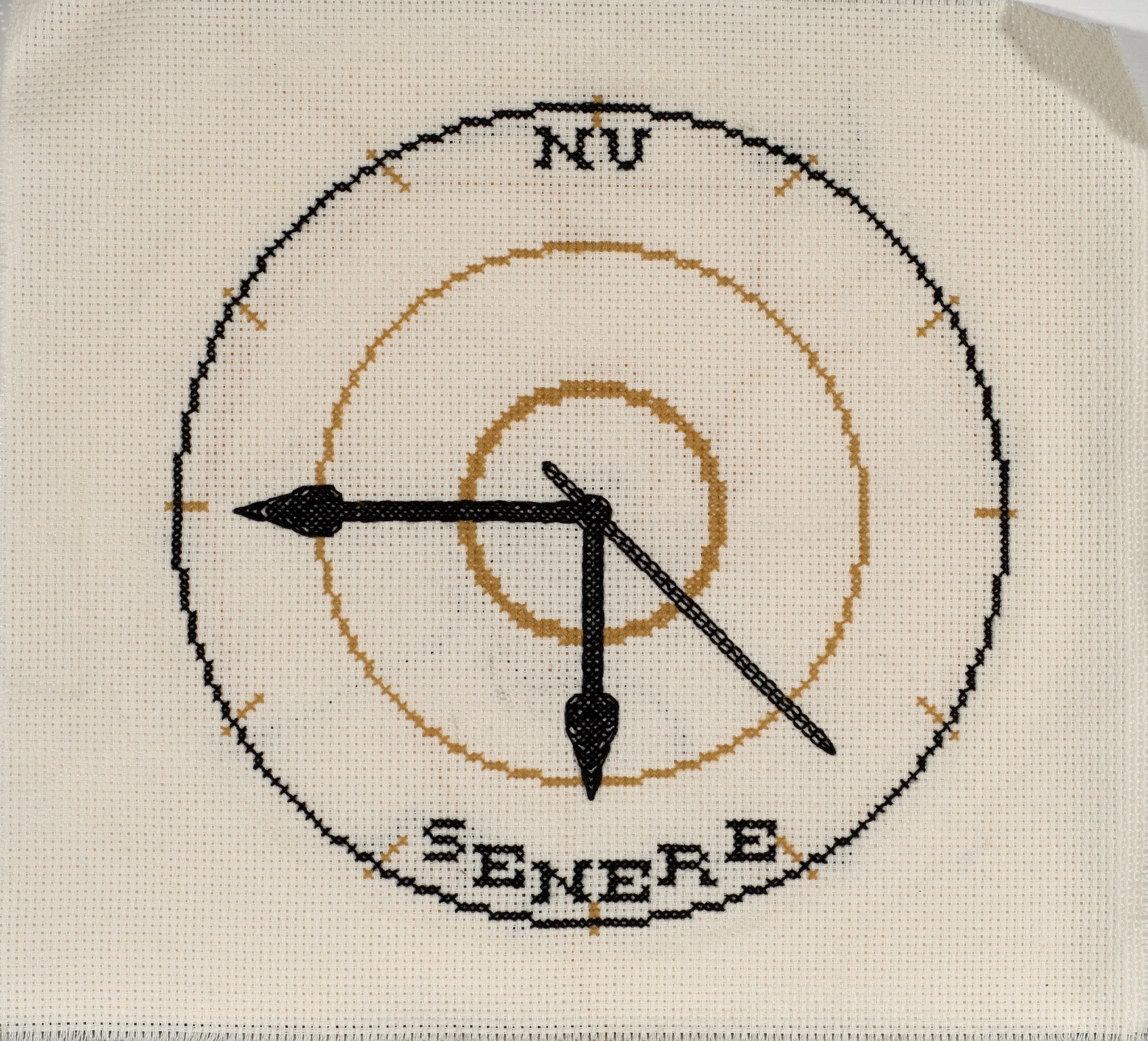
© Caroline Sofie Larsen
LM: For an institution of care, I think - no, I know - that what psychiatry fundamentally lacks is care. At the same time, it invokes a discourse of care like “compliance” and “for your own good” to legitimize violence. The struggle over who is recognized as possessing insight is likewise framed as care - once a person has been declared to lack insight, their own knowledge of what is happening to them, and of what might be good for them, can be disregarded. This is a form of paternalism that would be unacceptable in almost any other healthcare setting. But then again, psychiatry is the only part of the healthcare system that can remove a person from their life and confine them against their will, without that person having committed a crime.
In any case, as you know, I maintain that what psychiatry calls a lack of insight is often a refusal to accept the system’s version of reality. It is disagreement, not illness. And it rhymes with "compliance". Psychiatry is not interested in listening, it is interested in securing compliance and remaining unchallenged. So yes, we found our own way. Not necessarily to express ourselves, but to insist upon our voices. It was not even primarily about content, about what I said. My art, our art, was a position of enunciation as such: not merely something said, but the insistence that there was someone there to speak.
And I get your psychoanalysis-angle. Yes, listening. MAD! created a space for that, but not so that our suffering could be analyzed, nor so that we could be listened to for the sake of being healed. I do not need another authority to grant me permission to speak, or to offer me insight into my own insight. I want the listener to gain insight into themselves, to turn the gaze away from me and back towards the system of power, towards history, the museum industry, or the current drive towards ever more diagnosis. I am not another patient-testimony offered for interpretation. If my story were about me alone, I would never have exposed it. Exposure is far too risky. I speak because what happened to me does not belong to me alone; it reveals something about the system that made it possible. My testimony does not ask what my suffering reveals about me. It asks what my suffering reveals about the systems, histories, and institutions that produced and governed it.
And I speak because others cannot.
I hope those who came to see the exhibition gained insight, not into me, but into the structural violence we call treatment, and into suffering not as illness, but as a human response to an unlivable world.
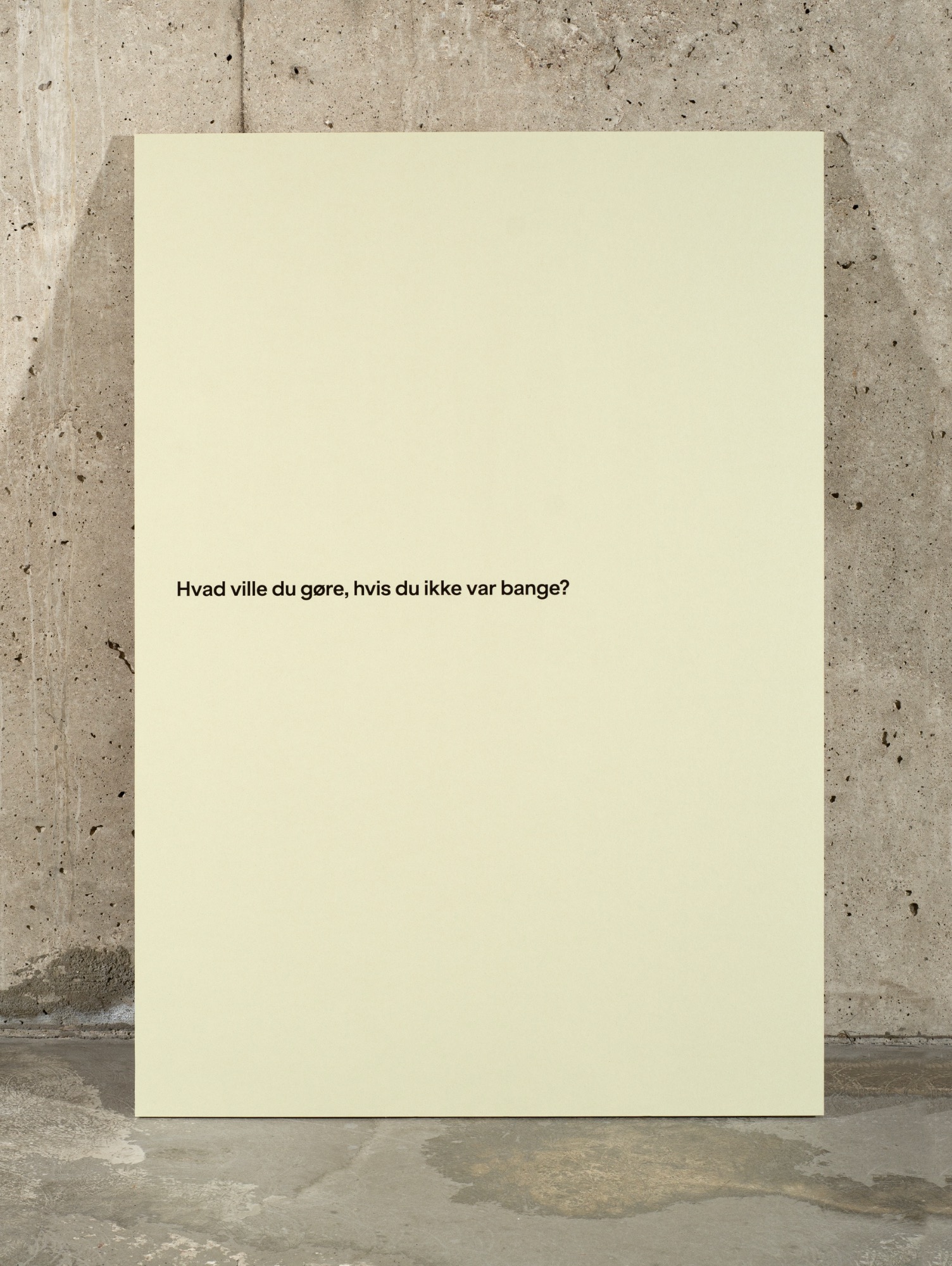
© Lea Muldtofte
BB: I want to ask you a question about what you just mentioned, namely that the MAD!-exhibition also was about pointing to history, to prior examples of patients taking back their right to speak, opposing the category of patient etc. - for example the Norwegian writer Amalie Skram who famously opposed the psychiatrist Knud Pontoppidan has been a great source of inspiration. In this way, the exhibition tried to point to a broader network of predecessors, people being stuck in similar situations, called "voices from the system" - also somehow keeping in mind that many were never heard, were forgotten, obliterated. Thus, the purpose of the exhibition was not to make a showcase for how art can improve the life of mental patients, thus art as some kind of (sanctioned) therapy, but be a site for agency, for critique and dissent, for a broader structural confrontation. I know that you find energy and inspiration here from Mad Studies. What is it that Mad Studies can bring into this? How - through this field of study and practice - do you work with madness as something else than diagnosis?
LM: Skram is my heroine! Said in all modesty, I feel like I could have been her - or at least the character in her autobiographic books - had I been born in another century: super annoying, a gigantic diva with an eye for the absurd who never ceases to rebel against the system on behalf of herself and others. I cannot, however, identify with the way Else Kant, Skram’s protagonist in Professor Hieronimus and På Sct. Jørgen describes the women with whom she is confined. She is deeply invested in distinguishing their madness from her own sanity and is, at times, condescending in her descriptions. Her gaze is clearly shaped by the privileged position of a woman of her time.
This is precisely the distinction we refuse to reproduce here. We do not defend our own humanity by denying the humanity of others, nor do we establish our sanity by making someone else insane. I have met all kinds of people in psychiatry. I have met some of my closest friends there. I have even found love. I have encountered behavior that was difficult, frightening, or hard to understand, but never a human being whose difference could legitimize their reduction to a deficit form of life.
The scariest part though - and also where Amalie Skram and I definitely shouldn’t connect - is the fact that our experiences from mental institutions are remarkably similar. It is as if more than 100 years collapses between us when I read her story. Anybody who reads Skram today agrees that she is not insane and that the treatment she was subjected to was violent and obscene. My point is that the distance between then and now is not as reassuring as we might like to think. A newer medicalized terminology of paternalistic "care" and the renovation of the old institutions into expensive apartments do not make the underlying relation of power disappear. We have made the past recognizable as violence while retaining an extraordinary capacity not to recognize analogous structures in the present. Worse even, acknowledging them as "care".
Mad Studies, yes. It has provided me with a new vocabulary, a community and a space from where to speak also within academia. In general, I am a fan of activistic research and of reclaiming labels that have been used derogatory by the dominating system of power. Like queer and crip. It's different for different people, but for me it’s not about the experience of madness, and I do not identify myself as mad. I make a systemic critique. Mad Studies is many different things, but as a general branch of academia, a standpoint from the margins that, through its methods, theories and materials, makes other accounts of madness, distress, care and psychiatry possible, re-writes history, and perhaps - if one is to hope - can help produce another future. Or just a future.
But you know that I am very suspicious of hope;) And yes, not just because one of us died - Caroline - but because many have died and continues to die in psychiatry, their voices kept silent. I died in there, parts of me never got out. Others’ brains and bodies are changed forever because of the treatment they were either coercively forced to take – or and worse – forced to trust. We wanted to bring them into the exhibition as a kind MAD choir. In that sense, the exhibition was a place of care. And a place of fun! A timeless explosion of desperate suffering from past and present, but also sassy, willful, unruly, excessive - and fun. Maybe that is mad method. To madden. Being annoying. Unruly. Excessive. Oppositional defiant.
BB: Yes, maybe madness is an important category for opposition. I like the differentiation you make between mad experiences and madness as method/activism. I do not think the two categories rule each other out, do they? At least I find a double-sidedness in certain historical figures, as well as in your work. In your novel, On Forsaking, you have these very dense descriptions of states of suffering. These states of suffering are already in themselves forms of critique of your surroundings - and the irony is that psychiatry only contributes to this critique growing even stronger. Psychiatry has this "sick" way of trying to explain suffering away, treating it in a very paternalistic-disciplinary way or simply just sticking to diagnostic labelling and rules. So, how to come from suffering and 'mad experiences' to a real change in our institutions, this is the challenge, right? How can the disturbance of suffering become another kind of social disturbance? Or as one of Larsen's embroideries has it: "Do not disturb! I am already disturbed."
LM: My hesitation towards madness as in mad experience is maybe grounded in hesitations towards othering myself. And making suffering into evidence of an other. Suffering is a human condition, and yes, I have lived through unbearable suffering. Like Agne has. And does. Like Caroline did. Like my partner has. And do. I still believe our suffering to be a reaction though. A reaction to violent surroundings, for me a reaction to literal violence, and I would repeat and repeat again that it would have been sick not to react. But the reaction was labeled as the sickness, it was labeled as that which disturbed. And my reaction was disturbing while my suffering was continuously ignored. It still is. And the reaction only accounted for as something in need of discipline. I was just a human being suffering.

© Caroline Sofie Larsen
On the other hand, I would object strongly to any kind of clichés like: "we are all a little mad." Sure. But we are not all unable to be and act in the world among others. We are not all socially and structurally discriminated upon. We are not all afraid of going to the doctor. And we are not all in danger of being picked up by the police and undergo coercive treatment. And we are not all left alone with our suffering because it is too dangerous to seek help. Suffering is real. And some suffer more and on completely different terms, some have grown up and live under different conditions.
That does not mean it needs to be in a different category than simply human. Universality of suffering does not mean equality of suffering, like shared humanity does not mean shared conditions. Is suffering then more disturbing than madness because it demands - or screams for - societal accountability? Madness - or insanity - can be located in the individual, silenced, disciplined, treated, even eliminated. But suffering points beyond the individual. It asks what happened, what conditions made this suffering possible, and who is accountable for them. Perhaps suffering is more disturbing precisely because it exposes the absence of that accountability? Maybe institutions of true care could begin with accountability beyond the individual.
BB: Suffering is real. I completely agree with that. But not in the sense of being just a plain human condition. It is political. It points to accountability as you say. Whereas psychiatry wants to narrow accountability down to the individual (or to genes or biomarkers), what we ask for is a broadening of perspective. When somebody suffer, this relates to societal context all the way up to social norms, authority, ideology. This is - as I take it - also a basic principle of psychoanalysis. If care is to be reinvented, it must begin from the premise of suffering being real and political. Thus, true care should also dare to disturb the policed dividing line between the individual and society. But do you believe in new types of institutions, Lea? What would it take? The MAD! exhibition was not hopeful, it was oppositional, defiant, 'mad', willful. But where to go from here?
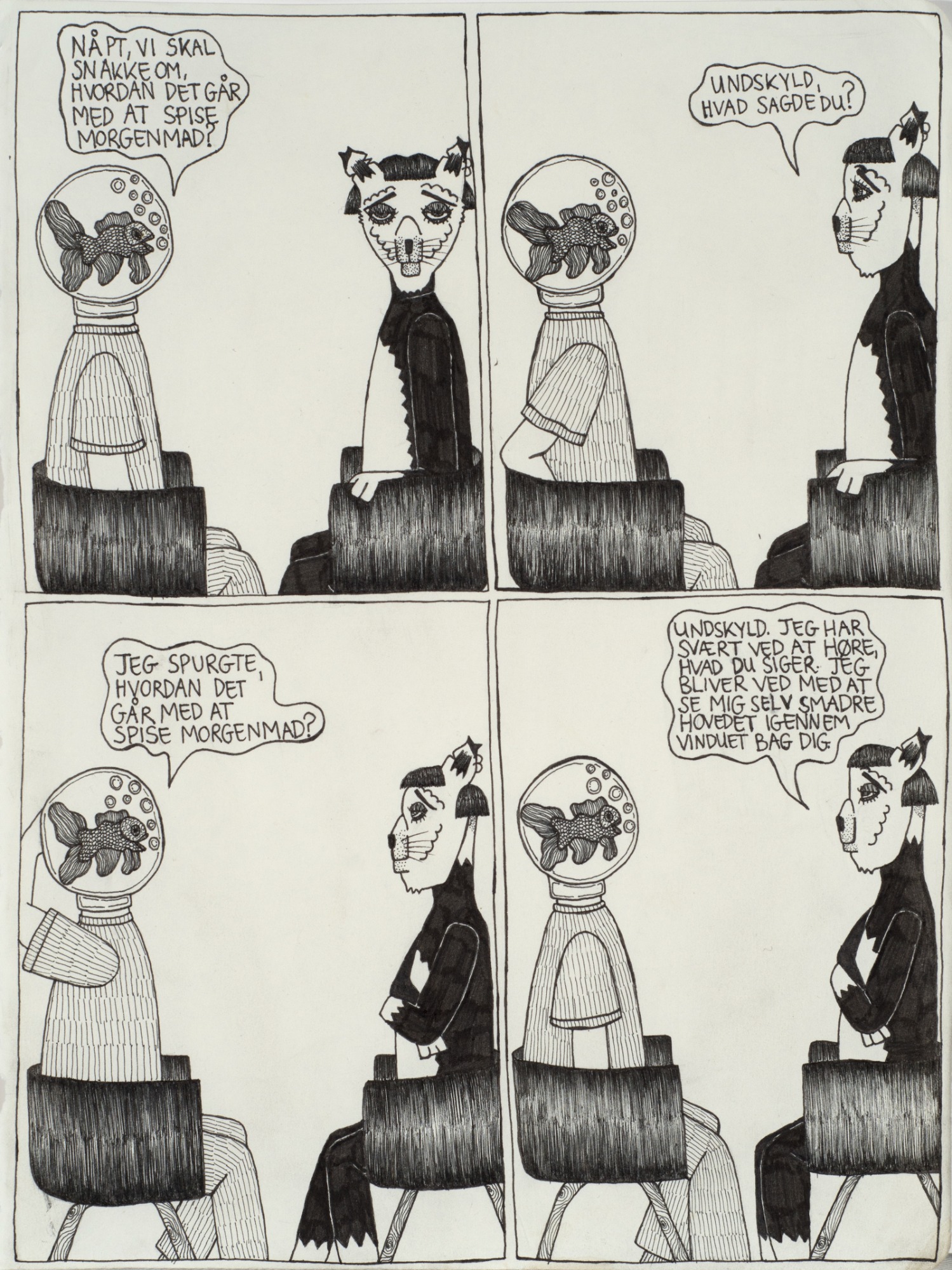
© Agne Gye
LM: I hate this question ;) But I like you, so.. No, I don’t believe in new institutions. I would never trust institutions again. There is a Kafka-quote that I keep mis-quoting. Or Walter Benjamin quotes Max Brod's account of a conversation with Kafka. Brod says: “Then there is hope outside this manifestation of the world that we know.” And Kafka: “Oh, plenty of hope, an infinite amount of hope – but not for us.” I remembered it as "but not for me". And that is what I would answer here; there is hope outside of the manifestation of psychiatry as we know it. But not for me.
And I have no idea how to establish institutions of care and accountability without it reproducing asymmetrical power relations. I don't know how we escape the historical construction of the mad person as someone whose account of the world can always be overruled, or the psychiatrization of society more generally. And perhaps I am suspicious of the demand that those of us who critique psychiatry should also be able to design its replacement. GALT! does not contain a blueprint. Refusal is not a blueprint.
What could hope look like? Perhaps I need to think about hope differently. Not as hope in an institution, but as the possibility that relations can be organized otherwise. Maybe hope is disturbance. When somebody refuses the position they have been assigned, and relations where care does not require obedience. You care. And perhaps this is also what the disturbance and willfulness of GALT! points towards. Willfulness is oppositional, yes, but opposition is not necessarily without direction. To refuse the path one is being forced down is already to insist that another path must be possible, even if I cannot yet describe it.
There may be an infinite amount of hope. For me, hope cannot be trust. It cannot be reconciliation with psychiatry, and it cannot be a better institution that I am able to imagine from where I stand. It is much smaller, a blink, it is the insistence that we exist. That Caroline is in her thread. And that you are there at other end of this mail-thread. That I was broken but still breathing. And that I have love.
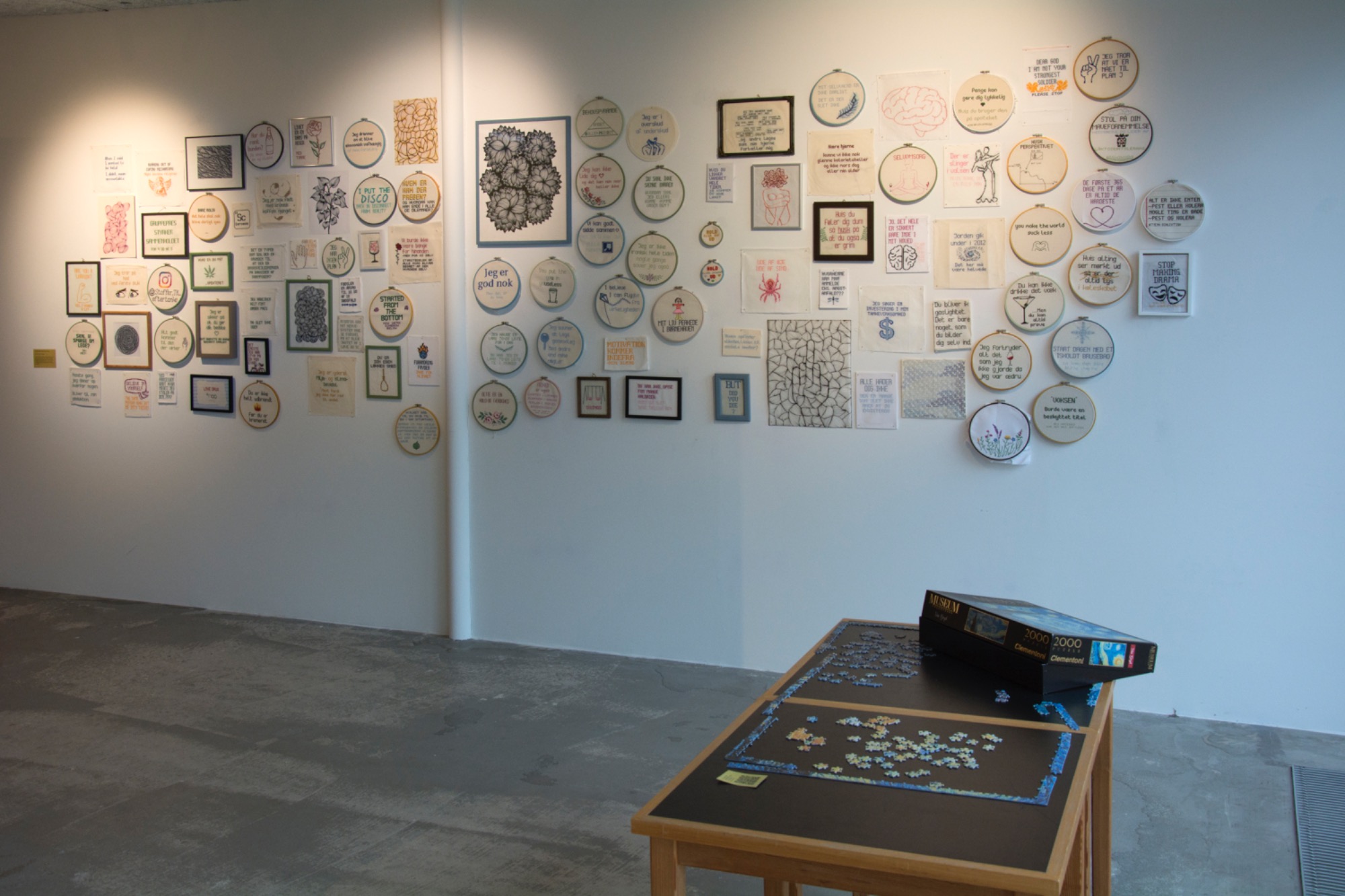
GALT! exhibition, Museum Ovartaci, 26 February to 17 May 2026
Brian Benjamin Hansen is a philosopher, curator and researcher at VIA University College where he leads a research-program on Social and Cultural Change. His work engages with psychoanalytic theory and practice, the history of psychiatry, aesthetic theory and practice, and cultural analysis. He hosts the philosophy podcast I teorien together with Anders Ruby and Henrik Jøker Bjerre. His latest book is Ovartaci: The Signature of Madness (Aarhus University Press, 2022) and most recent article is “The Other is Right! On Epistemic Injustice and Psychoanalysis” (Lamella, No. 10, 2026). Forthcoming is GALT! (Museum Ovartaci 2026), a book/catalogue co-edited with Lea Muldtofte.
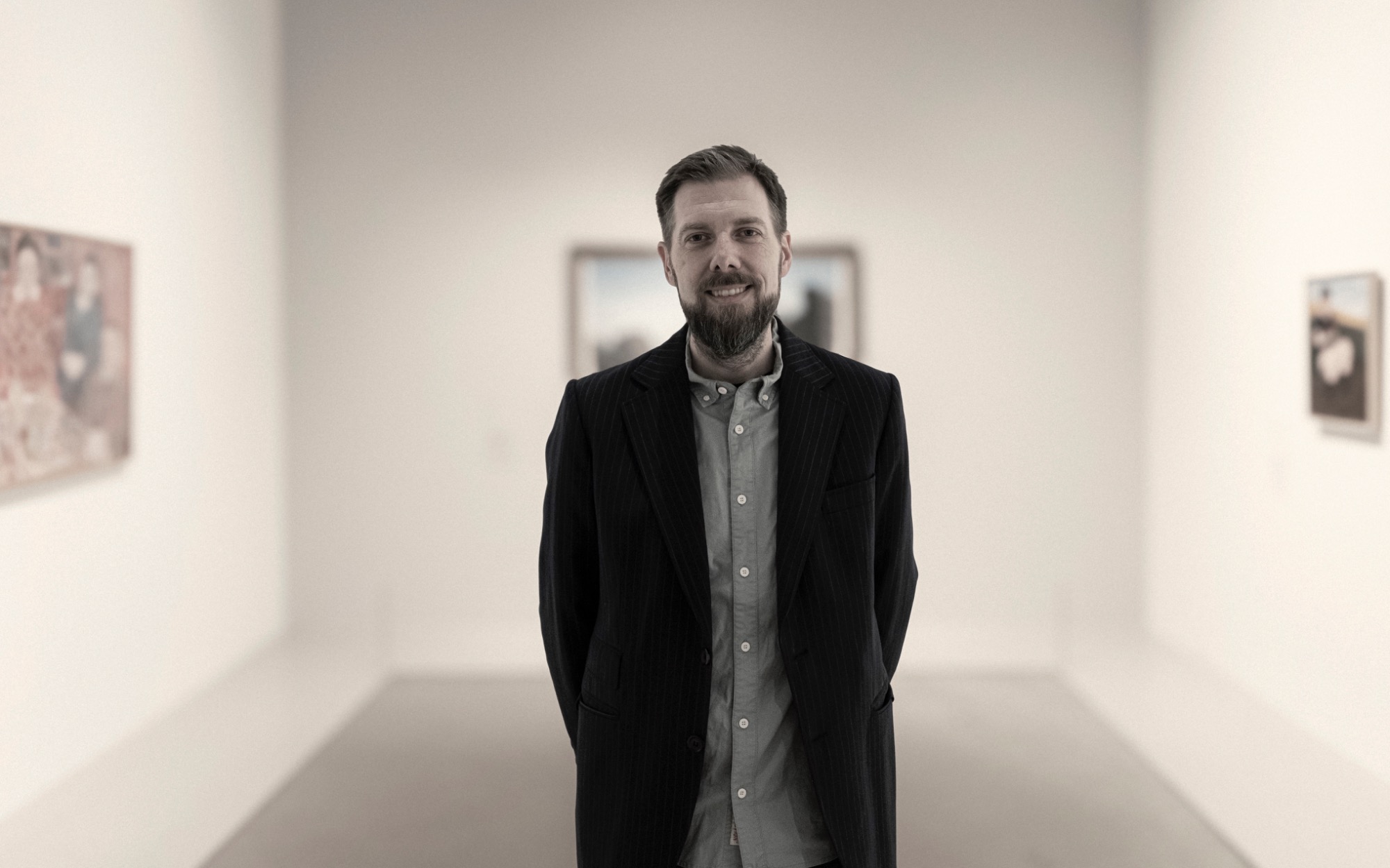
Lea Muldtofte, PhD, is an assistant professor. Her research moves in the intersection of Mad Studies, post structuralist and affect theory, critical psychiatry and artistic methods with an emphasis on epistemic injustice and lived-experience scholarship. Across these fields, she is concerned with questions of knowledge and power like whose experiences become knowledge, who is recognized as credible knowers, under what conditions marginalized knowledge becomes institutionally intelligible, and what kind of social and professional consequences the speaker of marginalized knowledge risks. She is the author of the novel "On Forsaking" in which she offers a systemic critique through a raw, matter-of-fact prose. She is also one of the three artists in the exhibition GALT!, which she also co-curated with Brian Benjamin Hansen. This interview is written from a situated and explicitly non-neutral position.