Q & A with
Henrik Jøker Bjerre
18.10.2026
1)We would like to begin, where your essay ends. In your reading of Lacan and the lie, you conclude with the statement, that an ear for the lie might make us interpret political movements differently? Can you say a bit more about this?
Some years ago, Alenka Zupančič said that the left had been too preoccupied with being right for a very long time. I think this was a brilliant expression, because it has a very precise double meaning: Politics has become a competition about debating and defeating your opponents to promote your own party or candidacy or even movement. Simultaneously, the left has adapted more and more of the economic and cultural policies of the right. We have seen some resurgence or even reinvention of a more progressive politics in recent years, but I think that her diagnosis still to a large extent has meaning. Why not be wrong for a change, like she said? I think this relates to what I was trying to say in the essay. Politics should include the ability to take seriously what other people are saying. You don’t have to agree with your opponent, of course, nor should you just accept a fake meta-neutrality that “agrees to disagree”. No, you should try to listen for a truth in your opponent’s speech – and indeed including truths that they might not be aware of themselves. What if they are saying something that you really need to know, but you can’t hear, because you are only listening for their inconsistencies and “weak points”? Take immigration, for example. After being “right” for some years in the sense of insisting on universal principles, respect for cultural differences, the left has turned right, politically, certainly in Denmark, for a decade or two. But it seems like there should be an alternative that has never seriously been sought: What if the critics from the right have valid points and worries, which, however (and this is crucial), you do not have to accommodate literally?
2)You have been part of Center for Wild Analysis? How would you describe this project and what was its purpose?
The Center for Wild Analysis was a philosophical collective that wrote two books, produced a national radioshow for one year, and had a weekly column in the newspaper Information for 13 years. Its purpose was, to put it as shortly as possible, to make the public think, and the collective expression was a central part of this ambition. We wanted to create interventions that made it possible for readers and listeners to focus less on the identities and interests of the people behind the writing and talking and instead focus on what was being said. (And to make people think, we made use of classical philosophy and psychoanalytic theory to analyse contemporary phenomena and discussions). During one public lecture, we were asked about our political position, and I think our answer was rather precise: The form of the enunciation is our political position, i.e. we speak collectively, because we believe in collective decisions and responsibility. At one point, however, we became aware that the project would have its expiration date, and we started thinking of it as one long intervention, which eventually lasted some 17 years – from 2006 to 2023.
3)Your new book in Danish is entitled The Postacademic University. What is the university today, and what is “postacademic” about it?
The university is a very old institution that is going through a kind of identity crisis of its own. The term ”postacademic” has been used by a couple of other people before, but I use it specifically to indicate that I am worried that academic work, strange as it may sound, is in danger of being expelled from the university altogether. By “academic work” I understand a collective endeavour from researchers and students to investigate and explain the world. This crisis has many causes, and I try not to single out one, specific motivation or reform or event to explain what has happened, but it has to do with new public management, anti-intellectualism, bureaucratization and commodification. The university has become a kind of pseudo-corporation, and its leaders are behaving less and less like curators of culture and science, and more and more like business leaders or municipality directors with the assigned task of supporting wealth-creation and employment. The book does not have many concrete policy suggestions for how to change this course, but I am trying to engage more in such discussions now, and recently I have been thinking about a lesson I was once taught by a Russian friend. Back in the 1990s, when everything was quite open and unstable in Russia and the neighbouring states, I asked him if he didn’t think that Russia was big and stable enough to get through the disturbances of these tumultuous times. Alexey, as he was called, looked at me and said: “No, you don’t get it. Russia is surely old and stable enough to overcome the turbulence and disturbance that was the Soviet Union!” I think we have to (convince ourselves to) look at the university in a similar way and consider the nomenclature of the contemporary regime to be only a short disturbance on the historical path of the university.
4) In your new book, you often move between high theory, such as Immanuel Kant, and very concrete examples. For example, you describe various student movements, such as the Occupy movement, as sites for the “public use of reason.” Can you explain what you mean by this term?
In his short essay on enlightenment from 1784, Kant distinguishes between a “public” and a “private” use of reason. Some interpreters find his explanation of this distinction rather confusing, but I think his point is quite precise and extremely relevant today. By private use of reason he roughly means the ways we reason and deliberate, when we are taking care of ourselves and our place in the world, i.e. when we are making use of our capacities to further aims that are defined by own interests in the expanded sense that it includes the interests of e.g. our workplace, even the state. Public use of reason, on the other hand, is what we do when we reason merely for the sake of finding out, establishing what is right and wrong, etc. The university should be the peak institution for defending and making concrete public use of reason, but unfortunately, it has become so absorbed by competition, corporate thinking, career paths, and external interests that it sometimes seems like the private use of reason is the only one that is made. Student movements sometimes have the ability to remind us of the public use of reason, and some of the “occupy” movements that we have seen take it very literally that we need to liberate and protect spaces for the public use of reason, where we try to think about truth, justice, right and wrong, for the sake of this activity alone.
5) In your new book, you also present the provocative thesis that the university today makes us more “artificially stupid”, drawing inspiration among others from Aleš Bunta. What does this mean, how does the new university make us stupid (and even artificially so?).
Bunta wrote a book on artificial stupidity quite some years ago now, in which he made a brilliant counterpoint to the big worry about “artificial intelligence” that has since exploded. In one lecture a little bit later, he distinguished between artificial stupidity of the first and the second order in a way which I found highly useful. In artificial stupidity of the first order, you make yourself more stupid than you really are. We find that in the research application for example, where you must present your ideas in a way that does not scare any evaluators away or sound like you just want to be left alone to do your own reading for a couple of years. The danger here is that you end up limiting what you can actually engage with and how open-ended it can be thought. But we also know the first order-stupidity from everyday life. In meetings, for example, when a leader shares their thoughts, you have to make sure that you agree and show your appreciation, even if you are secretly rolling your eyes on the inside. Artificial stupidity of the second order occurs when you actually start believing what the leaders are saying, or what you are saying yourself, if you are a leader. This is what happens, when a businessperson says things like “We in our company believe that…” after being employed for just a few years at a certain place. I would say that you have to be artificially stupid in the first sense to even survive in the university today, but I am afraid that artificial stupidity of the second order is quickly becoming even more important. Most of the higher officials must certainly to a significant degree convince themselves that they are on the right path, but I think it has become much more pervasive than that. We have already seen a couple of decades of intensified stupidity, and I think it must be extremely difficult as a young researcher today not to be simply taken in by this way of thinking.
6)Partly because of your engagement with the Ljubljana School, but also more broadly, can you say something about the relevance of Lacanian psychoanalysis to your work? What does it offer that “philosophy” cannot, or is that distinction itself a mistaken one?
I was convinced about the importance of psychoanalytic theory, when I first read Zizek 30 years ago. It was like seeing the world in a new light. The fundamental insight, of course, was that the subject is not as rational and transparent as we would have liked to think, but the implications are far wider. The very concept of the unconscious, in the way that Freud conceived it, changed the conditions for thinking about subjectivity, thought, reason, action, and a host of other concepts, even truth and being. I don’t see psychoanalysis as a particular kind of discipline or branch, or even as distinctively separate from philosophy, but rather as a reorientation in thinking (with clear affinities to Kant, Schelling, Hegel, Kierkegaard, Nietzsche, among others). I have been in analysis myself, but only for a couple of years. I don’t know if I really ended it, except that, like Freud said, analysis is over when you stop meeting for the weekly session.
7)What is your next field of research? What comes after The postacademic University?
Well, like I said, I want to engage a little bit more with the discussions of the future of the university, but this will not exactly be a part of my research as such. Instead, I will probably move back to my very old project about Kierkegaard. I have a book project more or less shaped but am still rewriting most of the chapters every now and then. Also, I expect to be interrupted again by other projects (which is my usual condition). One possible project could be a more serious engagement with the problem of lying, which was actually inspired by a group of psychologists and sexologists who wanted some philosophical inspiration for their work with sex offenders. I think the problem of lying raises a number of philosophical questions in almost all of personal and cultural life.
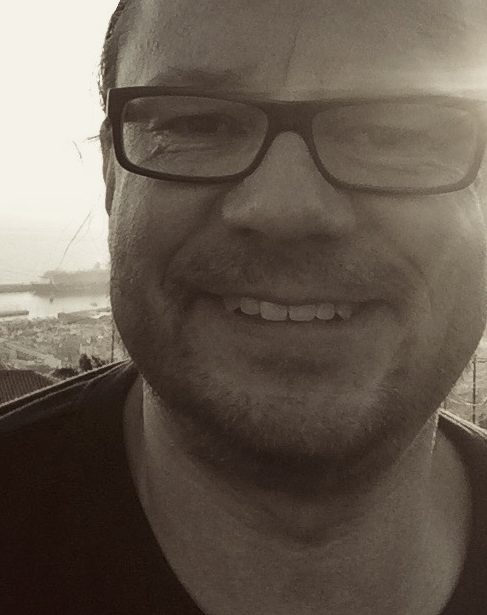
Henrik Jøker Bjerre is Associate Professor of Applied Philosophy at Aalborg University. He has worked with Kant, Kierkegaard, Lacan, and the Slovenian School. For 17 years, he was part of the philosophical collective Center for Wild Analysis. Together with Brian Benjamin Hansen and Anders Ruby, he hosts the podcast I teorien, which produces theoretical takes on everyday cultural symptoms. He has co-authored a number of books and himself published Kantian Deeds (2010), Analysér! (2015) and Det postakademiske universitet (2026).