Essay by Jakob Rosendal
The Disruption of the Gaze, the Translation of the Gaze
Transgender (In)visibility in Three Drawings by Agne Gye
14.9.2026
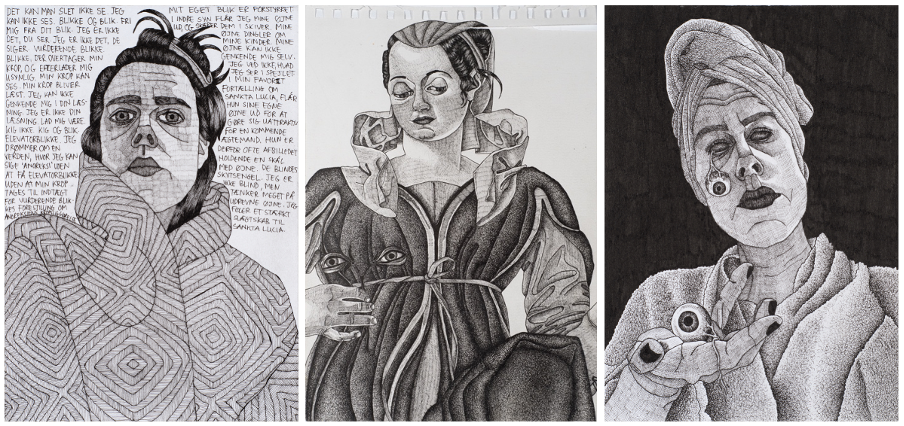
Agne Gye, Untitled, self-portrait with text, 2022.
Agne Gye, Untitled, self-portrait with eyes torn out, 2022.
Agne Gye, Untitled, depiction of Saint Lucy, 2022.
In many of their works – whether comics or individual images – Agne Gye draws themself looking out of the picture, addressing the viewer with a gaze directed straight at them. We see the artist seeing us, and we see the artist seeing themself. Agne Gye’s gaze is simultaneously an observation of the self and an observation of the viewer. This gaze, and this parallel and double exchange of gazes between artist and viewer, already raises questions about what is at stake in the act of seeing and about the possibility of seeing the other and seeing that which cannot be seen. What or whom can a particular gaze see, and what or whom can it not see? Is it possible to perceive that which, or the person who, cannot be seen? And is it precisely the disrupted – the mad – gaze that enables us to see the invisible, the barely visible, or the not-yet-visible?
Agne Gye’s autobiographical drawings examine the self and its relationship to the surrounding world. In diary-like comics, they depict their hospitalisations in a psychiatric institution and their everyday life outside of this psychiatric setting. We learn that Agne Gye suffers from anorexia, anxiety, and schizophrenia and is plagued by fantasies about food and by inner images of self-harm and dissolution. We are also given insight into Agne Gye’s life as a nonbinary transgender person who uses the Danish pronouns “den” (“it”) or “de/dem.” (“they/them”). Psychiatry is shown as incapable of seeing and listening – either to the patient’s accounts of their own suffering or to their gendered existence. Although the staff are occasionally shown to be caring, the psychic disorders are repeatedly neglected, while being transgender is met with persistent resistance or transphobia. Transgender identity is pathologised, the chosen pronouns are repeatedly rejected, and there is a cisnormative insistence that one must belong to one of two genders.[i]
At the same time, hospitalisation in psychiatric institutions also results in new friendships with other patients, who know how to listen and help when the psychic suffering becomes overwhelming and who do not oppose being transgender. The drawings of everyday life outside psychiatry likewise show how Agne Gye is plagued by phantasmatic images of food and the destruction of the body, and how friends and lovers see and affirm Agne Gye in images of trans joy and trans love. Across Agne Gye’s drawings, then, we find various complex and moving representations of transgender invisibilisation and visibility.
The drawings thus unfolds a situation and tension between what trans-scholar Jack Halberstam has called a transgender look and a transphobic gaze: a more intimate seeing with and an institutional seeing at and wanting not to see.[ii] But between this look and this gaze, a third decidedly more psychoanalytic kind of vision occurs, a symptomatic gaze, a disrupted and disruptive gaze. Agne Gye manages to translate this third gaze or to turn it into a (symbol of their) transgender look, which allows for both the mitigation of its disruptive force on a personal, psychic level and, vis-à-vis the transphobic institutional gaze, the insistence of a disruptive trans-existence.
Here, I will highlight three drawings – two self-portraits and one portrait – which do not explicitly or immediately concern being transgender but which nevertheless, I will argue, testify to Agne Gye’s criticism of and resistance to transphobia, and to the way in which they employ their disrupted gaze to affirm and insist upon themself as transgender.
Between the Judging and the Disrupted Gaze
In one of Agne Gye’s self-portraits, surrounded by text, they look out of the picture and down towards the viewer (fig. 1). The gaze appears calm yet insistent, welcoming yet gravely inquisitive, gentle yet confrontational and questioning. On either side of this self-representation, the background is filled with text that positions Agne Gye between two kinds of gaze.
On the left-hand side of the image, the judging gaze is presented as a gaze that physically invades the body: “Judging gazes […] take over my body.” It is a gaze directed at the visible body, a gaze that sees the body and subjects it to an interpretation: “My body can be seen. My body is being read.” This is made concrete in relation to anorexia, where the judging gaze is characterised as an “elevator gaze” that moves up and down the exterior of the body in order to see and read its anorexic form and assess it according to a preconceived “notion of the embodiment of anorexia.”
At the same time, it is a gaze that does not see and therefore misreads: “I am not what you see. […] I am not your reading.” Through this gaze’s inability to see, or its insistence on not seeing, it has an invisibilising effect upon that which it does not or will not see: “I cannot be seen. […] Judging gazes […] leave me invisible.” For this reason, Agne Gye also asks to be released from and resists this gaze: “Spare me your gaze. […] Leave me alone. Do not look.”
The text in the self-portrait begins with the sentence, “You cannot see it at all.” From the outset, then, the question arises as to what this “it” is that cannot be seen. The text’s first explicit answer is a different form of anorexia, one that, unlike our conventional images of the anorexic body, does not possess the same immediate visibility. But what cannot be seen is also Agne Gye’s gendered existence, their nonbinary transgender identity, and the judging gaze is implicitly also the transphobic gaze—which is explicitly drawn in Agne Gye’s black-and-white comic Ballerup, balleren, balladen: Også kaldet: Scener fra indlæggelser (Ballerup, balleren, the trouble: Also Known as Scenes from Hospitalisations).[i]
For the transphobic gaze is also a gaze that cannot or will not see – a gaze that cannot or will not see transgender existence and that insists upon a reductive, cisnormative, and often biologistic understanding of gender that recognises only two unambiguous and clearly separate entities. Everything that does not correspond to this gaze’s preconceived notions of the embodiment of gender disrupts this anxious gaze, which consequently seeks to render invisible that which exceeds its narrow binary framework. (See, for example, the full-page drawing from Ballerup, balleren, balladen entitled “Transphobia in Psychiatry,” which provides examples of the staff’s endless invisibilising and transphobic comments.)
On the right-hand side of the image, the second half of the text presents the disrupted gaze as Agne Gye’s own inner vision: “My own gaze is disrupted. In inner visions, I tear out my eyes and cut them into slices.” Through the disrupted gaze, a body in dissolution is seen, in which the boundaries between the self and the surrounding world and between interior and exterior become blurred, and in which the body is quite literally beside itself.
These inner images of dissolution and self-destruction overcome Agne Gye; they are not images they consciously evoke. In other words, the images appear to concern what psychoanalysis calls the unconscious. As one of the scenes in Agne Gye’s comics states, it is “schizotypy” that, as the active subject of the sentence, “places macabre films before my inner eye.” It is another psychic agency – the unconscious, the schizoid disorder and its fantasies as phenomena concerning the unconscious, as reactions to something unconscious – that evokes the gaze’s uncanny visions.
The disrupted gaze testifies to the disturbance of conscious vision by the unconscious and brings about the momentary collapse of the conscious ego as a recognisable psychic and bodily entity. Struck by the disrupted gaze, Agne Gye is no longer able to see themself and becomes unrecognisable to themself: “My eyes cannot recognise me. I do not know what I see in the mirror.” The unconscious does not constitute a determinate content but rather the site at which the habitual contents of consciousness break down.
The sentence “My eyes cannot recognise me” from the right-hand side of the self-portrait appears to repeat a sentence from the left-hand side of the image: “I cannot recognise myself in your reading.” In both instances, the self is unable to recognise itself, whether this is caused by inner visions or by an external interpretation. Both the judging and the disrupted gaze result in non-recognition, whether because of an unwillingness to recognise or because of the collapse of that which is recognisable.
Through its division into a left-hand side for the judging gaze and a right-hand side for the disrupted gaze, the text seems, by means of this very separation, to say something about their connection. The echo between the two sentences might therefore be read as testimony to a perhaps not entirely conscious – or at least not explicitly articulated in the drawings – causal connection between the two gazes. Is one gaze the echo of the other? Is the judging gaze the cause of the disrupted gaze? Is the disrupted gaze an effect of the transphobic gaze?
As an anxious gaze, and as a gaze that is at times paranoid, the transphobic gaze may itself be characterised as a disrupted gaze, but also as a gaze that works to pass the disruption on. As a socially – and, within psychiatry, apparently institutionally – dominant gaze, it is often the invisibilising character of the transphobic gaze that, as a symbolic but no less concrete form of violence, risks having a disruptive effect upon those who are subjected to it.
The final part of the text on the right-hand side moves from the statement that Agne Gye is unable to recognise themself to their recognition of themself in another, from being unable to see their own reflection to seeing themself reflected in another. This other is the Christian saint and martyr Saint Lucy, who has been represented in images and texts in a wide variety of forms extending back to the fifth and sixth centuries.
In Agne Gye’s drawings, the religious dimension does not appear to be significant. Instead, they are drawn to the fact that Lucy tore out her eyes and to the reason she did so: “In my favourite story about Saint Lucy, she tears out her own eyes to make herself unattractive to a prospective husband.” The fact that they share this macabre act causes Agne Gye, as the text’s final sentence states, to feel “a strong kinship with Saint Lucy.”
The text ends here. In contrast to the left-hand side of the self-portrait, however, where there is barely enough space and the text presses against Agne Gye’s right shoulder, the text on the right stops well before reaching their left shoulder, thereby leaving an empty white space at the point where the image may be said to end. This empty space opens up and emphasises the question of what follows from, or accompanies, the kinship that has just been established: the question of what this mirroring in Saint Lucy does to the disrupted gaze.
The Disrupted Gaze as a Transgender Gaze
This kinship appears to make it possible to do something with the disrupted gaze, so that the disruptive and disrupted character of this gaze can assume a different form and become something other than pure disruption. The disruptive disruption can become a creative disruption.
It is a beautiful example of what psychoanalysis calls sublimation, in which unconscious wishes and drives – here the urge to tear out one’s own eyes and cut them into pieces, and the death drive’s dissolution of the ego – are suspended or redirected along new paths, through which they are transformed into something else, something less disruptive and more liveable. The kinship with Saint Lucy as a culturally significant figure makes it possible to inscribe the disruptive gaze within images and narratives that can give it a new meaning.
As such a figure, Lucy gives form to otherwise formless dissolution, and as a cultural sign, Lucy gives content to the incomprehensible and contentless disruption of the unconscious. Drawing on the psychoanalyst Jean Laplanche, we may also say that Saint Lucy makes possible the translation of the unconscious as an incomprehensible, enigmatic noise within the communication between people.[ii] The disrupted gaze is translated through Saint Lucy’s gaze.
This does not mean that the contentless and meaning-disrupting character of the unconscious is now translated without remainder or shown to possess a final meaning. Rather, translation invests the disruption of the gaze with a certain meaning, a provisional meaning, through which the disruptive is transformed into something potentially more usable and more liveable.
There is something about the image of Saint Lucy that already appears, in itself, to testify to the possibility of taking care of that which disrupts. As Agne Gye points out, Lucy is “often depicted holding a bowl containing eyes.” This way of representing Lucy, which is widespread in the history of Western Christian art, shows how the destruction of the body as a container is embraced and held within a new container: the bowl. Self-harm is transformed into an attribute, destruction into a symbol. Lucy’s torn-out eyes become the iconographic motif by which she is identified. The self-destructive becomes self-affirming.
And is this not also why Lucy is often depicted with new eyes in her face while holding the torn-out eyes before her? Agne Gye likewise represents this in a drawing that reworks the Renaissance painter Francesco del Cossa’s Saint Lucy of approximately 1473–74. Here, Lucy looks down with new eyes at the plant she holds in her right hand, whose two flowers are her torn-out eyes (fig. 2).
These eye-flowers appear in themselves to provide an apt image of how the disruptive unconscious may be used to sublimate, to create something new, how it may be translated and transformed so that something suppressed and repressed is released. The torn-out eyes provide access to a new gaze; they affirm another possible gaze. Saint Lucy’s gaze makes it possible to see anew and to see that which has been rendered invisible.
In Agne Gye’s retelling of the legend, we hear how Saint Lucy “tears […] out her own eyes to make herself unattractive to a prospective husband.” By destroying her own sight, she destroys what her future husband sees, or expects to see, in her. Lucy’s act is an act of resistance to the man’s image of the attractive woman.
Following transgender scholar Susan Stryker, if we understand transgender as involving a “move across (trans-) the boundaries constructed by […] culture to define and contain […] gender,”[iii] then something transgender may be said to characterise Saint Lucy. Although she remains a woman, she nevertheless crosses a gendered boundary: she opposes the male gaze’s image of woman and thereby moves away from normative femininity and towards another femininity. She moves from one vision of womanhood to another – her own new vision. The violence directed against her own eyes concretises a resistance to the other’s gaze, while simultaneously heralding the realisation of other possibilities, which the new gaze both concretises and symbolises.
Agne Gye’s kinship with Saint Lucy therefore consists not only in their most explicit similarity – their similarly violent treatment of their eyes – but is also based, more implicitly, upon their related resistance to the gaze of the other and their insistence upon remaining in motion in relation to normative conceptions of gender.
It is not only their evident self-destruction, their disrupted gazes, that connects them, but also their creation of something by means of this self-destruction: their ability to create a different gendered existence. Where Saint Lucy resists the male gaze and insists upon another femininity, Agne Gye resists the transphobic gaze and insists upon their own nonbinary transgendered existence.
By employing Saint Lucy as a cultural figure, Agne Gye is thus also able to translate their disrupted gaze, their schizoid fantasies of tearing out their eyes, and, through this translation, to transform the disrupted gaze into a transgender gaze.[iv]
In another self-portrait, Agne Gye depicts their inner macabre vision, their disrupted gaze (fig. 3). The framing and perspective are almost the same as in the first self-portrait discussed above. Once again, Agne Gye looks outwards and down towards the viewer. Both of their eyes still appear to be looking at the viewer, but the right eye now hangs from its socket, while Agne Gye holds their left eye out towards the viewer with their right hand.
At a cursory glance, this self-portrait might appear to be merely a visualisation of the disrupted gaze. When compared with Agne Gye’s representation of Saint Lucy, however, it becomes clear that the self-portrait also depicts their kinship. Wearing a dressing gown and a towel around their head, Agne Gye recreates something resembling Lucy’s flowing robes and headdress. And just as Lucy holds her eye-flowers before her in her right hand, Agne Gye displays their torn-out left eye with their right hand, which is extended towards the viewer like a small bowl in a manner that is even more intrusive, demonstrative, and confrontational than Lucy’s gesture.
At the same time, it becomes clear that this kinship has a calming or healing character. However macabre the image may be, it contains a certain elevated tranquility: Agne Gye does not appear disturbed but composed and concentrated. It is an image of focused address. Here, the disrupted gaze is also the focused gaze.
The disrupted gaze is represented and offered as the possibility of another gaze: as Agne Gye’s gaze, which sees what cannot be seen at all, which sees what the other’s gaze—the transphobic gaze – seeks to render invisible. The self-portrait is therefore a portrait of mirroring, in which the self is represented as another, and consequently also a portrait of translation, in which the disrupted gaze is transformed into a transgender gaze.
[i] Arguing against such normative institutionalised discourse I am inspired by the work of psychoanalysts Patricia Gherovici, Avgi Saketopoulou and Ann Pellegrini working at the intersections of Lacanian and Laplanchian psychoanalysis, queer theory, and trans studies. For their critique of psychoanalysis (as a field and an institution) see for instance Patricia Gherovici, “Psychoanalysis Needs a Sex Change”, Gay & Lesbian Issues and Psychology Review, vol. 7, no. 1, 2011, pp. 3-18 and Avgi Saketopoulou and Ann Pellegrini, Gender without Identity, The Unconscious in Translation, 2023.
[ii] Jack Halberstam, “The Transgender Look”, in In a Queer Time and Place: Transgender Bodies, Subcultural Lives, New York University Press, 2005, pp. 76-96.
[iii] Ballerup is the name of a small city near Copenhagen where the psychiatric institution, Psychiatric Center Ballerup, is situated. The expression “balleren” is a nickname for that institution, and so is “balladen”, which translates as “the trouble”. The title thus display a movement from institution to trouble, and implicitly from the transphopbic gaze to the disruptive transgender look.
[iv] Jean Laplanche, New Foundations for Psychoanalysis, translated by Jonathan House, The Unconscious in Translation, 2016.
[v] Susan Stryker, Transgender History: The Roots of Today’s Revolution, Seal Press, 2017 (2008), p. 1.
[vi] As far as I know, Saint Lucy is not a widespread mirror-figure nor a widespread symbol for trans people. Agne Gye’s connection to Saint Lucy is to be sure a very personal one, in so far as it is founded on their singular symptomatic fantasies of dissolution or self-destruction. I know of only one other example, where the possibility of relying on Saint Lucy to translate and metabolise the sexual unconscious and to symbolise transgender existence is made manifest. That’s in the Spanish movie 20,000 species of Bees (20.000 species de abejas). It premiered in the beginning of 2023 and was made during 2022, that is the same year that Agne Gye drew the self-portraits and her version of Saint Lucy.
Jakob Rosendal is an art historian, researcher at Randers Art Museum, and an analyst at the Institute for Wild Analysis in Aarhus. He is currently working on a three-year project focusing on the Danish artist Sven Dalsgaard’s (1914-1999) explorations of what could perhaps best be called the polymorphic sexual image. His research is situated at the intersections of semiology, psychoanalysis, queer theory, trans studies, and art history/visual culture and often combines with an exhibition practice. He has worked on everyday images and their overlooked signs and ideological fantasies, gender and sexuality in images of children, and the art historical and visual cultural unconscious. In collaboration with KØN: Gender Museum Denmark he simultaneously curated and published the same-titled exhibition and book Barnestreger: Køn og seksualitet i børns tegninger (Crossing Lines: Gender and Sexuality in Children’s Drawings) (Passepartout, 2020). In English he has co-edited and/or contributed to the anthologies Analysing the Cultural Unconscious: Science of the Signifier (Bloomsbury, 2020) and Alt Kid Lit: What Children’s Literature Might Be (University Press of Mississippi, 2024).