Book excerpts by Lilian Munk Rösing, translated by Søren Larsen
Tove Ditlevsens veje[i]
28.12.2025
The Working Class Living Room
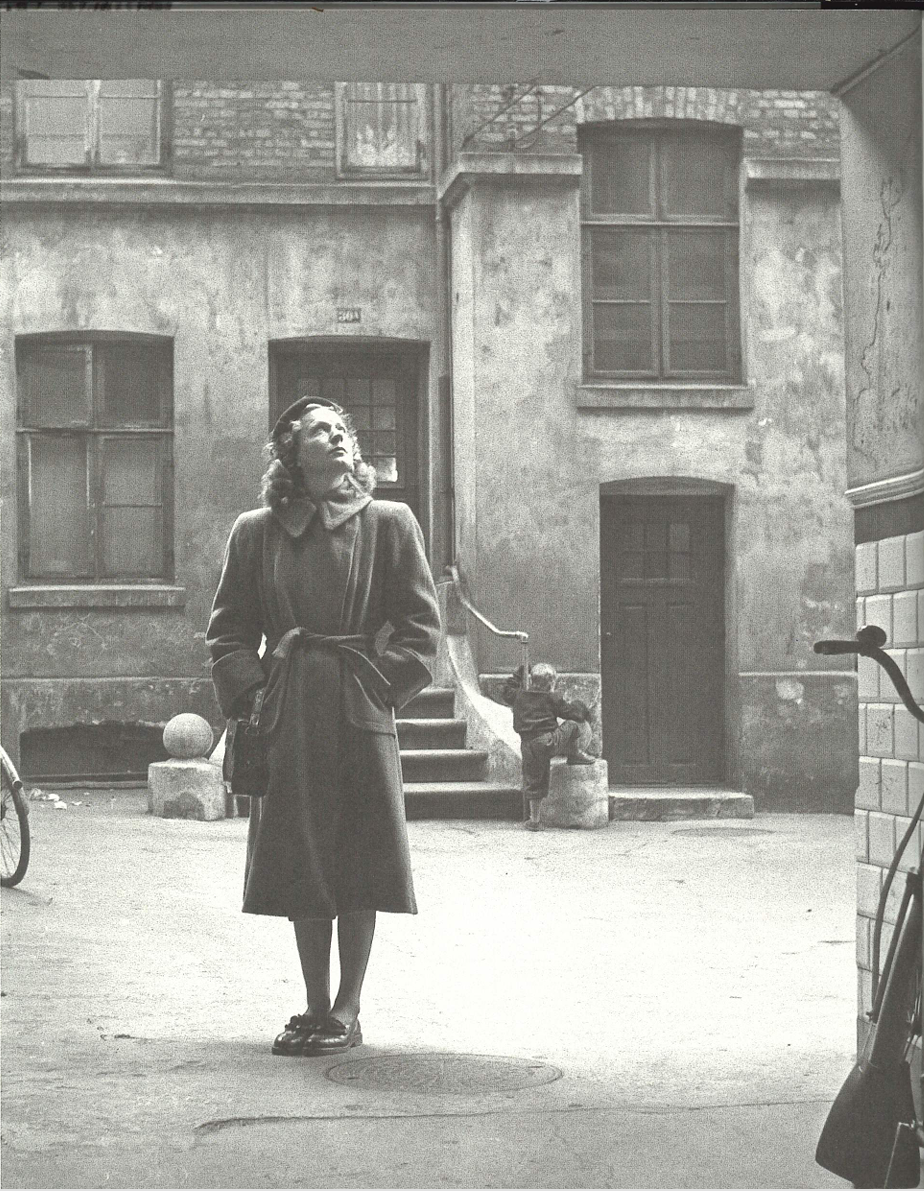
After I had written down the address “Hedebygade 30A”, I went there. I rose from my window ledge in Christianshavn[i], where I had been sitting and writing on this spring morning. I put on my green suede lace-up shoes with light crepe soles, my trench coat of caramel-colored leather, and a mint-colored beret. The closest I could come to a look resembling TD[ii] as she appears in the photograph in which, as an adult, she stands in the courtyard in Hedebygade and looks up at her childhood home. Later I read that she is looking quite precisely up toward the bedroom. That is to say, she is looking up toward the very window ledge where she herself sat as a child and looked down into the courtyard. This exchange of glances between the young girl and the adult woman is a characteristic figure in Ditlevsen’s authorship. Perhaps it is most condensed in the poem “There lives a young girl in me who does not want to die,” where the young girl, who the poet once was, stares at her “from the mirror of the lake of the eyes” and asks how things have gone with dreams and joy.
Hedebygade was paradisiacally peaceful on this sunny yet cool late-April morning. Noise in Istedgade, with crowds of people at the sidewalk cafés in the sun. Noise on Enghavevej, a thoroughfare for bicycles and cars. But in Hedebygade a blessed stillness, only the soft sound of church bells striking eleven, and sunshine on the side of the street where 30A is located. In fact, unsuitable weather; in TD’s books the street of childhood is associated with rain. At one end of the street now lies “Tove Ditlevsen’s Square,” (Tove Ditlevsens Plads) at the other end a kindergarten bearing the name of one of Ditlevsen’s novels: The Street of Childhood. (Barndommens gade). A small girl looks curiously out at me through the kindergarten window. For a moment she becomes that mirror in the lake of the eyes from which the child returns the adult’s gaze and asks what has become of joy. My chest feels heavy and burdened by vanished childhood—not my own, but my children’s. On my way, I crossed the playground in Skydebanehaven; I had entirely forgotten I so often took them there “Ah, if you only knew how grown my children are!” as the middle-aged Ditlevsen mourns.
The small working-class apartment. I think of it as a mythical place I carry with me from my own childhood. I likely know it from texts by and about TD, from photographs in history books, and I also clearly remember a reconstruction of a working-class home from an exhibition—I believe it was at the National Museum. I found it so cozy. This idea of children and adults sitting at the same small table (with a red and white checkered tablecloth), each occupied with their tasks: newspaper, handicrafts, homework. I grew up in a detached house myself and had my own room in which to do my homework, but I usually sat there longing for the shared living room and all the coziness I associated with it, feeling excluded from it, alone with my essays and arithmetic problems.
For a schoolgirl who feels lonely with her homework in her own room, this can sound enticing: “The living room is an island of light and warmth through many thousands of evenings, with the four of us always inside it, like the paper dolls on the wall behind the columns in the puppet theater my father made following a model in the popular weekly magazine, Familie Journalen. It is always winter, and outside in the world it is ice-cold, just like in the bedroom and the kitchen. The living room sails through time and space, and the fire roars in the tiled stove.”
In Ditlevsen’s final novel, Vilhelm’s Room (1975), loneliness is defined as the moment, when one no longer has someone with whom one can recall the living room of one’s childhood: “this island of a living room, which seemed to float somewhere between earth and sky and contained the three people who had shaped her fate for all time.”⁸ TD lost her mother at the age of forty-seven, her brother at fifty-two, and her father at fifty-four.
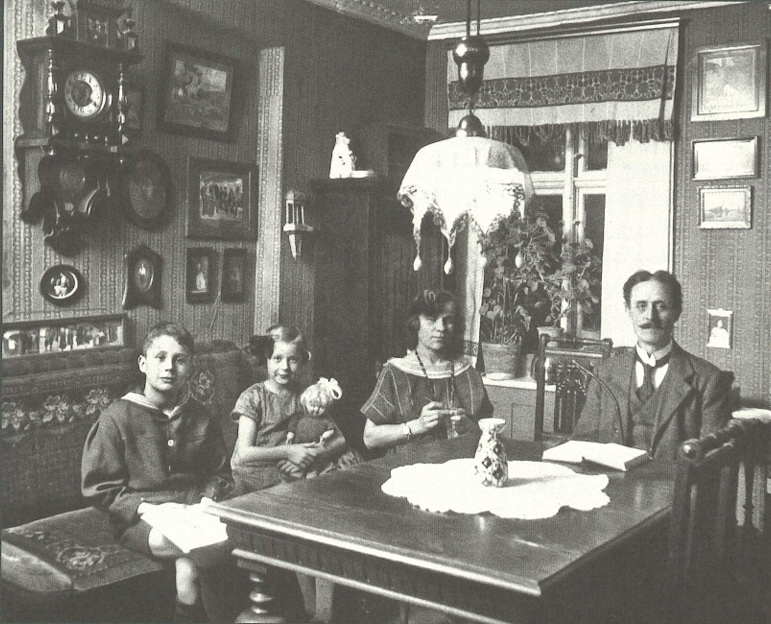
There is a photograph of the Ditlevsen family seated in the living room in Hedebygade: the working-class family gathered at the table in their very best clothes. The father is in his jacket, vest, and tie, with an open book on the table before him; in his lap beneath the table he holds the pipe whose long stem protrudes upward. The mother with her crochet work and bobbed hair, dressed in a modern short-sleeved dress with a bateau neckline and a long necklace. The children in a sailor suit and dress on the softly upholstered bench with flower-embroidered cover. The open book in Edvin’s hands mirrors the father’s book; the doll in Tove’s arms mirrors herself; both the doll and Tove have, on either side, a large, slightly shapeless bow in their hair—Tove’s is dark, the doll’s is white. The children look well-behaved, but also happy, proud of their family. Tove looks slightly mischievous, her mouth pressed together in a smile. They look at the photographer with open gazes. So does the father. Mother Alvilda’s gaze is blurred, lowered.
The interior is Biedermeier. High, carved chair backs and turned table legs. The wall is covered in patterned wallpaper and densely hung with pictures in wide frames and something resembling a Swiss cuckoo clock with carvings and scrollwork. The lamp above the table is draped with a dripping lace cloth with tassels, like a refined lady wearing a headscarf. The valance of the light-colored curtains has fringes and a black border of embroidered flowers; here the style may be more Art Deco than Biedermeier. On the polished tabletop stands a finely patterned porcelain vase on a white crocheted doily. (Was this the vase Tove later deliberately smashed? – as she describes it in one of her most famous poems, as a warning of her destructive nature) On the window ledge, there are lush potted plants. It is family idyll as puppet theater. But it is also the safe oasis that becomes a kind of encapsulated eternal space in Tove’s memory.
The older brother is the one, who is furnished with a book in the family photograph, not Tove. He bears the sign of being heir to the father’s literary interest. In the novel The Street of Childhood, it is also the older brother (there named Carl) whom TD equips with poetic talent rather than her alter ego (there named Ester). In Tove Ditlevsen on Herself, she writes that it is Ester who is “an artist’s soul in swaddling clothes,” but that she assigned the talent to the brother “solely in order not to cross with my mother.”⁹ The father was a reader—and he wrote diaries and a small memoir about his upbringing on the island of Mors. But it lay beyond his imaginative powers that his daughter, a girl, might become a poet. According to Childhood, he states directly: “A girl cannot become a poet!” when she, in her enthusiasm for the word “kummer” [trouble, distress. Ed.] (which she has read in one of his books by Gorky), expresses her own poetic dreams. In Childhood we read that the older brother Edvin nearly dies laughing when he finds her secret poems in the drawer. Yet, he is also the one,who believes in her talent and, through a friend, puts her in contact with an editor at the newspaper Social-Demokraten.
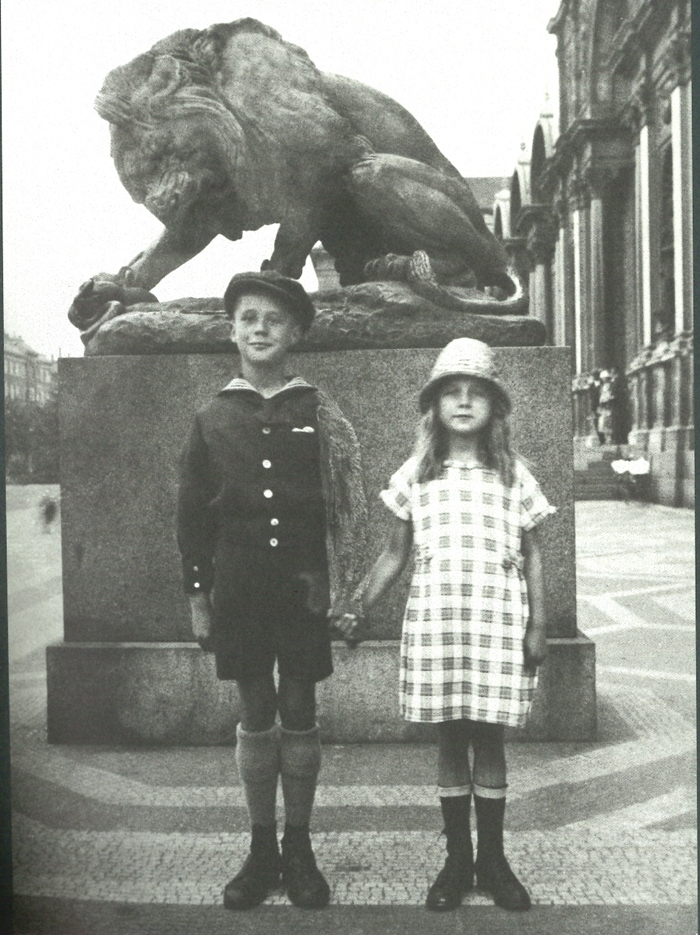
In another photograph, little sister Tove and older brother Edvin are posed in the square in front of the art museum Glyptoteket, with one of the lions as a backdrop. There are two lion sculptures in front of Glyptoteket: one majestic and immobile, the other dramatically crouched in battle with its prey, a snake. Tove and Edvin stand before the dramatic lion, holding hands, upright and cheerful. With lace-up boots, a short checked dress, and a cheeky hat, Tove could easily resemble a hipster girl from contemporary Copenhagen. Or perhaps Pippi Longstocking. There is something of a cheeky rascal about her. Edvin’s sailor suit and sixpence cap place him more unequivocally in the past. He looks cheeky too, with a slightly crooked smile and a hint of the irony one can have in the awkward situation of being photographed. One of his arms is a lion’s arm. The arm with which he holds Tove’s hand looks as though it is made of gray fur or gray stone—gray stone lion fur. It must be something that happened in the development of the photograph, but it lends the image a touch of fairy tale, of magical metamorphosis. Here stands the girl whose brother has a lion’s arm.
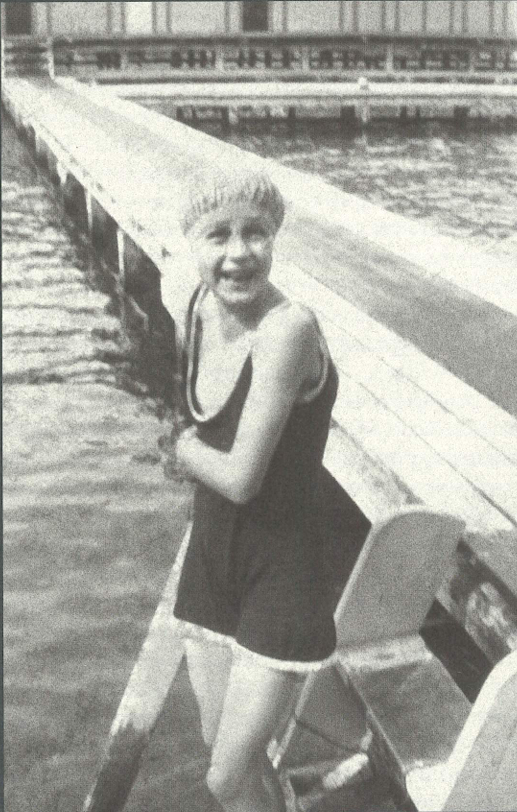
If Childhood offers an image of Tove as a melancholic dandelion child in the window frame facing the backyard, then the family album provides other images of TD as a child:
In a limp, dark swimsuit the tall, gangly girl stands on the bathing jetty’s small wooden ladder on her way down into the water. With one arm she holds herself shivering beneath the breast. On her head is an unflattering, bag-like bathing cap. But the face beneath it is radiant, exalted—the mouth open in a grin of the fear-mingled joy of anticipation one can feel on the way into cold water. The photograph must have been taken at the bathing establishment near the Ditlevsen family’s small garden cottage, which was close to what is now Sjællandsbro, the bridge connecting the island of Zealand with the island of Amager. A leisure girl, a bathing child full of cheer. According to Karen Syberg, Tove, as an older girl, was an excellent swimmer who brought home medals.
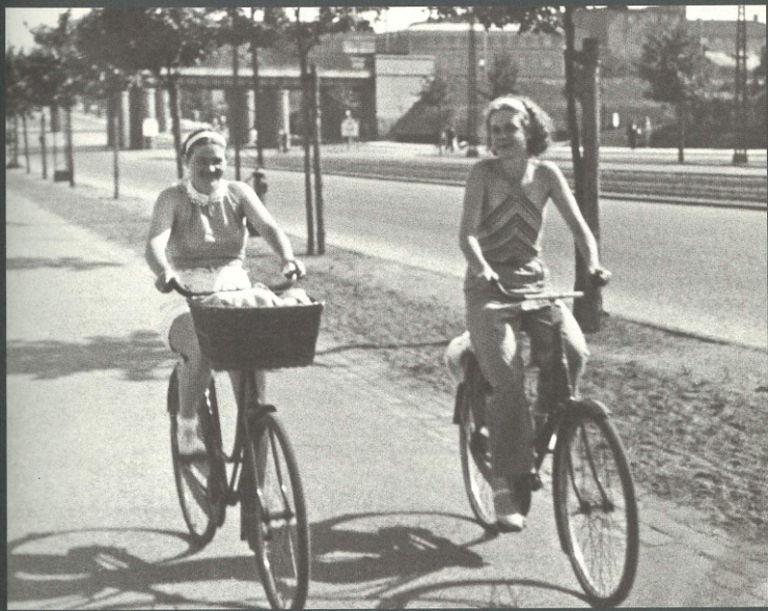
The swimmer girl Tove, the cyclist girl Tove. In a photograph one sees her cycling off in the summer heat with a friend. Tall and upright on a men’s bicycle, dressed in long trousers and a smart striped summer top, she could be a young Copenhagen girl of today. A hairband keeps her full, half-long curls in place; she smiles gently and confidently. “Take your bike, ride out, and be happy!” she writes at this age in her poetry notebook, in a poem that recalls a popular song: “Ja træd kun pedalen/læg kræfter deri/du er ung du er stærk du er svimlende rig/hele verden er din/som den hedeste vin” “Yes, just press the pedal / put your strength into it / you are young, you are strong, you are dazzlingly rich / the whole world is thine / like the hottest wine.” The young Copenhagen cycling girls. A constant mass. Once Tove was one of them. Once I was one of them. I think of what Thomas Mann has Goethe think in Lotte in Weimar: that the mass of youth is constant. In a way, when one looks at youth, one cannot console oneself with the thought that it too will grow old, because it will not; its mass is constant.
I am writing this in Istedgade, in the old pharmacy that in 1997 was converted into the city’s first hip café. After a while my eye is caught by the beautiful painted frieze in the Danish Jugendstil at the top of the wall: a sea of red poppies with women in long dresses picking them. I ask the kind woman behind the bar about the frieze’s origin; it dates from the 1930s, from the pharmacy’s time. In the middle of the poppy field sit the god and goddess of medicine in Greek garments—she with red poppy petals in her lap, he with a ribbed poppy bloom, only stem and seed head—both bearing around scepter or arm the pharmacist’s emblem, the serpent. Medicine for the people. Poppies for the people. Opium for the people. Surely TD must have seen the frieze; surely she must have stood here in the pharmacy and observed the poppies, which were probably bright red then, now darkened. Poppies, opium, morphine—the things that would become her vice. How lovely to disappear into this poppy field. How lovely to disappear into the morphine haze. Until it was not so lovely anymore. We will return to that; for now we have not yet come any farther than Istedgade.
Beginning
The beginning of Childhood is one of the strongest beginnings I know:
“In the morning, hope was there. It sat like a fleeting glimmer of light in my mother’s black, glossy hair, which I never dared to touch, and it lay on my tongue together with the sugar in the lukewarm porridge I slowly ate, while I observed my mother’s narrow, folded hands resting completely still on the newspaper, over reports of the Spanish flu and the Treaty of Versailles.”
The fleeting hope appears in fleeting phenomena such as a glimmer of light in the mother’s hair and the melting sugar in the porridge. Hope here is somewhat like Walter Benjamin’s “Mummerehlen:” a maternal fantasy creature (arising from the child’s misunderstanding of adult words) that stands for a utopian liberation, and of which the little Walter, according to the elder Benjamin’s childhood recollections, catches a glimpse in the first snowflakes or in the shimmering pattern at the bottom of a soup plate.[ii]
Hope and silence belong together; hope has to do with the mother sitting “completely at peace,” and with the child’s ability to imagine a wordless communication between them, where “mother” is something her heart whispers, while the mother says her name “without words”. Hope is the utopian hope that the entire world might be filled with “something resembling love,” and this would require remaining within the wordless communication.
It is the mother’s voice that cancels hope: first the laughter that sounds “as if a mass of paper bags filled with air were popped all at once,” then the “clear and defiant young girl’s voice […] which did not belong to her in the same way as her voice later in the day, when she would begin to argue with the shopkeepers about prices.” The defiant young girl’s voice that breaks into a half-cheeky song, in which “Tulle” rhymes with “visselulle.” [lullaby]
When the mother’s calm is broken, hope is “crushed.” She becomes the unpredictable creature with “dark anger” whom Tove fears. And then the waves of words come to the rescue: “Inside me, long strange bright waves of words began to flow through me; I knew that my mother could no longer do anything to me, for now she ceased to mean anything to me.”
Poetry becomes a protective armor, and perhaps also a counter-language to the mother’s half-silly, clumsily rhyming song, which Tove dislikes. (Lise Busk-Jensen links the waves of words to the lullaby: “Words soothe because rhythmically they re-establish the bodily closeness of mother and infant as in the lullaby”: she sees them as a re-creation of the mother — the caring mother of the infant — in language and fantasy.)[iii]
The word-waves through the mind are a protective membrane, a skin:
“I felt that my poems covered the ruptured places of my childhood like the fine, new skin beneath a wound that has not yet completely healed.”[iv]
I like this thought, poetry as skin. To weave oneself a skin from the music of language, a skin that can protect against the mother’s “dark anger” and lay itself healing over the places where the thin skin of childhood has been ripped off. Since I encountered it, I have been fond of the psychoanalytic concept of the “skin-ego.” The idea that what defines our ego is the skin; a skin that must be sufficiently thick to protect us from the world, and sufficiently porous to allow the world to seep in.[v]
Skin not only in a concrete sense, but as a collective term for the membrane or zone that surrounds us and holds us together: touches, temperatures, scents, but also voices, sounds.[vi] The mother’s popping laughter and clamorous young girl’s voice do not settle around Tove as such a skin; instead, they cut through. But Tove weaves a new skin from within, a skin of the sound and rhythm of words.
Aside from the mother’s anger, the word-waves protect Tove from sexuality as well. There are sexual innuendos in the “Tulle” song with which the mother disrupts the peace, and later we hear that “the obverse side of sex yawns ever more openly” toward Tove and “more difficult than before” allows itself to be “covered by the unwritten, trembling words my heart always whispers.” And even later (“in the last spring of my childhood”), Tove no longer wants to walk around with her girlfriends in Istedgade, because they speak only of “raw and smutty things, which do not always transform themselves into delicate, rhythmic lines in my increasingly skinless mind.” Skinlessness again. And the experience that the word-waves cannot always “cover,” be skin.
Even at the sight of pregnant women, Tove calls on poetry for help in order to “transform” the “raw and smutty” into something delicate and rhythmic; she searches (in vain) their faces “for signs of a supernatural happiness as in Johannes V. Jensen’s poem: I carry in my strapped breast / a sweet and anxious spring.”[vii]
I sense that here I am in the process of formulating a view of poetry that I do not like very much. Poetry as something that covers over the raw, the sexual; poetry as cosmetic painting and repression. But perhaps it is precisely the skin woven from the sound and rhythm of language that can offer a somewhat different image: not a matter of repression, but of protecting oneself against untimely, aggressive intrusion — from the mother’s enigmatic anger, from the adults’ enigmatic sexuality. This is rather what sexuality is: not so much a raw fact behind a pretty surface, as a riddle, a mystery; diffuse surplus- or co-meanings that stream from the adults toward the child.
“When it starts to sing in me,” writes TD, thereby turning poetry into an impersonal “it” that insists, a drive in itself (and not a repression of the “sexual drive”). “The song in my heart and the garlands of words in my mind” are like a force that cannot be stopped, even though none of the adults can tolerate it.
Words That Save: "An Eggnog"
In “An Eggnog”as well, the words have a potential power to change everything; the child waits for “the saving, unknown words” from the mother’s lips; the words that will free her from her mother’s suspicion of wanting to steal, a suspicion she fears she has aroused by standing there with her mother’s purse in her hands. The mother is a tired, single factory worker; the child is a loving daughter who waits for her with dinner ready and longs for her presence and attention.
The words that finally come over the mother’s lips are the ones that have given the story its title: “You can go make yourself an eggnog.” They could have been spoken by a character in a novel by the Danish author Helle Helle. Helle Helle’s characters are precisely of the kind who do not use grandiose words for grand feelings, but at most express them discreetly or indirectly. But TD is Helle Helle stuffed. With detailed reporting from the subtle inner life between the sparse lines of dialogue.
The final pages of “An Eggnog” take us from the mother’s harsh words when she has seen the daughter with the purse in the kitchen: “What are you standing staring at out there?” through a shift in her tone of voice: “Then she called the child by name with a gentle, strange voice” — and on to the redeeming words: “You can go make yourself an eggnog.” Like a piece of music with shifting moods and tempos and a final chord that dissolves the dissonance. All the movements that take place in the minds between the few spoken words are finely rendered with shifts between the mother’s and the daughter’s perspectives and insertions of an entirely third narrative perspective. A great deal can happen in a person’s mind while, outwardly, they are merely picking up a woolen slipper. It can be brought forth by a harsh question into a gentle caressing.
The child comes and sits “with an undefined gleam of hope over the thin little face.” It becomes clear that it is not the mother who sees this gleam, as it is compared to the gleam the child has on her face when she stands waiting for the mother “in the darkness on the kitchen stairs;” a place where the mother does not see the child, where no one sees it — where only literary fiction sees the child, for only in literature can the perspective be carried by such a disembodied “no one”. Is this disembodied narrative perspective not almost like Christ here; like the disembodied one who is with you in suffering. As I have heard priests preach in church: No matter what suffering you go through, Christ has also gone through it and is with you …
Visually it is the mother’s mouth that is in focus; those “red and coarse” lips that the daughter clings to, that “factory-marked machine-mouth” and “wild gaping mouth” that the narrator sketches for us, with “lines that were never softened into gentle and loving words.” If it were a film scene or a painting, the mother’s mouth would fill the whole canvas. The child waits at the mother’s mouth as the women waited before the grave, with the hope that salvation would step out of the mouth, out of the grave …
There is something in the child’s waiting for the mother’s words that reminds me of a scene in Nathalie Sarraute’s childhood memoir, which bears the same simple title as TD’s: Childhood. Little Nathalie stands in front of a shop window with her mother and says of the mannequin in the display that “she is prettier than you.” An unforgivable remark, just as unforgivable as stealing money from one’s mother’s purse. In Sarraute as well, words become things, become material blocks that can block every exit. And in Sarraute, too, the little daughter hopes for her mother to pronounce the words that would save her; words that would remove the blockage that her own words have placed. But in Sarraute’s memoir the mother says nothing.
In TD’s Childhood it is her brother Edvin for whom Tove stirs an eggnog. I am old enough to know what an eggnog is. It belonged to my own childhood: egg yolk stirred with sugar until it becomes a foamy, pale-yellow cream. Sometimes I mixed in cocoa and regretted it when the brown color overtook the whole cream, but before that there was a brief and lovely moment when the brown formed streaks in the yellow. Then it became forbidden to eat raw egg yolks because of salmonella, therefore I did not make eggnog for my own children until I found out you could buy bacteria-free egg yolks in cartons. I remember how happily I served my boys their life’s first eggnog — and how they didn’t like the taste at all. In TD’s story “eggnog” becomes exactly the nourishing mother-word the daughter has hoped for. My eggnog was not the right motherly gift.
But what if the girl (like my own boys) doesn’t like eggnog at all? What if she willingly runs into the kitchen and stirs the eggnog only in order to please the mother? Like little Anna Freud who, feverishly, murmured that she wanted strawberry cake, just to please her parents. Like children can be inclined to confirm their parents’ fantasies about their desires. (The parents’ desire for their children to desire something.) Perhaps it means nothing. Perhaps the redemption is also there even if the mother’s line “You can go make yourself an eggnog” can be translated as “I would like to give you a gift” — and the daughter’s answer: “You should have one too, Mom” can be translated as “I would also like to give you a gift.” It is the word as gesture, as gift, that is essential.
The eggnog is one of the motifs that TD complains about being asked to explain. Schoolchildren contact her to find out what it “means,” but TD rejects that it should have any symbolic meaning. The schoolchildren must have been taught to think that literary analysis means finding symbols in the text and interpreting them. As I hope for (and indeed try to teach) literary analysis, it is an analysis of how the author has shaped the language. The eggnog “means” nothing if meaning is something hidden in the darkness behind a sign. But it means everything as a performative utterance, as a gesture, as an exchange of gifts between mother and child.
We want to thank Kristen Williams Leónard for her invaluable help in editing the translation.
Notes
[i] Translator's note: The translator would like to thank Lilian Munk Rösing and Kristin Léonard for invaluable help in translating the excerpts.
[ii] Walter Benjmain: Childhood in Berlin around year 1900.
[iii] Lise Busk Jensen in Kultur og Klasse nr. 50, p. 118
[iv] Barndom, chapter 12
[v] Ester Bick: “The experience of Skin in Early Object Relations”.
[vi] Didier Anzieu: Le moi-peau
[vii] Barndom, kapitel 8 and 17
Lilian Munk Rösing is Associate Professor at the Department of Arts and Cultural Studies, Copenhagen University, and a literary critic. She does her research and writing in the cross field of aesthetics, psychoanalysis, and critical theory. Her most recent books are Friedrichs farver, on Caspar David Friedrich (2025), and Tove Ditlevsens veje (2025). In English, she has published one book: Pixar with Lacan. The Hysteric’s Guide to Animation (Bloomsbury 2017) and co-edited two anthologies: Literature. Introduction to Theory and Analysis (Bloomsbury 2017) and Analysing the Cultural Unconscious (Bloomsbury 2021).
Søren Bo Aggerbeck Larsen is a writer and theorist with strong interest in the relationship between psychoanalysis and aesthetics. He holds a Ph.D. from Cornell University, focusing on Paul Celan, lyric subjectivity and the difficult politics of universal. He has published mostly in the field of psychoanalysis as a tool for cultural critique, with a focus on aesthetic form and the operations of enjoyment in language. He lives in Copenhagen.