Essay by Søren Bo Aggerbeck Larsen
Paul Celan and the Peacock
10.11.2025
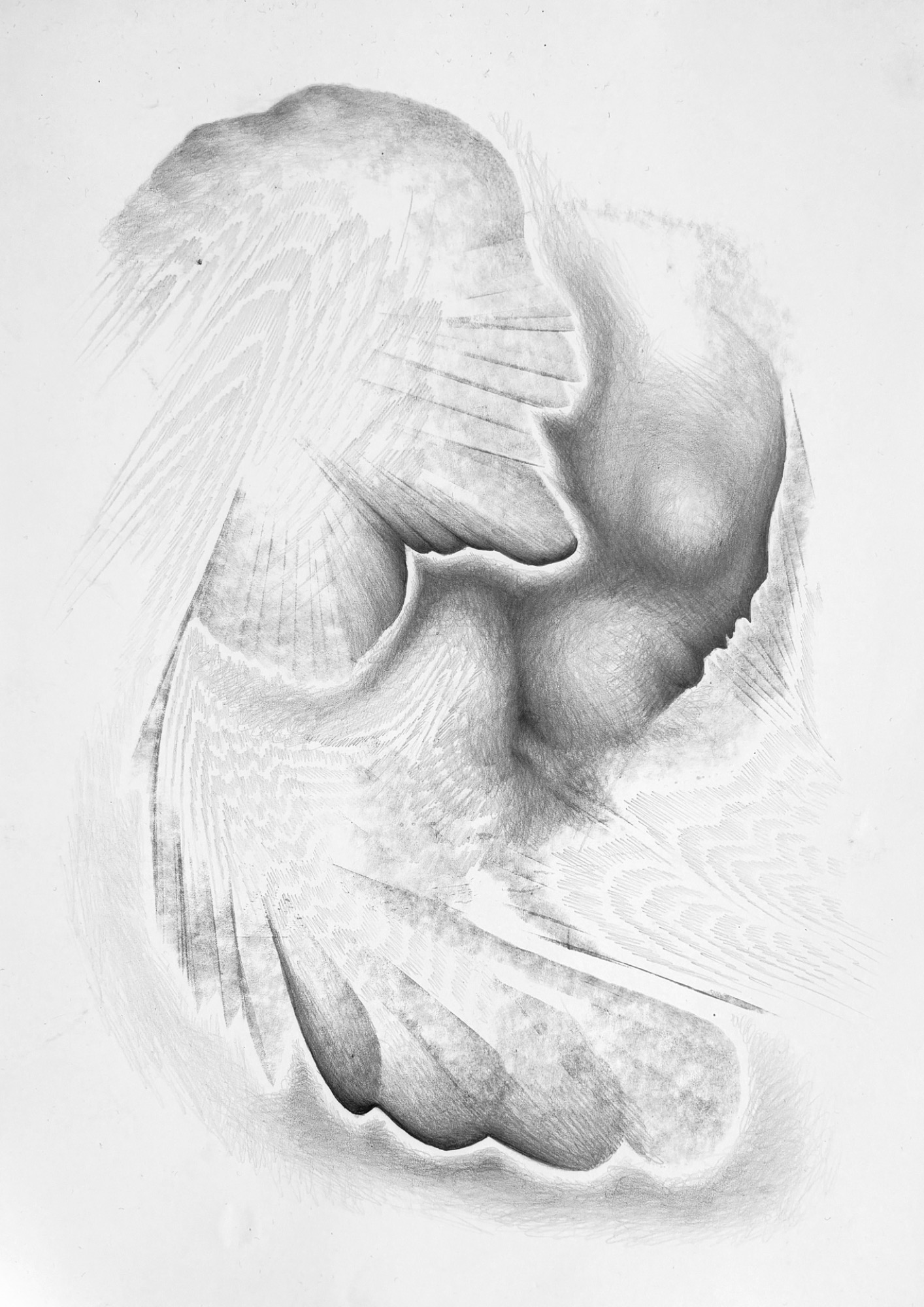
Patricia Detmering, October 2025
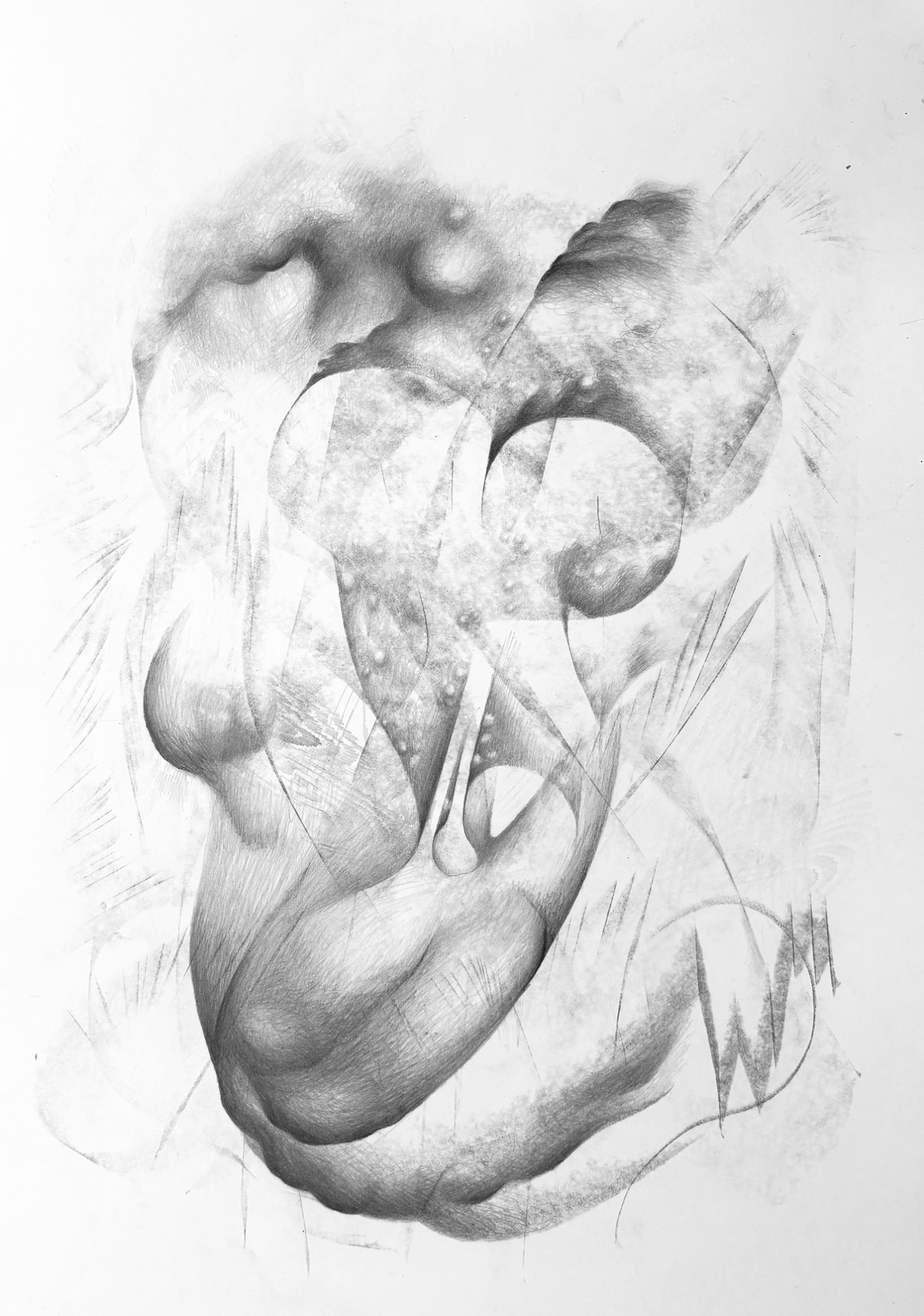
Patricia Detmering, October 2025
In the English preface to Seminar XI: The Four Fundamental Concepts of Psychoanalysis, dated 17 May 1976, Lacan says that "I am not a poet, but a poem. A poem that is being written, even if it looks like a subject."[i] While this statement is made in the last year of his teaching, and forms part of the preface that were not said in the original seminar, it resonates with the motif of earlier seminars that the subject is not who speaks (a poet), but who is spoken (a poem). The subject is decentered by the structure, the speech of the Other.
The subject is not a poet, if by that we understand misrecognition of the ego, who is master of his own words. Words surprise us, they overcome us, they overwhelm us, “language is a virus” as Lacan says, we never know what we are saying. Colette Soler continues Lacan’s thoughts on the poem in the direction of the cure. At the end of analysis, the cure turns out to be nothing but the signing off of the poem that one is[ii]. However, by saying a poem, rather than a subject, Lacan adds something to the decenterment and “structuralism” of the earlier seminars. A poem is enigmatic speech, a speech that cannot be immediately understood, grasped, in contrast to prose presumably, material remainders scattered around, signifierness that “fans out”.[iii]
I want to compare this to a wonderful, but rarely mentioned poem by Paul Celan, which cannot not be found in any collection of his poems published in his life time. It was written on occasion for the Festschrift in 1967 for the birthday of German writer Victor Otto Stomps (1897-1970)[iv]. Celan's poem celebrates Stomps’ seventieth birthday by turning the subject Stomps into a poem. More importantly, the poem stages the gaze.
The poem is an unusually playful one among Celan‘s oeuvre, one that reminds the reader of the games with puns and play on words, that he and his friends would often make in his younger years.[v] Here is the full poem.[vi]
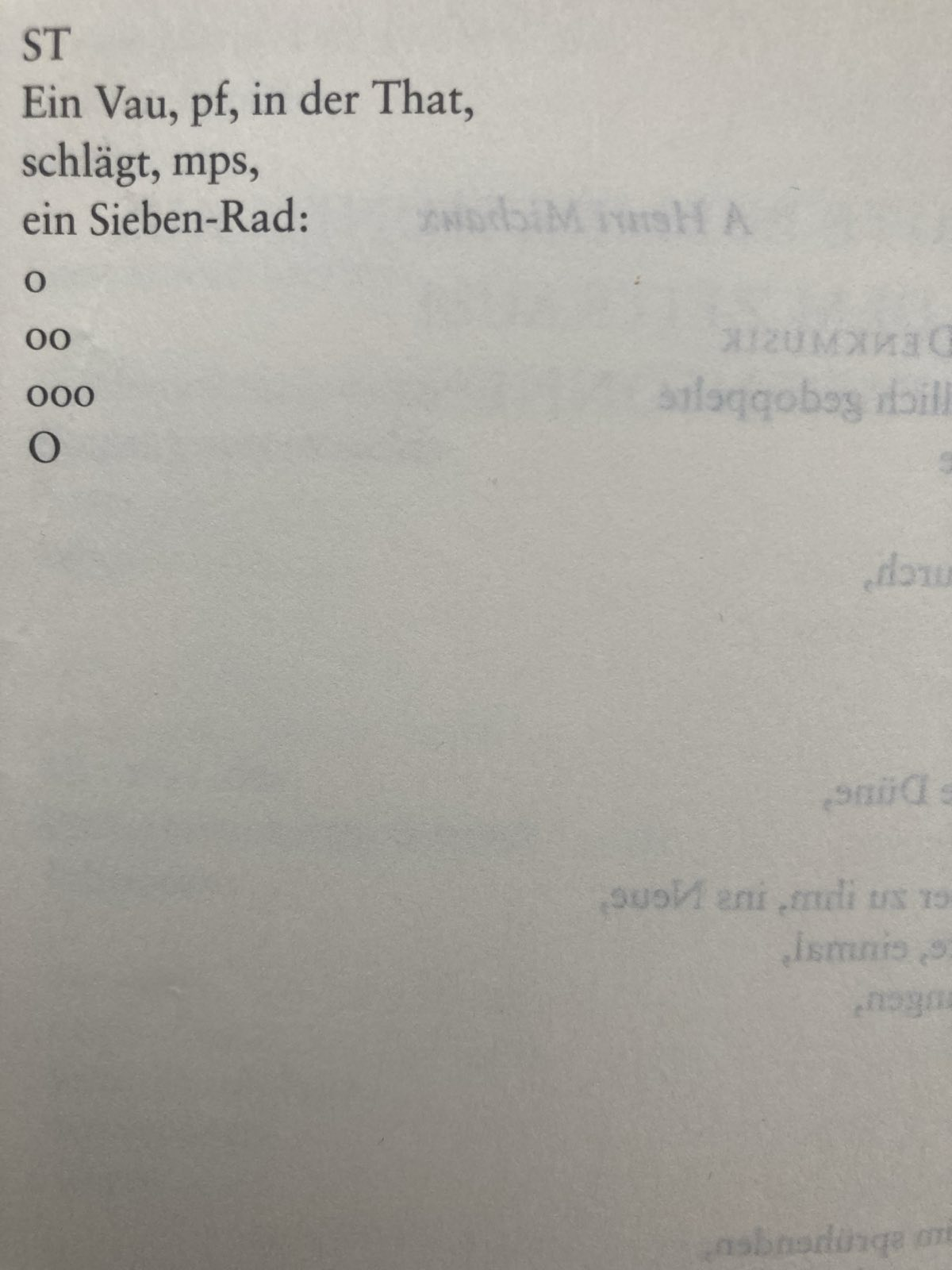
What to say of this strange, but fascinating poem, that surely does not lend itself readily to understanding? It is full of enigmatic morphemes and scattered signifiers, that are turned into a visual display on the page. I will try to indicate some of them and bring them into conversation with Lacan. The point is not to read the poem biographically, but rather to show how the biographical references at a certain point begins to “slip”, where the poem turns break with the hermeneutical search for meaning (including, of course, biographical meaning.). This is also the moment of the gaze.
The line “Ein Vau, pf, in der That” plays with layers of reference and tone. “Vau” is the German name for the letter “V,” here pointing to the “V” in the dedicatee’s first name, V. O. Stomps. In French, the abbreviation “pf” stands for pour féliciter (“to wish happiness” or “congratulations”), a formula common in birthday cards. By adding the pf, the poem plays on the near homophony between Vau (the spelled out pronunciation of the first letter of Victor = V.) and pf =Pfau (peacock).
The phrase “in der That,” uses an archaic spelling “in der Tat” (“indeed,” “in fact”), adds a mock-formal, slightly antiquated tone that underscores the poem’s playful and ceremonious character. Hegel uses the phrase over seventy times in his Phänomenologie des Geistes (1807) to show the way something turns into its other, the Sichanderswerden, or “self-othering“, how the presumably stable position of this or that concept is undermined. Stomps’ humanity and possible self-assurance at the mature age of seventy seems suddenly undermined when Vau can become Pfau. Not the most common birthday card.
The line “schlägt, mps,” brings together sound, motion, and naming: in English, “stomp” is a verb meaning to tread or walk heavily or noisily, hence a bit like the schlägt of the visor of the clock. The verb schlägt (“strikes” or “beats”) can suggest the striking of a clock or chimes. The poem thus nods back to a long poetic tradition of the link between a strike of a clock and a reminder of human fragility or mortality, most famous the English poet John Donne’s “for whom the bell tolls/it tolls for thee,”[i] while simultaneously evoking the turning of a wheel (the wheel of time, the Sieben-rad, in the next line). The strike can also refer to the dramatic moment when a peacock “strikes” by suddenly displaying its fan. The fragment mps continues the dispersion of the dedicatee’s name, Stomps, as if the poem would enact a subjective destitution, dissolving Stomp into material scraps, scattered sounds and letters (ST, the Vau for Victor, mps for Stomps, O for Victor Otto, the four o’s in the final stanza, for the four o’s in the name in etc.).
The phrase “ein Sieben-Rad” literally means “a seven-wheel” or “seven-spoked wheel.” The prefix “Sieben-” is completed by the sequence of “o”s that follows in the final stanza, together forming “70” thereby marking the dedicatee’s seventieth birthday. At the same time, the image of the wheel resonates with the peacock motif, since the circular spread of a wheel mirrors the fanned tail of the bird, each spoke corresponding to the shafts of its feathers.
The sequence “o / oo / ooo / O” introduces the poem’s final and most dazzling visual play, where language turns into graphic encounter on the page, where the poem is no longer simply describing a peacock’s tail, but rather visually enacting it. Each “o” becomes a visual sign, the “peacock eyes” (Pfauenaugen) on the fanning tail. Their gradual multiplication—o, oo, ooo—mimics the peacock’s act of fanning its tail.
In my reading, the eyes on the peacock’s train are not so much the imaginary “eye, the misrecognition when a human looks another human in the eye, but rather what Lacan calls the gaze. The gaze is, counterintuitively, situated by Lacan, on the side of the object, not the side of the subject. In this case, the poem becomes such an object in the final stanza. To refer to my own experience as I was reading, I was caught by surprise when I discovered that the o’s in the final stanza actually displayed the peacock’s tail. I first thought, as I was reading the poem, that the final stanza was a meaningless repetition, a kind of stuttering, or an ecstatic culmination. But in any case, a collection of o’s to be read. Then I saw that o’s were actually the peacock’s fanning tail and the ‘eyes of the fan. The act of reading then turns, at least for me, into an surprising experience, as though I would have been “looked at” the entire time, but from a place, where I “do not see myself see”, to paraphrase Lacan (first we do not see the graph, but just meaningless letters).
This involves a change of perspective. The gaze always introduces a rupture in the subject’s vision. In other words, the poem as text, and the poem as graph, or image, do not add up, do not smoothly align. One cannot gradually move from one to the other. There is a slip, a cut, when one moves from one perspective, from the poem as text, to the other, the poem as image on the page. There is a split of perspective, but within the same poem. Or perhaps one should not say split of a perspective, but rather perspective emerges as a split. This happens, in my reading, when the poem moves from text to graph, there is a certain leap.
If we go back to peacock-motif this adds more to the poem. The play with form and ornament draws on the traditional association of the peacock with vanity and beauty, as the poem itself indulges in a kind of showing off through its enigmatic signifiers and striking, almost vertiginous visual arrangement. Furthermore, in the biblical tradition, the number seventy often marks the span of a mortal life, most famously in Psalm 90:10: “The days of our years are threescore years and ten.” Read in this light, the poem’s reference to seventy, and the introduction of the gaze, is then not merely a birthday greeting but also a reminder of the reader’s and Stomps’ finitude. The poem, however, also reverses the long tradition of associations of the peacock with immortality. There is a "self-othering" of the peacock as a symbol. In antiquity and early Christianity, the peacock was often a symbol of immortality. The poem plays on this, but also dialectically undermines it: the poem’s gaze is like a reminder of mortality, “thou art that”, you do not see the way you are inscribed in the picture before you.
The peacock is, of course, also associated with vanity. But here the vanity, I would argue, is turned around as something more “positive”. The point is not simply “life is vain”. But rather something like: because life is finite, all the more reason to “show off”, to “turn into a peacock” (as the poem does eloquently). The display of feathers becomes rather something like an insistence through or with exposure and finitude.
It is very interesting to look more at the o’s in the final stanza and connect them with Celan's reflections on what poetry should be. It’s another dialectical turn, a Sichanderswerden of a long poetical tradition. The O in poetry is most often thought of as the enabling apostrophe, calling the Muse: “O, Muse tell me…”. It is the call for the Muse to inspire the poet’s song. It is the enabler of poetic breath.[ii] But instead of the living voice, the o is here rather silent, as if a suspension of the living voice had been suspended, or silenced (this in fact would make it closer to the Lacanian understanding of voice, like the psychoanalyst's silence, but I leave that be...). The poem therefore stages very concretely a way to understand Celan’s difficult poetics of a breath-turn (Atemwende). It is not a call for a different kind of breath, we might say, not another kind of life, but rather a rupture in breath, a turning away from breath. This can also be read as the transition from text to gaze: Lacan phrases it thus: “you never look at me from the place from which I see you”.[iii] The same with the poem: The o’s in the poem are like stains at first, but they show as they become image rather than simply text, the reader can never look at the poem, from the same place where he is seen by it.
The peacock thus emerges from the play between phonetics and writing.. This emphasis on the poem as visual, a being on the page, introduces a silent reminder of the reader's mortality: while sound unfolds in time and disappears as soon as it is spoken, the written birthday card endures beyond the fleeting moment of the birthday celebration, and on its biographical occasion. The playful arrangement of letters and o’s remains legible long after the occasion and Stomps himself has passed, transforming what began as a pun into a kind of floating memento mori. In this way, the peacock’s fan, inscribed in writing, stands not only as a spectacle of life but also a lasting reminder of its finitude. Celan's "fanned out" signifiers, thus makes a pretty radical transition another "fan"-poem, namely Stephane Mallarmé’s Autre èventail de Mademoiselle Mallarmé written on a fan, and part of Mallarmé's "symbolist" poetry and formal innovations.[x] But Celan's poem is much more intensely invested in the singularity of the person/peacock of Stomp and the dialectics of text and image. In Celan’s poem Victor Otto Stomps’ name is also “fanned out”, but more like so many material scraps that seem no longer to signify anything, like the way the text plays with sound clusters (ST, Vau, o,oo,ooo,O, mps) as though they were reduced to phonetic beats.
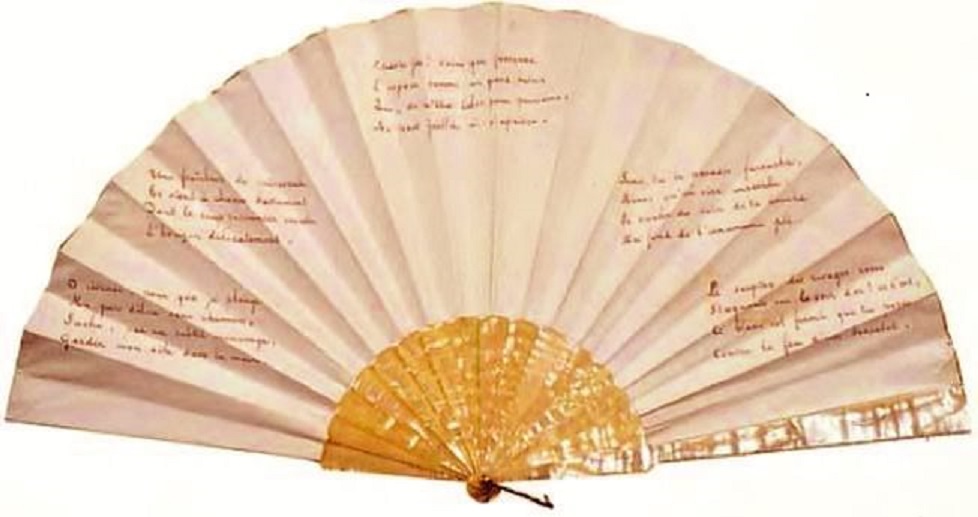
Stéphane Mallarmé: Autre éventail de Mademoiselle Mallarmé (1884)
The poem’s graphic display looks back from the place from where the subject does not see, but is seen. Celan’s poem thus enacts the opposite of "I see myself seeing myself" whereby Lacan describes a certain idealism. He says:
"…the phenomenologists have succeeded in articulating with precision, and in the most disconcerting way, that it is quite clear that I see outside, that perception is not in me, that it is on objects that it apprehends. And yet I apprehend the world in a perception that seems to concern the immanence of the I see myself seeing myself. The privilege of the subject seems to be established here from that bipolar reflexive relation by which, as soon as I perceive, my representations belong to me."[v]
If it is a certain philosophical dream to be able to "see myself see," to see, where no point escapes my vision; the gaze is precisely the introduction of a stain, some place where I don't see, but where I am seen - in this case the sudden moment when the peacock fans its tail in the second stanza.
The gaze, as Lacan describes it, is anamorphic: it appears through a perspective that unsettles the subject’s hold of itself and its semblance of a world. The repeated "o"s can also be read as anamorphic "stains." Between the eye and the gaze there is no symmetry, but rather a cut. "The correlative of the picture, to be situated in the same place as it, that is to say, outside, is the point of the gaze."[vi]
In Celan's poem this relates to another dialectic mentioned by Lacan, that is between beauty and the gaze in painting. Most paintings are an elision of the gaze. That is the function of beauty. It has a pacifying effect, much like the hypnotizing view of the peacock's tail. Lacan says:
The painter gives something to the person who must stand in front of his painting which, in part, at least, of the painting, might be summed up thus - You want to see? Well, take a look at this! He gives something for the eye to feed on, but he invites the person to whom this picture is presented to lay down his gaze there as one lays down one's weapons. This is the pacifying, Apollonian effect of painting. Something is given not so much to the gaze as to the eye, something that involves abandonment, the laying down, of the gaze."[vii]
Celan's poem does both. It plays on this pacifying effect through the many virtuously written references to Stomp. Thus, all my search for biographical connections turns out to be only so much “for my eyes to feed on”. Yet, instead of laying down the gaze and offering something to the eye, this poem then introduces the stain (the o's), as the point where the reader is seen by the poem, or where spectator is inscribed in the picture, "you never look at me from the place from which I see you"[viii] "in the scopic field, the gaze is outside, I am looked at, that is to say, I am a picture."[ix]
In Seminar XX, Lacan also describes a certain “fan” or “fanning out” of the signifier. Here he refers to the materiality of the signifier, not its presupposed “content”. He calls this “signifierness”. It is the way the signifier is pas tout and ruptures the One: “signifierness” (signifiance) is something that fans out (s’éventaille), if you will allow me this expression, from the proverb to the locution.”[x]
A proverb is like a complete saying, a generally shared meaning without a particular speaker. A locution, on the other hand, is a particular way of saying. An analysand that, for example, says a proverb in analysis immediately turns it into a locution, since it is no longer a general truth, since he or she said as part of analysis. The locution, unlike the proverbs generality, includes the speaker in what is said. It also does not have to be a complete phrase, but can be a rather simple expression or turn of phrase. We might say that Celan takes this “turn of phrase” very literal, since it turns from the phrase into image. This is not a general truth, like a proverb, but is something that can only be encountered through reading the poem in its singularity. The poem is a locution, just as the "pf", the french pour féliciter, even if the poem is written in German to a German speaker is a subtle reminder of its origin in Paris.
Celan’s poem is not like proverb, but more like a locution, it fans out and includes the speaker in what is said, as is the case in everything that happens in psychoanalysis. The subject is a saying included in the said that prevents the One from being whole, just as the gaze is not the panoptic One that looks at the subject, but the stain in the picture, the place where the eye cannot grasp a totalizing vision. It is the same with Celan's poem: there is a saying, a subjectivization included in the said, this particular dedicatee (V.O. Stomps) but also the particular saying of the poem. As Celan emphasizes the poem must be singular (Einzeln), it has a finitude, it is "mindful of its dates”:
“Vielleicht darf man sagen, daß jedem Gedicht sein ’20. Jänner’ eingeschrieben bleiben. Vielleicht ist das Neue an den Gedichten, die heute geschrieben werden, gerade dies: daß hier am deutlichsten versucht wird, solcher Daten eingedenk zu bleiben? Aber schreiben wir uns nicht alle von solchen Daten her? Und welchen Daten Schreiben wir uns zu?“
Readers most often attribute this emphasis on dates, such as Celan’s focus on the 20th of January, the date of the Wannsee conference, and it also refers to Georg Büchner’s novella Lenz, where the date is mentioned as the day where Lenz walks in the mountains. When Celan speaks of “dates” it is almost always taken as dates of caesura and catastrophe, but also of turning things up-side-down (Lenz looks at the sky as though it is the ground). This is, of course, very important and is very often the case. Nevertheless, I want to suggest that we find a completely different emphasis in relation to the dates in this poem. Here, the “poem mindful of its dates”, would rather be turn into something more celebratory, the date is a birthday. Or, to make turn of phrase, to go from proverb to locution, like Celan’s text itself does: not simply a birthday, but also, why not, birth of a new day, staging a new beginning. This seems to involve almost a miracle, a certain leap, like a Vau turning into Pfau, a fanning out of the signifier, to the point where human subject turns into a peacock. Where the subject becoming scattered across the page into morphemes. Where Stomps is scattered into ST, o,o,ooo, O, mps. Stomps becoming a poem, even if it looks like a subject.
Notes
[i] Jacques Lacan, The Four Fundamental Concepts of Psychoanalysis, edited by Jacques-Alain Miller and translated by Alan Sheridan (New York: W. W. Norton, 1981), viii
[ii] The poem that I am, that I did not write but is written by my saying, constitutes me; and I can, thanks to an analysis, sign it…I must affix my signature to it even though the text at my disposal is incomplete, since the effects of lalangue go beyond me. . ..To sign a poem or to identify with a symptom are two equivalent expressions by which to designate the position of a subject who has come to recognize his real. Colette Soler Lacanian Affects: The function of affect in Lacan’s work, trans. Bruce Fink (New York: Routledge, 2016), 163.
[iii] Jacques Lacan, The Seminar of Jacques Lacan, Book XX: Encore. On Feminine Sexuality, The Limits of Love and Knowledge, edited by Jacques-Alain Miller and translated by Bruce Fink (New York: W. W. Norton, 1998), 18-19. I return to this quote in the end.
[iv] For a short commentary on biographical circumstance see Paul Celan, Die Gedichte. Neue kommentierte Gesamtausgabe, edited by Barbara Wiedemann (Berlin: Suhrkamp, 2018),
[v] John Felstiner, Paul Celan: Poet, Survivor, Jew (New Haven: Yale University Press, 1995), 191.
[vi] Paul Celan, Gesammelte Werke in sieben Bänden, vol. 3, edited by Beda Allemann and Stefan Reichert (Frankfurt am Main: Suhrkamp, 2000), 276.
[vii][vii] No man is an island,/Entire of itself./Each is a piece of the continent,/A part of the main./If a clod be washed away by the sea,/
Europe is the less./As well as if a promontory were./As well as if a manor of thine own/Or of thine friend's were./Each man's death diminishes me,/For I am involved in mankind./Therefore, send not to know/For whom the bell tolls,/It tolls for thee.
[viii] For an excellent study of the poetics of breath decoupled from traditional views of “life” see Stefanie Heine, Poetics of Breathing: Modern Literature’s Syncope (Albany, NY: State University of New York Press, 2021). In January 2025, at the conference "Reawakening Freud" in Copenhagen, Heine gave an inspiring and thoughtful talk of the apostrophic quadruple O-O-O-O (four o's) in various places (although not this particular poem, "ST", by Celan). .
[ix] Lacan, Four Fundamental Concepts, 103
[x] In Mallarmé’s occasional poem “Éventail (de Madame Mallarmé)”, the fan (éventail) isn’t merely an object but a conceptual and visual device. The poem’s layout mimics the very structure of a folding fan—its lines are short and discontinuous, echoing the fan’s segments; its syntax is fractured, mirroring the folds that conceal and reveal in equal measure.
[xi] Lacan, Four Fundamental Concepts , 86
[xii] Lacan, Four Fundamental Concepts, 96
[xiii] Lacan, Four Fundamental Concepts 101
[xiv] Lacan Four Fundamental Concepts 103
[xv] Lacan, Four Fundamental Concepts 105
[xvi] Lacan, Encore, 18–19
Søren Bo Aggerbeck Larsen is a writer and theorist with strong interest in the relationship between psychoanalysis and aesthetics. He holds a Ph.D. from Cornell University, focusing on Paul Celan, lyric subjectivity and the difficult politics of universal. He has published mostly in the field of psychoanalysis as a tool for cultural critique, with a focus on aesthetic form and the operations of enjoyment in language. He lives in Copenhagen.
Patricia Detmering is a media artist from Berlin. She has given lectures in renowned galleries, foundations, and universities, such as the University of Bochum and the Krupp Foundation in Essen. Her work has received multiple awards and has been exhibited at the Centre Pompidou in Paris, the Berliner Festspiele, the Kunstmuseum Bochum and other international venues. In addition, she has received numerous scholarships. For more visit www.patriciadetmering.com.