Essay by Brian Benjamin Hansen
What is the madness of power? Skram, Lacan, Muldtofte
14.9.2026
Even if I write this text from a privileged position, the position of a relatively well-off academic, having never been in contact with the psychiatric system, I aim here for solidarity, trying to cross a powerful divide that was put up and policed by academics like me: a divide between psychiatric patients and ‘normal’ or ‘healthy’ people, or more fundamentally or conceptually between madness and normality.
My intervention adopts the mad principle of juxtaposing three positions on madness. The three positions are of course selected because they have something to offer each other, but I did not aspire to a total alignment between them and their arguments. I would want them to violently supplement each other, filling in each other’s gaps, disturbing each other. The three positions that I contrast come from different historical settings and angles: Amalie Skram’s fin de siècle report on being a psychiatric patient in a mad system, the work of Jacques Lacan and psychoanalysis originating from the ‘doctor-side’, and Lea Muldtofte’s present-day activist work as a psychiatric survivor, most recently through the exhibition GALT! (“MAD!”) at Museum Ovartaci.[1]
All three positions go against the grain of present-day psychiatry. They refuse to accept the language of diagnosis and its dualist ontology, where madness is allocated to a certain class of people – the idiots or unlucky bunch who unfortunately did not make it and cannot act according to the normal procedures of life and everyday affairs – in this way blocking solidarity between people that suffer in different ways. They all, although in different ways, ask for a politization of the seemingly neutral language of mental illnesses and diagnosis. Skram and Lacan ask: What if the doctor is just as mad as the mad people at the asylum? What is the madness of power? Muldtofte wants to dismantle the very label of mental illness, fighting the epistemological and physical violence that comes with it.
Skram
Amalie Skram was a Norwegian writer, the most known female writer of the Modern Break-Through in Scandinavia, who completely shattered the psychiatry of the day with two books from 1895, Professor Hieronimus and På Sct. Jørgen (“At St. Jorgen’s”).[2] The novels are fictionalized autobiography, following her own hospitalization at Kommunehospitalets sjette afdeling (Ward Six of the Copenhagen City Hospital) under the leadership of the then well-known and famed psychiatrist Knud Pontoppidan – brother to the Nobel-prize winning Danish author Henrik Pontoppidan. After Skram’s novels were published a big public debate followed and Pontoppidan resigned from his position as the first lecturer of nervous diseases at the University of Copenhagen – he then moved to Jutland and became chief physician of the Jutlandian Asylum.
Skram’s novels are reports from the inside of the asylum. There is in the entire text of the two novels a tone of bewilderment. The protagonist, Else Kant, simply cannot believe what is going on. Following an artistic crisis and a period of insomnia, Else and her husband have decided that it would be best for her to spend some time in hospital, where she can get some rest. However, much to her surprise she is simply placed in a cell, put under observation, and the physician, Professor Hieronimus, only very sporadically turns up. She does not take herself to be mad, and yet the doctor treats her as completely mad and overcome by her emotions. Not for a second does the Professor listen to her. He seems perfectly satisfied with receiving information from her husband, whom she is not allowed to see, and her house doctor. This enrages Else, which, of course, only tightens the physicians’ grip on her.
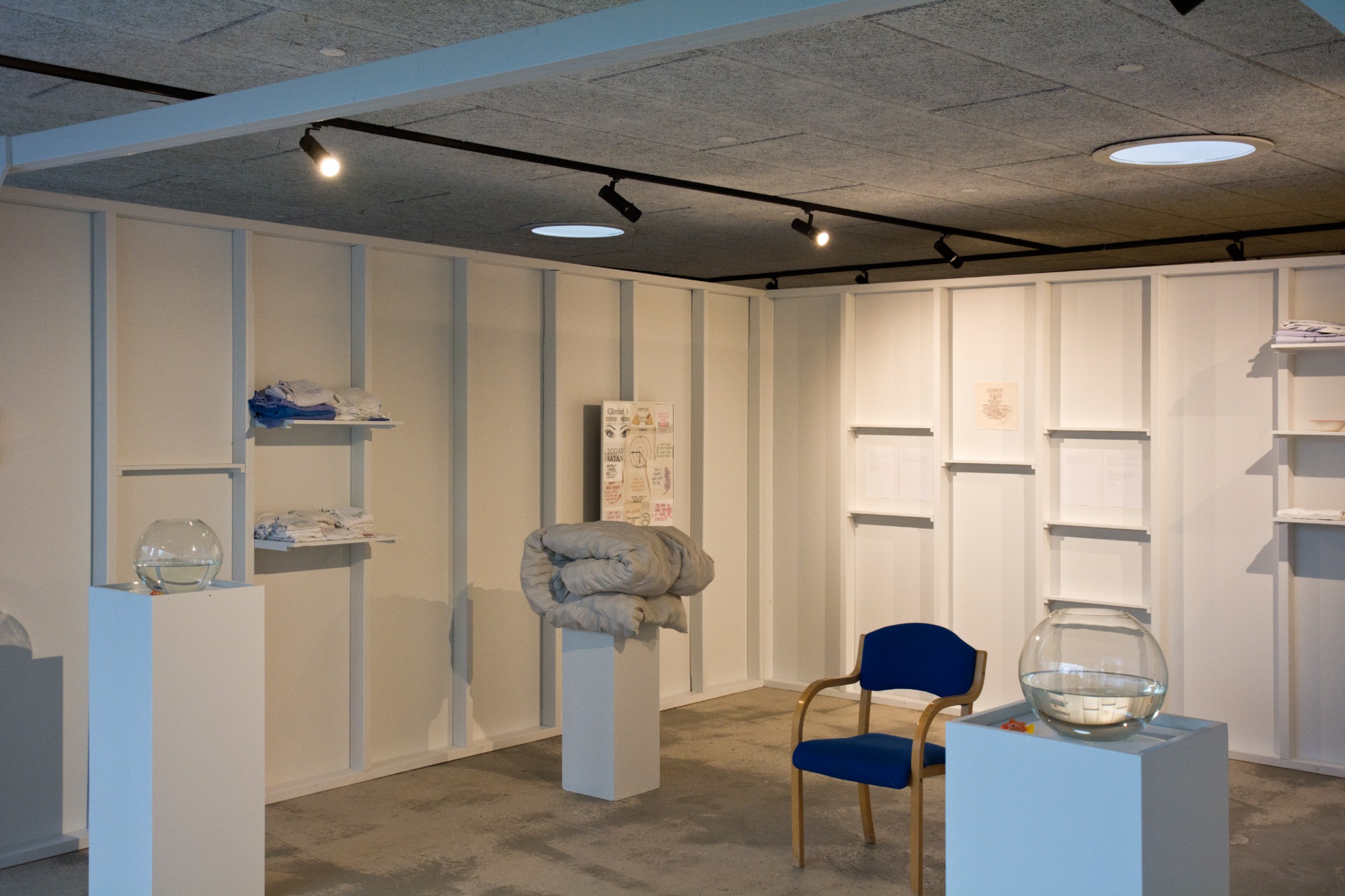
GALT! Museum Ovartaci in Aarhus, 26.02-17.05 2026.
Professor Hieronimus shows how the hospital is organized around the authority of the doctor: Everything the personnel does refers to him and his decisions. We have here the classical discourse of the master still in its place, even though psychiatry throughout the 19th century tries to establish itself as a field of scientific and transparently produced knowledge. If Professor Hieronimus is the master, Else occupies what Lacan would call the discourse of the hysteric, lamenting the conditions at the hospital, attacking the professor and criticizing him.
Else is under observation. She is scrutinized, constantly surveilled. She is a painter, and thus she has access to all things visual, but here she is put in the spotlight. Being under observation means also being mistrusted as a speaker, as a source of knowledge about herself. She may speak, but no one, and least of all the Professor, listens. But she, and Amalie Skram herself, will get her revenge.
In Paa Sct. Jørgen, there is a wonderful passage of the revenge to come, put in the mouth of Else, but driven by the rage of the author herself. The chief physician at Sct. Jørgen (a depiction of the mental institution Sct. Hans in Roskilde, where Skram was sent to by Pontoppidan), discovers that Else is going to write about her experiences with Hieronimus, and he patronizingly, although in a tone of compassion, warns her from doing so. She will become a laughingstock or an object of pity, he says, such an “assault will not bring down an authority like Hieronimus” [3]. Yet, Else insists that only death can prevent her from doing so: “You might just as well ask the rain to stop falling, or the river to turn around and run back up over the mountain”.[4]
The confrontation between Else Kant and Hieronymus is thus not only a personal one, but also a conflict between the reign of the imaginary (Else as an object of observation) and the reign of the symbolic (Else as a thinking, speaking and writing being).[5] The reign of Hieronimus entails registering and measuring the patient’s behavior according to certain norms and standards (the ideal-ego of the normal person). Historical accounts tell us that Pontoppidan visited Jean-Martin Charcot in the 1880s, and Charcot would be the epitome of the master of the imaginary. Charcot famously commissioned and published photographs of hysterics ‘losing it’, was notorious for his clinical observational skills, and he also practiced hypnosis, this cure of the imaginary, of the voice as command, where patients are instructed to drop their symptoms. It is this dimension of authority that, according to the chief physician at Sct. Jørgen, is impossible to bring down.
In Skram’s novels, the will of the hypnotist is confronted by the will of the hysteric, whose force is like that of rain that cannot be held back, or a river in full spate. Else/Skram, finds a way to speak back. She opens the axis of the word, the plane of the symbolic, she questions the very ‘labeling’ to be mad that is as violent as unfounded. As Else says, with one of the book’s powerful slogans: “For those who have had the label ‘mad’ stuck to them, there is no pardon”.[6]
Else Kant claims not to be mad, and she complains that nobody, and least of all the Professor, can tell why she is deemed to be mad, why this label is put on her, with the devastating consequences it has for her and her freedom. But this complaint is already part of the epistemological deadlock of the psychiatry of the master: Else’s complaint does not make any sense (even though it is completely well-formed and understandable) as you cannot explain to a person labelled mad, why they are mad, because madness consists in the inability to reason and thus in epistemological deficit. We are thus back in the divide, the cosmological ‘chaos vs. logos’ and ‘madness vs. normality’-solution to the problem of the mind. But what if things are more complicated than that? What if madness and so-called ‘normality’ are much closer to each other than we, and especially the doctor and the psychiatric system, would like to admit?
There is a wonderful passage in På Sct. Jørgen where Else speculates on the question of what madness really is. Would it not be possible to label everyone as mad? She then enlists different forms of madness, like having an aversion for cats, needing to place one’s shoes in a precise spot before going to bed, believing in ghosts, suffering from insomnia because of work-related matters, drinking too much etc. etc. Finally, she enlists the madness of a person who is “grandiose and fancied he knew exactly what should be called insanity and what should not”.[7]. Clearly, this relates to the position of Hieronimus. Further, she then ironicizes, every street in the city should have their own policing Hieronimus that in his mad fashion could put other mad people in mental institutions, and then there should of course also be a Chief-Hieronimus keeping track of the lower-ranked Hieronimuses. Madness would reign over madness.
Lacan
A provocative and often-quoted statement by Lacan goes: “if a man who thinks he is a king is mad, a king who thinks he is a king is no less so”.[8] What Lacan does here is not to try to narrow the concept of madness or try to distinguish it more sharply from its opposite, quite the contrary. It is not only that if madness has to do with delusions – with believing stuff that is not commonly accepted – then there are more delusions around than we might imagine. It is a question of fathoming another kind of delusion, as delusion that is much more fundamental, in that it belongs to our very identity. Further, a delusion that belongs to power itself. If the king simply accepts his status as a king, not thinking about it being conferred on him socially, then he is trapped in an illusion. Neurosis is when you question your identity – ‘am I really what they say I am?’ – madness is when you don’t. This means that Hieronimus is definitely mad, whereas Else Kant is not. The mad reign of Hieronimus consists in his belief that he truly is the distinguished Professor of psychiatry (and thus it is, to his luck, concealed behind a public truth).
But are we not back, then, in the problem of deciding who is mad, as presented in Else’s wonderful speculation about the madness of ever higher authorities to decide who is mad? In some sense yes, and this is where psychoanalysis operates, at the very Möbius-strip of normality/madness. Analysis is not about deciding who is mad and who is not but analyzing forms of madness, ways that people get around the deadlock of living. An analyst does not claim to know ‘exactly what should be called insanity and what should not’ but simply someone who have already tried to lay bare the coordinates of their own mad existence. There is no knowledge of madness in psychoanalysis that does not come from navigating your own madness.
This is not to say that suffering to a degree where you badly need help, or where you are picked up by the police and sent to a mental institution, is the same as being slightly neurotic Woody Allen-style. Conditions are very different. But the important thing here is to note that when you are labelled mad in the Amalie Skram-way psychiatry places you outside of society, in the position of a brute animal or piece of bio-chemical substance, and this is what psychoanalysis opposes. Even if psychoanalysis to some extent speaks the language of psychiatry, inherited from psychiatrists like Griesinger, Charcot and others, I take its impetus to be one of a non-conformist stance on madness. Psychoanalysis does not proceed from the basic assumption of an ideal of normality, it has nothing to say about being a normal, healthy, well-functioning human being.
Importantly, psychoanalysis does not claim that madness does not exist – what does not exist would be the social ideology of madness as being localizable to a certain unlucky portion of humanity. But madness, or mad ideas and behaviors, are in psychoanalysis theorized as answers to a more fundamental suffering. A suffering central to life and inscribed into life’s social and political texture. Therefore, there is a politics of psychoanalysis: If analysis is to live up to its name it must expand the battlefield of analysis, meaning the original talking cure and the practice of listening. What if people in severe states of suffering are worth listening to?
Listening to madness is of course also listening to the madness of power, to the sway of grandiosity and megalomania, like in the case of Hieronimus. But psychoanalysis presents as the complete opposite to the mad discourse of power, to the Hieronimus-discourse. Psychoanalysis is not a neutral discourse of listening, and not a servant-discourse to just any discourse, but a paradoxical practice of listening in the service of subversion. It does not aim to reinforce the master, but rather to dismantle the master, opting for other kinds of social bonds, new types of politics.[9]
Psychoanalysis occupies a special position regarding madness. It works close to it, and it has itself been deemed to be some sophisticated form of madness, not least the Lacanian version of it. However, it has also diverged from mad movements, early on for example surrealism, because of a certain romanticization of states of madness detected herein. Freud opposed Breton, their encounter was not a fruitful one. Freud and Lacan did not leave the clinique, like for example Deleuze and Guattari. Whereas Deleuze & Guattari tried to follow the madman out into the landscape, in his escape from the psychoanalytic couch, Freud and Lacan did the exact opposite: Expand the couch to the entirety of society. Psychoanalysis is a practice of humility, also regarding madness and its ‘controllability’ (“ne deviant pas fou qui veut”, another famous quip from Lacan[10]), and yet at the same time a revolutionary practice.
Muldtofte
In 2023, Lea Muldtofte published her debut novel, Om forladelse (”On forsaking”).[11] As a heir of Skram, the novel depicts a life that is falling apart, as well as the assaults of the psychiatric system. In terms of style the novel is entirely its own. It consists of a kind of diary entries, which would thus match the record-keeping done by the doctor. Although here the chronologically ordered journal is simply replaced by a jumble of fragments of text that do not follow one another chronologically and have no intention of being neat and orderly.
The book deals with the condition of anorexia but moves beyond this diagnostic category towards a much more direct description of suffering, as well as critique of psychiatry with its “welfare faces”, and its infantilizing and paternalistic approach. The text does not suggest that behind it all, there is some kind of explanation of the suffering that someone simply has not grasped. Rather, it insists on speaking, even when language frays. But who is listening?
In a manifesto, displayed on a wall in the GALT!-exhibition, called EPIKRISE (“EPICRISIS”), Muldtofte writes on behalf of “voices from the system” about the violence of the psychiatric system, both epistemic and physical. The first three statements of the manifesto go:
Psychiatry as a system kills. In all the ways a person can be killed.
Mental suffering is not illness. Suffering should not be pathologized.
Suffering is not a defect in the individual. Suffering is not a defect in the brain. It is a response to external factors. Suffering is intelligible, human, structural, and political.
EPIKRISE[12]
This approach makes her side with present-day Mad Studies. The psychiatric system must be completely torn down, from its epistemology to its power-structures. Being labelled ‘mentally ill’ is the carte blanche of the system to put in motion all kinds of debilitating measures, from subtle but nonetheless disciplinary practices to the use of coercion. A person is first reduced to a collection of symptoms, then a plan of action is decided to eradicate these symptoms, and if the person disagrees then coercion begins.
At the center of Muldtofte’s concerns are the right for people to be heard, to tell their own story, and thus the struggle against epistemic injustice. The principle of “Nothing About Us Without Us” insists that people with lived experience lead research, policy, and decisions affecting their lives. They must be placed at the center of treatment, even if ‘treatment’ also should be rethought – as it is now, harm is done even if it is presented in the form treatment or from benign motives. A person can be “killed in many ways”, as Muldtofte’s manifesto has it. In Mad Studies the critique of psychiatry is local and material, rooted in accounts of injustice from eyewitnesses, as well as pointing to the “psychiatrization” of society at large, predominantly from the end of WWII and onwards, with the consolidation of diagnostical systems like DSM and ICD, the proliferation of psychiatric medication and a general neo-liberal/conservative atmosphere of the ideal of the useful, effective, flexible, and “positive thinking” individual.
Muldtofte points out how a diagnostical category is never neutral, it is not a window onto the world as it is; it is constructed, maintained and policed by a system of professionals and a body of knowledge. It grants agency; however, this agency is ultimately and authoritatively placed on the side of the system. If you suffer from a broken leg or from cancer this does not give the system the right to coercively heal you, but in the case of mental suffering once you enter the psychiatric ward, the professionals there can hold you captive as long as they want, against your will – or they can throw you to the streets if you are not judged to be sick enough or in the right way. Mad activism is about changing this, fighting for justice.
Muldtofte’s work, as informed by Mad Studies, dares to disturb or interrupt the line between insanity and normality in yet another way. Concluding the EPICRISIS is a set of statements about the voices of the mad continuing to let themselves be heard, to yell, to insist, to “madden” in other formats, such as art, when the system has turned the deaf ear. When the system declares you to be mentally ill, it wants to control you – according to Muldtofte the problem for the system is really not that the person in question is ill, but that the person is troublesome or what she, building on Sara Ahmed, calls willful, having-your-own-will. Compare here to the will of Else/Skram, with her urge to write about the crimes of Professor Hieronimus, her voice coming through like a raging river. “Bad madness” is psychiatrized madness, “good madness” is the madness of resistance, of opposition. Against the label of madness, even if in the neutral language of mental illness, is put an oppositional energy, possibly mediating between unspeakable suffering and truth-speaking. Once again, however, the discourse of the master strikes back: Even if this voice must let itself be heard, it comes with a price for the person carrying it. You put yourself out there, not only fighting this or that pity Hieronimus, but an entire structure or discourse that judged you to be mad, took away the credibility of your speech.
In Lacan’s discourse of the master, there is the madness of power itself, when someone like Hieronymus succeeds in taking the position of power without restraint and without reason. In the discourse of the university, madness or ‘mental patients’ are treated through scientific measures that nonetheless, and even if treatment is done from the most benign motives, are not neutral; the truth of this discourse is still the authoritative distinction between ill/mad and healthy/normal. In the discourse of the analyst, Lacan’s ideal of psychoanalysis, you shut up and allow madness to speak; this is a free discourse-space, a heterotopia, where normal discursive bonds and obligations are suspended.
Finally, the discourse of the hysteric is where suffering and sufferers take the floor and speak, as they do, as they are bound to do, because it cannot be otherwise, because an uncontrolled drive-like excess reports itself. What Lacan sees in hysteria is not some pathology to be cured. It is rather a name for the confrontational energy of the oppressed. The hysteric is at the edge of society, and thus finding outlets for suffering, for critique, may be challenging. But in the discourse of the hysteric, it happens, even if in convoluted forms or ‘sublimated’ in art or political movements. Hysterics speak, even if nobody listens, and not under the auspices of anybody but themselves, like the artists of the GALT!-exhibition.
[1] GALT! was presented at Museum Ovartaci in Aarhus from 26 February to 17 May 2026. The exhibition featured three artists who had not previously exhibited their work: writer Lea Muldtofte (b. 1987), visual artist Agne Gye (b. 1992), and textile artist Caroline Sofie Larsen (2000–2024).
[2]English translations of both novels were published in one volume, Under Observation (Women in Translation, 1992).
[3] Amalie Skram, Paa Sct. Jørgen, i: Professor Hieronimus og På Sct. Jørgen (Gyldendal, 2020), p. 260.
[4] Ibid.
[5] I rely here on Benjamin A. Bigelow’s excellent PhD-thesis Tensions Between Word and Image in Amalie Skram's Professor Hieronimus (unpublished, 2010). https://scholarsarchive.byu.edu/etd/2136.
[6] Amalie Skram, Paa Sct. Jørgen, i: Professor Hieronimus og På Sct. Jørgen (Gyldendal, 2020), p. 229.
[7] Ibid., p. 268.
[8] Jacques Lacan, Presentation on psychic causality, in B. Fink, H. Fink, & R. Grigg (Eds.), Écrits: The first complete edition in English, (W. W. Norton & Company, 2006), p. 170.
[9] For more about this see Mladen Dolar’s essay “Freud and the Political” (Theory & Event, 12(3)). Dolar here investigates psychoanalysis as the practice that tries to expose and undo knots of identification that uphold social and political groups – without itself being able to solidify into a political project because of its task of ‘undoing’.
[10] The passage is by Bruce Fink rendered as, “Not just anyone can go mad”, however another meaning built into it would be, “One does not become mad simply by wanting to”. See: Jacques Lacan, Presentation on psychic causality, in B. Fink, H. Fink, & R. Grigg (Eds.), Écrits: The first complete edition in English, (W. W. Norton & Company, 2006), p. 176.
[11] Certain passages below a slightly altered versions of passages from my text to be published in the (Danish) catalogue documenting GALT! (Museum Ovartaci, forthcoming 2026).
[12] To be published in the catalogue of the exhibition (Museum Ovartaci, forthcoming 2026).
Brian Benjamin Hansen is a philosopher, curator and researcher at VIA University College where he leads a research-program on Social and Cultural Change. His work engages with psychoanalytic theory and practice, the history of psychiatry, aesthetic theory and practice, and cultural analysis. He hosts the philosophy podcast I teorien together with Anders Ruby and Henrik Jøker Bjerre. His latest book is Ovartaci: The Signature of Madness (Aarhus University Press, 2022) and most recent article is “The Other is Right! On Epistemic Injustice and Psychoanalysis” (Lamella, No. 10, 2026). Forthcoming is GALT! (Museum Ovartaci 2026), a book/catalogue co-edited with Lea Muldtofte.